
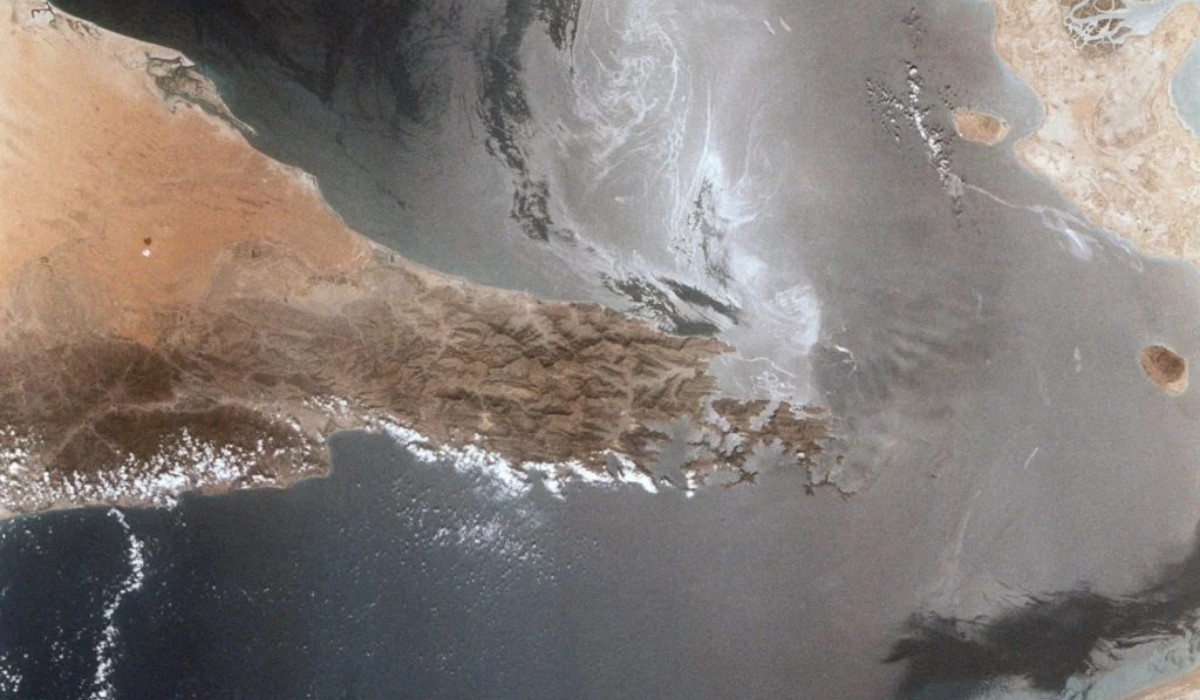
 Strait of Hormuz. Photo: NASA / PDM 1.0
Chris Bambery spells out the realities of action in the Strait of Hormuz. He looks at the economic and political consequences of the US/Israel war on Iran and concludes that neither Netanyahu nor Trump have achieved their goals. Trump’s attack on Iran misfired badly. He must think long and hard before he launches similar adventures
Is there a blockade of the Straits of Hormuz? The answer is yes and no. Let me explain. Iran effectively controls the Straits of Hormuz and allows vessels from countries it regards as friendly or neutral through, for a fee, but not those that it doesn’t.
The US’s blockade is out in the Gulf of Oman and the Indian Ocean – its vessels don’t want to get too close to Iran because they fear missile strikes.
Despite the extension of the ceasefire between the US and Iran announced by Trump this week, the President keeps saying the US is blockading the Straits of Hormuz. But Iran is continuing to export oil through those same Straits.
The Maritime Executive reported this week that:
“… at least 34 vessels linked to Iran have avoided the U.S. blockade. The paper writes that after the blockade was imposed on April 13, at least 19 tankers, including several owned by Iran, have been able to depart the region. At least six, it says, were laden, carrying a total of 10.7 million barrels. An additional 15 tankers are believed to have avoided the blockade and made it into the Persian Gulf and Iranian ports.”
On Wednesday US Treasury Secretary, Scott Bessent, announced that Washington has extended sanctions relief on Iranian and Russian seaborne oil for 30 days because of requests from countries facing shortages of oil.
Bessent told a US Senate Appropriations subcommittee budget hearing that the requests came from finance leaders of about 10 countries during last week’s International Monetary Fund and World Bank meetings.
Last week Bessent stated that he would not renew expiring sanctions waivers.
Iran is benefitting through these oil exports and through the tolls it charges on ships going through the Straits of Hormuz. These have to be paid in Chinese Yuan or cryptocurrency.
For oil, Iran charges approximately one dollar per barrel. Consequently, a ship carrying millions of barrels of oil would generate millions of dollars for Iran. For other cargo, the charges are determined based on the value of the oil barrels.
Iran’s Revolutionary Guard Corps (IRGC) says they seized two ships in the Strait of Hormuz and transferred them to Iranian waters. A third vessel was also reportedly targeted by the IRGC and is “now disabled off Iran’s coast,” according to Iranian media. It came after a maritime agency said at least two container ships were hit by gunfire in the Strait of Hormuz.
One of the ships seized is tied to billionaire Gianluigi Aponte’s Mediterranean Shipping Company (MSC) empire. The vessel, was stormed by the IRGC and redirected near Bandar Abbas. A swarm of IRGC “mosquito boats,” small, fast boats carried out the operation.
The MSC Group is the world’s largest shipping line and has partnered with Israeli cargo company ZIM to freight military supplies to Israel throughout the genocide in Palestine, including to businesses in illegal Israeli settlements.
Between January 1 and November 22, 2025, loading bills show that MSC carried at least 957 shipments of goods from Israel to the US.
The US Navy boarded one Iranian vessel. As I understand it was returning from China.
One obvious danger is what happens if the US intercept a Chinese vessel. China buys a great deal of its oil from Saudi Arabia and Iran. The Iranians will allow its ships passage through the Straits.
Pressure on Trump at home and abroad
As it seems Iran will enter into further negotiations with the US in the Pakistani capital, Islamabad, Trump is under pressure at home and abroad not to restart this war.
Domestically his approval ratings in polls this week are hovering in the mid-30s percentage wise.
The Guardian reports:
“The AP-NORC center for public affairs research poll published on Monday found that seven in 10 Americans described the economy as poor and think the country is headed in the wrong direction. The poll showed that Trump’s handling of the economy has fallen to 30% approval, down from 38% in March, while 72% said the country is headed in the wrong direction, a figure unchanged since February. Just 23% approve of how he is handling the cost of living, while 76% disapprove.”
Sixty seven percent said they disapprove of Trump’s handling of the war with Iran and 61 percent said the US should not take any further military action in Iran.
Higher petrol prices and inflation and the prospect of fertiliser and food shortages can only add to the unpopularity of the war.
The 60-day War Powers Act period ends next week. The last time the US House of Representatives voted on this war, it passed by just one vote.
International pressure comes as inflation is rising globally and the world faces shortages of oil. Liquid natural gas, fertilisers and much more which comes from the Persian Gulf.
How are the negotiations progressing?
Turning to the negotiations in Islamabad, Iran’s 10 points which it sent to Washington via the Pakistanis include recognition of its control of the Strait of Hormuz; it must retain its stocks of enriched uranium for civilian use; the ending of sanctions relief; the release by the US of its frozen assets; retention of its ballistic missiles; war reparations; an end to Israel’s war on Hezbollah; removal of US forces from the region.
These are not an opening gambit; this is what Tehran sees as being required for a lasting peace.
The last time the two sides met Iran said progress had been made but after 21 hours and a dozen phone calls to Trump, Vice President J.D. Vance reverted back to demanding Iran surrenders its enriched uranium and its missile arsenal, and ends support for Hezbollah, Hamas and the Houthis.
At that the Iranians ended the negotiations.
Iran knows time is on its side. Firstly, it does control the Straits of Hormuz and there is little Trump can do about that. If he tried escalating matters, the Houthis are capable of closing the Red Sea which would be a tipping point for the world economy.
Secondly, Iran has taken pain, through sanctions, for decades, and through two and a half months of war with the US. It must reckon Trump and the US cannot take pain.
Despite Trump’s announcement of the ceasefire extension, oil prices rose as an immediate response.
Susannah Streeter, chief investment strategist at Wealth Club explained:
“The ceasefire extension hasn’t done much to calm nerves given that worries remain about the impact of the energy squeeze on the global economy.”
Will Israel be Trump’s scapegoat for the failures of this war?
Trump is going to need a scapegoat for all this to deflect the blame form him. It was Israel who told him that if they de-capitated (assassinated) the Iranian leadership the regime would collapse in days. Trump went to war believing that. Unfortunately for him it was a fantasy.
Israel is the likely candidate for Trump to shift the blame too.
The Israeli journalist and author, Gideon Levy, writes:
“The United States is gradually slipping from Israel’s grasp; Donald Trump may yet turn against it, and in any case, the president who replaces him in less than three years – Democrat or Republican – will pursue a different policy towards this major ally. The days when America sat comfortably in Israel’s pocket are over, perhaps for good.
Europe, too, is waiting for a signal from the United States that will allow it to shift its own policy towards Israel. There, as well, patience is running out with an Israel that is seen as occupying, aggressive and megalomaniacal.”
The problem facing Israeli prime minister, Benjamin Netanyahu, is that the Israeli public view Iran as an existential threat, having been told just that over and over. But Netanyahu has not succeeded in destroying Iran and has been sidelined by Trump in negotiations with Tehran. That’s unsettling for those who believe Iran seeks to destroy Israel.
Furthermore, Netanyahu promised to destroy Hamas and Hezbollah. He didn’t succeed in either case.
Israel has always prided itself that it was invincible and could, therefore, intimidate anyone in the region. It does not look invincible today.
Going back to Gideon Levy’s point. The major shift in US public opinion away from support for Israel is a massive worry for a state which depends on US arms and finance. Sensing the mood Bernie Sanders and AOC, Alexandria Ocasio-Cortez, who for long sat on the fence over the Gaza genocide are now demanding US support for Israel ends. On the right Tucker Carlson, one time champion of Trump, offers a very coherent critique of both Israel and the Iran war.
Trump wanted a quick, victorious war, like the attack on Venezuela and the seizure of Nicolas Maduro. His attack on Iran misfired badly. He must think long and hard before he launches similar adventures.
Before you go
The ongoing genocide in Gaza, Starmer’s austerity and the danger of a resurgent far right demonstrate the urgent need for socialist organisation and ideas. Counterfire has been central to the Palestine revolt and we are committed to building mass, united movements of resistance. Become a member today and join the fightback.

Chris Bambery
Chris Bambery is an author, political activist and commentator, and a supporter of Rise, the radical left wing coalition in Scotland. His books include A People's History of Scotland and The Second World War: A Marxist Analysis.