
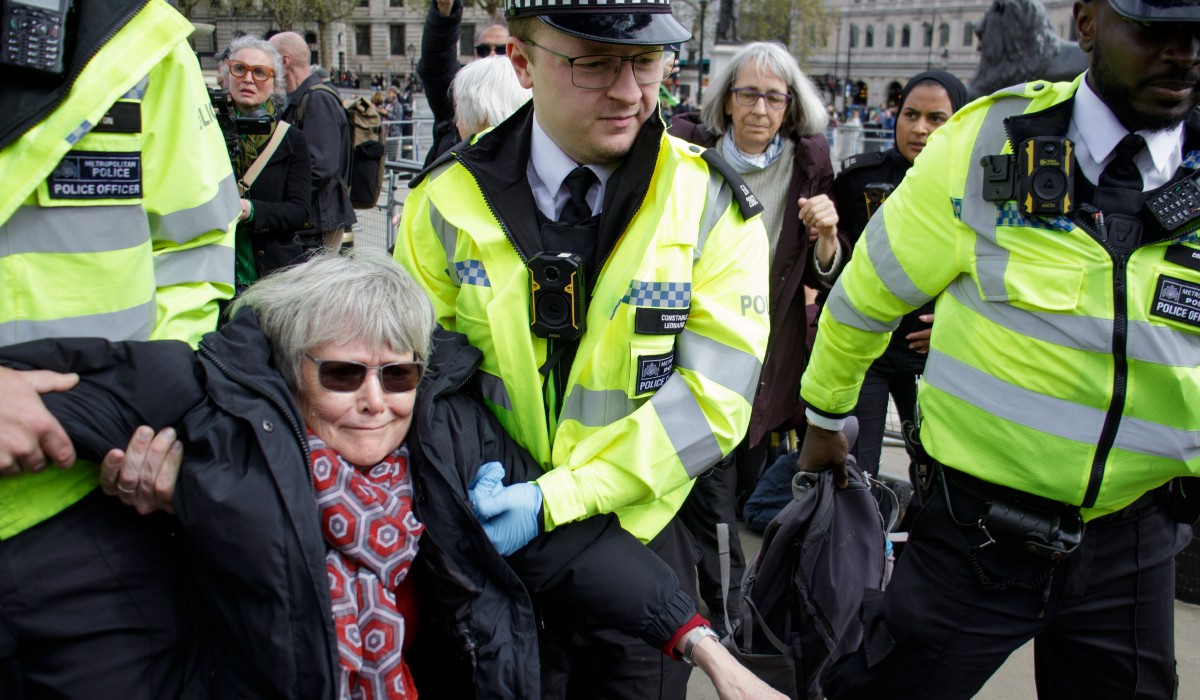
 Defend Our Juries protest, Trafalgar Square, 11 April. Photo: Steve Eason / CC BY-NC 2.0
Parallels are emerging from testimony uncovered in the Spycops Inquiry and the draconian actions of the police clamping down on protest today, writes James Simpson
Two weeks ago the Undercover Policing Inquiry (UCPI) reached another milestone as the last field officer of the much-maligned Special Demonstration Squad (SDS) due to give open, oral evidence left the stand. Fittingly, Rob Hastings, cover name Rob Harrison, who infiltrated the London branch of the International Solidarity Movement (ISM) for Palestine, gave three days of the worst tempered, unmeasured testimony so far. Accusing UCPI counsel, Sarah Hemingway, of trying to “torture” him by taking him through his own Skype messages sent to a woman he had deceived into a long-term sexual relationship and shouting at a public gallery full of victims of undercover policing that they “may think this is a joke”. An undignified end that felt apt for the final deployment in the forty-year history of this Metropolitan Police Service (MPS) undercover unit.
History repeating…
One accusation that has been levelled at the UCPI, is that these units were a historical aberration that has been left in the past. That energy spent on this by activists is a distraction from the problems of today. Never has this view been more undermined than by the last few months of testimony. This has come amidst the backdrop of real-world events and actions by the modern-day police and security services as they have hit the headlines.
The process and conclusion of the trial of Ben Jamal and Chris Nineham clashed with the latter giving his own oral testimony on the SDS spying on his activism two decades before. The two leading Palestine activists were standing trial under public order legislation misused in the lead-up to and during the January 2025 National Palestine solidarity march. This was at the same time as Palestine Action activist Qesser Zuhrah’s home was raided at 6.30am by masked counter-terrorism officers for her social media posts about direct action. Only weeks after being released from fifteen months of custody awaiting trial for her part in non-violent direct action against the British Government’s material support for the genocide in Gaza, this was a draconian step into authoritarianism.
Meanwhile, questions reverberated around the inquiry room seeking to justify and excuse the deep infiltration on peaceful movements, and activists’ lives, for how, when and why they exercised their right to organise, act and assemble against state excesses and criminality.
The Metropolitan Police announcement that central London will be given to Tommy Robinson’s far right “Unite the Kingdom” march ahead of the yearly Palestine solidarity march on the anniversary of the Nakba brought further questions of the supportive relationship between the far right and the state highlighted by many of the deployments of SDS officers into anti-racist groups (and the minority that deployed into the far right groups of the era). This is further highlighted by the security services being forced to settle with the victim of somebody in their paid employ – a neo-Nazi who had violently abused the female victim and then attempted to hide the truth by lying in court.
This brings further questions of how misogyny and abuse are being sidelined in favour of ‘the mission’ regardless of who that seems to protect. A process all too familiar to the victims of the SDS further underlined by the Undercover Research Group report, released in December 2025, into the now convicted paedophile Nick Gratwick. A paid informant in the environmental and animal rights movements around the turn of the millennium, leads to questions about what the police forces and corporations that paid for his services knew about his criminality and maybe, therefore, what repercussions they protected him from.
Even the geopolitical events of 2026 started to look eerily familiar through the lens of Spycops testimony. Hastings described spying on ISM during the 2006 invasion of Lebanon by Israel just as the similar military incursions was displacing a million Lebanese from their homes in 2026. Cover name, “Jason Bishop” also reported on the Fairford coach protests of 2003. Protests that were organised to highlight the use of the Gloucestershire, ostensibly RAF, base by the US Air Force for bombers to depart from during the illegal invasion of Iraq. Just weeks after his testimony ended, B-52s joined already stationed B-1 bombers of the US Air Force as another illegal US war began in Iran with RAF Fairford once again a staging post.
They say jump, and you say how high, you brain dead? You got a fucking bullet in your head?
For some reason during the latter stages of evidence at the UCPI I regressed into listening to the dulcet tones of Zach de la Rocha and his band Rage Against The Machine more and more often on the long, early morning coach journeys between Bristol and London to attend the UCPI. The refrain from the song Bullet in the Head, the chorus of which I have used in the subtitle, perhaps subconsciously, became increasingly reflective as the testimonies were heard.
The first day of evidence of the SDS officer ‘Simon Wellings’ (cover name, real name undisclosed), coincided with a pivotal day at the trial of Ben Jamal and Chris Nineham. Wellings had in fact spied on Chris Nineham, two decades earlier. Infiltrating the anti-globalist group Globalise Resistance (GR). GR, with some success, attempted to build a mass movement to counter the increased globalisation of the neoliberal capitalist order, through mass mobilisation of as many strands of society as possible.
This led to my decision to spend half a day at Westminster Magistrates Court. There the legal team of Nineham and his co-defendant, gave detailed, compelling and plausible rationale as to why the case against them should be thrown out to the dismissive, dickie-bow-tied evangelist, District Court judge, Daniel Sternburg. This was followed by an afternoon hearing where Wellings gave UCPI testimony about the unthreatening, comradely, and legal way that GR (as well as Stop the War Coalition) and Nineham organised protests against the state visits of George W Bush, Ariel Sharon, the multiple protests against the wars in Iraq and Afghanistan, the World Economic Forum protest in New York, and at the European Union summit in Seville (yes SDS officers certainly got around). The Sharon protest will be re-visited later in a different context, but ultimately the outcome of all of this was that Wellings agreed these GR actions were organised legally with minimal threat of any public order event.
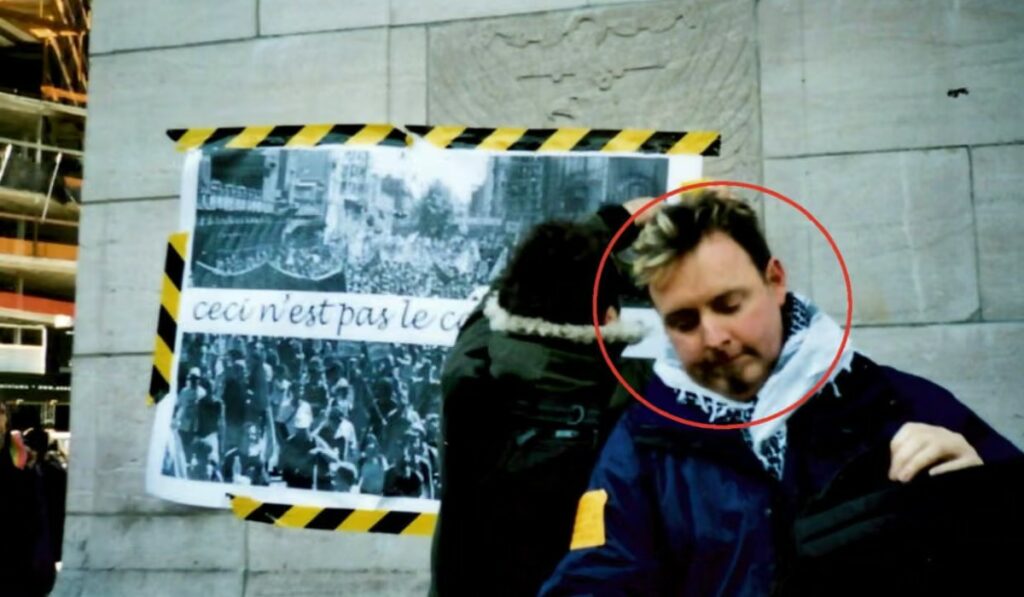
Nineham has had, probably largely due to the actions of Wellings, a special branch registry file since at least 2002. This has meant that the state, regardless of his actions, will have regularly used intelligence operatives to monitor his movements and political expression. There should be a mountain of evidence, available to Sternburg and the state, of exactly the political motivations and actions Nineham involves himself in – building movements across society to lead to democratic change toward a more peaceful and just society for all. Alongside the actual evidence that was presented to the court, the deployment of Wellings and the subsequent unspecified state infiltration of Nineham’s life this will have led to, should have further underlined the farcical nature of his prosecution. Or at least provided a darned good character reference that Sternburg would have struggled to be so dismissive of.
A unique event in the history of the Spycops story may give further insight into the motivations of the state when examining why they placed such importance into infiltrating knowingly peaceful activist groups. In late January 2004, Wellings accidentally left a voicemail on a GR activist’s answer machine service. In this he was heard (mis)identifying activists that his handler was showing him pictures of. This was in the days of the BT 1571 service, meaning GR activist, Guy Taylor, had, in quick order, organised recording the message on an external device before it was automatically deleted (the recording can be heard here).
The recording was played to GR activists, including Wellings, as the group attempted to identify the person. This process took seven months, before a chance set of circumstances led Taylor to put the pieces together matching a certain colloquialism of the undercover officer from the tape to a preceding recent conversation. Wellings was kicked out of GR, believed to have been an informant. Remarkably his SDS employment went on another three years as he went on spy on the anarchist Dissent! network.
In those seven months Wellings and his SDS managers discussed what to do. His handler, Detective Chief Inspector Mike Dell, wrote a report on the incident and its potential outcomes that says, “Consider, with C Squad, whether we should leave GR [Globalise Resistance] intact, or, through RW [you] mount a destructive operation.” This is taken from the witness statement transcript of Wellings’ evidence, as presumably the document will not be fully available in its original, albeit redacted format, until Dell gives evidence in the summer.
The effect of these words is chilling. In the same report and in short order, GR is confirmed to be a peaceful movement, Wellings remaining embedded in the months before his unmasking is deemed not risky, and the discussion turns to dismantling GR by the MPS. Under what legal authority this could have been done is not clear.
But this affirms the suspicions of many activists spied on by undercover policing units: their role was not to police potential breaches of public order, but to actively manage and undermine protest groups. Jim Boyling, an SDS officer that went undercover in Reclaim The Streets (RTS), discussed in his testimony that protest had the possibility of “embarrassing the Government” whilst referring to “UK PLC” in his reporting. Public order policing is not a notion that can be garnered from these sentiments. The prevailing sense is that the SDS, its successor, the National Public Order Intelligence Unit (NPOIU), and likely all areas of the police and security services that deal with protest movements, are little more than filters to strain acceptable forms of limited dissent and undermine the democratic rights of people to organise collectively on behalf of the ruling political and capitalist class.
Boyling himself, unwittingly, furthered this notion by recanting an “old SDS joke…..that protest movements were always more successful when they were infiltrated by SDS officers”. The bit he did not consider in that statement was, in light of all of the testimony heard so far, the question has to be, for whom? Certainly in RTS he was heavily involved in many successful actions, but by the time his successor in the movement, ‘Jason Bishop’ entered the fray, the years of infiltration and undermining by SDS officers had taken their toll and the once vibrant movement came to an end. But it became the beginning of multiple other movements which would also find themselves in the creepy gaze of the SDS and NPOIU in the years ahead.
It is with this knowledge garnered from the recent UCPI hearings, that you can view the contemporary excessive use of legal force and political pressure, particularly of the Palestine movement, as a sign of the state in panic. The tools it has been using to undermine and defang anti-war voices in recent years has not diminished the movement and has led it to increasingly shaky ground. Convicting Ben Jamal and Chris Nineham, raiding Qesser Zuhrah’s home over social media postings, and the resumption of arrests of Palestine Action-supporting pensioners, are signs of a state in decline. A state turning to ever more authoritarian solutions as the intelligence services become increasingly nervous concerning their hold over the populus.
Institutional racism (again) and the missing pieces
The recent hearings of the SDS have to be seen in the light of one of the most seismic events in modern British policing history. The murder of black teenager Stephen Lawrence, the subsequent failed investigations, and the resultant Macpherson Report findings that the MPS was institutionally racist, shook British society to its core. Not that you would garner this from the evidence of the era’s SDS officers. Only a few ventured that these were even limited topics of discussion in SDS meetings, whilst all denied ever hearing a racist word from any of their SDS or Special Branch colleagues.
Often you feel with the former SDS witnesses, that when there is such uniformed approach to certain topics, then this is the result of the coaching they take from the MPS legal team advising them. There is a definitive line in the sand when discussing racism in the MPS, which even officers that have been dismissed in disgrace, like Hastings and Boyling, are unwilling to cross. But perhaps this absolutist approach speaks louder than words could. It speaks of an institution still unable and unwilling to confront these problems head on. Whilst stop and search patterns and prison population demographics indicate little change over time, some light has been shone on problematic areas of SDS reporting by the SDS.
Wellings was present at a planning meeting for a GR protest over the state visit of Ariel Sharon to the UK. After the meeting, activists went to the pub and the ideas for the protest spilled out there. It was at this time, reported the SDS officer, ‘MT’ came up with the idea that they would make a fake suicide bomber vest and attempt to charge the visiting Prime Minister of Israel. An idea that was, on the night, rejected and put to bed by Guy Taylor, Noel Douglas and Wellings.
This version of the story is not disputed. However, what is disputed is the identity of MT. Taylor and Douglas, as well as MT themselves, have said that the idea was that of a middle-aged, eccentric white man. Wellings attributed the plan to a young, brown-skinned student. The SDS officer went further to say that the plan went beyond the planning phase and that he had seen a fake explosive device. This matter was, as you would expect, pored over in some detail by the UCPI legal team. It received the unusual intervention of UCPI chair, John Mitting, giving Wellings one last chance to see if this was the story he wished to stick to, clearly disbelieving his version of events.
This was the early years post-9/11, and came at a time of increasing Islamophobia and racism in connection with garnering some consent for the wars in Afghanistan and Iraq. Five years later Rob Hastings, would see MT, and report the same incident from the pub as if it were rationale for his own actions within the Palestine and anti-deportation movements. What consequence could there have been for MT and for other brown-skinned individuals from the misreporting of this event? Management used this incident in their justifications for the work of the SDS and the whole trumped-up, fabricated report clearly had legs beyond the confines of the unit and Special Branch. How many more times did police officers of the time racialise their reporting to contribute to the air of suspicion and mistreatment of people?
This provocation of tension and stoking of a faux environment of racial disharmony can be seen in more reporting of nearly all SDS officers in anti-racist groups. Carlo Soracchi is accused of suggesting firebombing a charity shop said to be owned by Roberto Fiore, a fascist and suspected perpetrator of the Bologna railway station bombing in the 1980s (and of course given sanctuary and protection by the Bristish state). Mark Jenner, is seen as a counter-protester in Dover goading and trying to provoke further violence, in a news report video shown at the UCPI. He would later report on furtive meetings with the Irish Republican Army, whilst on holiday with the woman he deceived into a five-year, live-in relationship, ‘Alison’, and union activist Steve Hedley. It was Hedley’s mum they were visiting on a holiday, where he camped in their back garden with Alison. Unbeknownst to them, their ‘friend’ and fellow activist was reporting back to the Special Branch about their holiday.
The modus operandi of all these SDS officers of the era has been to fabricate, twist and lie in their reports. Turning ordinary events into extraordinary tales of danger and subterfuge. This obviously contributes to a much different outlook on how all groups are policed and has disastrous effects on people’s lives when you consider the employment blacklists of the era.
But in terms of anti-racism, there is an extra layer of deceit to consider. At any one time there were about ten undercover officers deployed by the SDS. Many of these in the 1980s, 1990s and 2000s were deployed in left wing groups. But throughout that period, between one and three SDS officers were deployed to fascist groups: the National Front, Combat-18 and the British National Party.
Now consider how they operated almost uniformly in left wing groups from the 1980s onwards. They were the drivers, on the steering committees, integral parts of the internal planning of actions, and were the treasurers of groups. In many instances they were pushing for more dramatic action and many committed crimes. Now transpose this to the workings of groups like Combat-18 or the BNP. Were SDS at least witness to and even actively encouraging the racism and provocations of such groups?
It seems likely that at Welling in 1993, where the BNP had a fortified headquarters that it called a bookshop, that with multiple undercover officers in the anti-racist march, there was likely a SDS officer undercover inside the bookshop or certainly the inner circles of the BNP. With so many undercovers on both sides, the fact that this was so heavily policed with overt force, with anti-racists kettled and beaten by police, and suitable news headlines generated and prosecutions to follow, is telling. This willingness to allow, and even promote disorder and racial aggravation, is counterintuitive to the public order reasons for the SDS’ creation given after the Grosvenor Square protests at the old US Embassy in 1968 against the war in Vietnam.
This may give rise to further questions when considering the MPS decision to give the ‘Unite the Kingdom’ rally control of central London next month over the Nakba day anniversary march led by the Palestine Coalition. This massively increases the risk of disorder on the day, whilst seeking to push the peaceful Palestine solidarity movement into an impossible position. Undermine the movement or risk the repercussions of disorder, the MPS and Home Office are saying, and using fascists like Tommy Robinson and those around him as their willing stooges. The only solution on the day will be to march in the greatest numbers any Nakba day march has seen. But lessons from the UCPI and the SDS deployments and testimony, both said and unsaid, give clearer explanation to how UK Government seeks to fabricate societal conditions favouring the ruling class on 16 May.
Before you go
The ongoing genocide in Gaza, Starmer’s austerity and the danger of a resurgent far right demonstrate the urgent need for socialist organisation and ideas. Counterfire has been central to the Palestine revolt and we are committed to building mass, united movements of resistance. Become a member today and join the fightback.
