
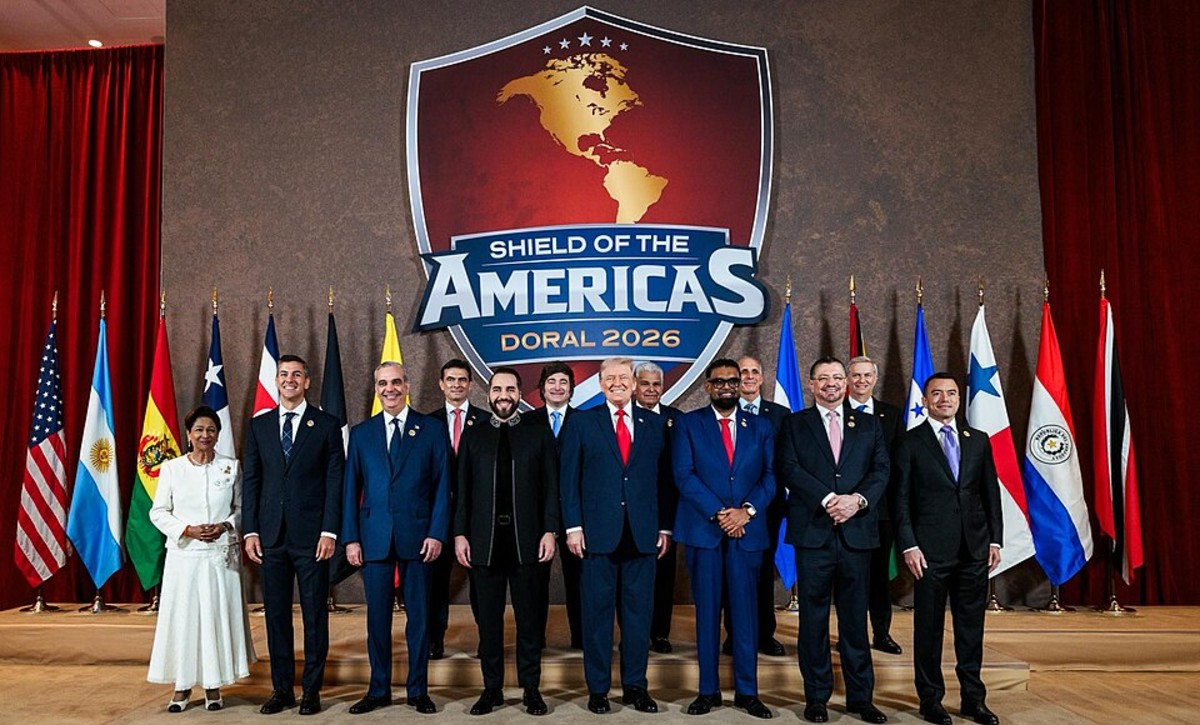
 Leaders on the Shield of the Americas summit 2026. Photo: Daniel Torok / Public Domain
Trump’s aggression in Latin America on the pretext of the drug trade follows a long history of US imperialist policy, but this may result in another intractable quagmire, argues John Clarke
The deaths of two US officials in a car crash in northern Mexico have brought to light their participation in an anti-narcotics operation. For its part, the Mexican government appears to have been unaware of the role of these two agents, much less to have granted permission for such involvement.
This unauthorised activity is only one expression of the Trump administration’s growing effort to conduct a war on drugs in Latin America that is very much part of its drive towards intensified domination of the region. In this regard, Trump is building on an approach that Washington had adopted long before he became president.
On 27 April, the Guardian reported that the two US officials who were killed were ‘widely reported to be CIA officers.’ Moreover, ‘Mexico’s security cabinet said in a statement that the US officials lacked formal accreditation to participate in security activities in Mexico and that one of them had entered the country as a tourist.’
Mexican president Claudia Sheinbaum has insisted that such acts of interference by the US must not be repeated and has stressed that her government ‘will not accept US agents or forces participating in operations on Mexican territory.’
US aggression
Despite this display of indignant surprise, we may be sure that the direct involvement of US intelligence agents in enforcement operations in Mexico is common, if not routine. Sheinbaum’s mild message of admonition is unlikely to deter the CIA and other US agencies from acting in such a fashion. Indeed, Trump himself has aggressively asserted that US interference is likely to intensify dramatically in the days to come.
Time reported in January that Trump was threatening direct US military strikes, related to the war on drugs, in Latin American countries, including Mexico. ‘We’ve knocked out 97% of the drugs coming in by water,’ he stated at the time, ‘and we are going to start now hitting land with regard to the cartels.’ He added that the ‘cartels are running Mexico—it’s very, very sad to watch, and see what’s happened to that country.’
Trump’s threat of US military action followed an ongoing series of boat strikes against alleged drug traffickers. As the Guardian noted this week, following yet another lethal strike, the ‘US campaign targeting boats in the Caribbean and eastern Pacific has killed at least 178 people since last September, but there is not detailed evidence behind military officials’ claims that the vessels targeted are involved in drug trafficking.’
This stark form of US aggression is being continued despite the fact that legal ‘experts argue the US military is violating domestic and international law in conducting its attacks, and the families of two men from Trinidad killed in a strike have filed a suit against the government.’
Though, as I shall stress, the Trump administration is far from having invented the war on drugs as a means of furthering regional domination, its efforts on this front are especially vigourous. Early in March, as PBS News notes, ‘Trump encouraged regional leaders gathered at his Miami-area golf club to take military action against drug trafficking cartels and transnational gangs that he says pose an “unacceptable threat” to the hemisphere’s national security.’
Described by the White House at the ‘Shield of the Americas’ summit, this gathering brought together the most right-wing and pliable regimes in the region that Trump knew could be relied upon to co-operate with his war on drugs, along with his broader agenda of economic and political domination and the effort to exclude major investors and competitors, especially China, from Latin America.
The now infamous National Security Strategy that the Trump administration issued last November makes the strategic thinking behind the priority it has placed on the war on drugs very clear. The document calls for a ‘more suitable Coast Guard and Navy presence to control sea lanes, to thwart illegal and other unwanted migration, to reduce human and drug trafficking, and to control key transit routes in a crisis’ (p.16). It also promises: ‘Targeted deployments to secure the border and defeat cartels, including where necessary the use of lethal force to replace the failed law enforcement-only strategy of the last several decades’ (p.16).
As the Trump administration implements this plan of action, it does so with a broader strategic purpose in mind. The document openly declares that after ‘years of neglect, the United States will reassert and enforce the Monroe Doctrine to restore American preeminence in the Western Hemisphere, and to protect our homeland and our access to key geographies throughout the region’ (p.15).
Monroe Doctrine
This candid perspective of imperialist domination, which is even referred to as the ‘Trump Corollary’ to the Monroe Doctrine’ (p.15), shows very clearly that the utilisation of the war on drugs by the Trump administration is certainly not the product of over-exuberance or improvisation. A refocused US imperialism is moving to tighten its grip on Latin America and the assault on ‘narco-terrorism’ is a tactical means of advancing and justifying that objective.
The Trump administration’s course of action in Latin America is undoubtedly brutal and rapacious but, at the same time, it is very much rooted in a long history of imperial intervention in the region. Trump may be focusing more sharply on objectives of domination and acting with less restraint but he is most certainly not breaking any new ground.
Jeena Shah, a professor of law at CUNY University in New York City, has offered a succinct and compelling account of the role that the war on drugs has played in furthering US aims. She notes that this approach ‘facilitates not only direct accumulation for the security industry, but also the restructuring of formerly colonized economies for land and wealth extraction.’
As the neoliberal period took hold, massively indebted Global South nations agreed to impose austerity measures on their populations. Under the gun in this way, they ‘also agreed to enter into trade and investment agreements with the Global North that made them again become captive markets to the Global North and rendered their land and labor available for pillaging. This has led to the dispossession of many peasant and indigenous communities.’
In this context, with ‘few other options, many of these dispossessed communities turned to illicit drug production.’ US governments have then responded to a situation that they created with moral panic and crackdown. Thus, the war on drugs ‘has also served as moral cover for disciplinary mechanisms deployed against Global South powers that resist U.S.-led capitalist imperialism.’ The abduction of Venezuelan president Nicolás Maduro is only the latest example of this.
On this basis, it becomes easy to see the role that the war on drugs plays in the particular context of the Trump administration’s efforts to greatly increase the power it exerts in Latin America and to take the Monroe Doctrine to new levels.
As we have seen in the case of the assault on Iran, however, a weakened and overextended US imperialism has a very limited capacity for the massive and sustained deployment of military power that its agenda of domination is likely to require.
Relatively low-cost displays of strength designed to obtain compliance, such as the aggression against Venezuela, are one thing. However, tightening the grip and imposing increased levels of exploitation on a region with a long and proud history of anti-imperialist resistance is likely to require more than quick bursts of ‘shock and awe’. The application of the ‘Trump Corollary’ to the Monroe Doctrine could well result in yet another quagmire for the US. Washington’s war on drugs has functioned as a means of advancing imperialist domination, while partly camouflaging and even justifying the process. For the architects of gangster imperialism gathered around Donald Trump, however, their crude, brutal and enormously provocative application of this tactic may be yet another reckless miscalculation.
Before you go
The ongoing genocide in Gaza, Starmer’s austerity and the danger of a resurgent far right demonstrate the urgent need for socialist organisation and ideas. Counterfire has been central to the Palestine revolt and we are committed to building mass, united movements of resistance. Become a member today and join the fightback.

John Clarke
John Clarke became an organiser with the Ontario Coalition Against Poverty when it was formed in 1990 and has been involved in mobilising poor communities under attack ever since.