
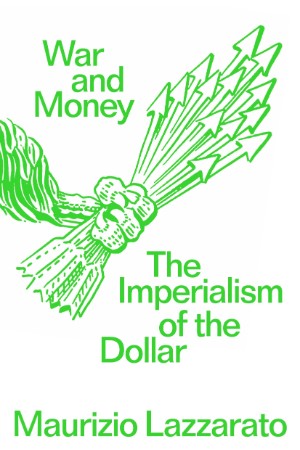
 Maurizio Lazzarato, War and Money: The Imperialism of the Dollar (Verso 2025), vii, 216pp.
War and Money, an attempt to analyse US imperialism through its financial hegemony, is confused about how capitalist economics and exploitation works, finds Dominic Alexander
The title of this book promises much, since Marxists have long argued that war is inherent to capitalism, particularly in its imperialist stage. Coupling war with money, and linking it specifically to the imperialism of the US and the role of its currency suggests a particular analysis of how US financial imperialism, and the dollar’s role as world reserve currency, interacts with the ever more dangerous belligerence of capitalism’s greatest imperialist force.
There is much that could be discussed here, particularly as the relative economic decline of America has made it much more vulnerable to challenges to its international hegemony, both politically and financially. US financial dominance is unlikely to disappear imminently, but there are issues which make it more precarious now than it has been for decades. Foreign exchange reserves of US dollars reached their lowest level in July 2025. A major fall in foreign holdings of US dollars would have a severe impact on dollar bond markets, forcing up the rate of interest the US government must pay for its debt. With increasing concerns about US debt levels, there has been some movement in the dollar markets, and it is becoming increasingly questionable how much longer, as a relatively declining economic power, the US can maintain its financial hegemony. This is an issue that has been brewing for some time, and the war spree since the start of the War on Terror is surely driven by worries about the maintenance of US hegemony, economic and political.
War and Money is meant to provide some guidance about the nexus of financial power and military aggression that characterises the current imperialist phase. However, a certain conceptual sloppiness is evident from the start. Lazzarato describes imperialism now as something different from that ‘experienced by Lenin or Rosa Luxemburg’ because ‘it is no longer territorial, but rather monetary and financial’. It would be a surprise to Lenin, and indeed to readers of his Imperialism: the Highest Stage of Capitalism (1917), to learn that he had not been analysing imperialism precisely in economic and financial terms.
Lazzarato then goes on to claim that in this new imperialism ‘rent and profit tend to blur’ (p.3). It’s become fashionable to use ‘rent’ as a metaphor to cover profits which seem due to monopoly power, but this remains just a metaphor, and Lazzarato never defines in any way what he means by rent in this context. The danger of this conceptual slippage is that it appears as if there is a ‘good’ or ‘fair’ capitalism to be found if we could get rid of monopolies, imperialist or otherwise, that distort some kind of ‘fair trade’. If, however, we recognise that all profits, as well as interest and rent, are simply shares of the surplus that comes from the exploitation of labour, then the singular, systemic nature of the enemy is clear. Instead, Lazzarato peppers his text with rhetorically stirring yet analytically blunt formulations such as ‘imperial pillage and rent’ (p.26).
In this particular instance, Lazzarato is being uncharacteristically specific in describing how the dollar’s function as the world’s reserve currency gives it tremendous power, not just to wreck the financial stability of poorer countries in the Global South, but to siphon an extra share of the world’s surplus for itself.
Finance and exploitation
That is true, but currency dominance is not the only, or even the main mechanism of imperialist exploitation. If it were, then the lesser imperialisms of the UK, France, Germany and Japan, for example, would not be able to exist as developed imperialisms at all. A major way in which imperialist nations capture an outsize share of surplus value from global social production is through technological advantage. Higher concentrations of capital capture disproportionate profits, due to the law of the equalisation of the rate of profit, so countries with advanced technological industries gain this imperialist dividend. Hence, all the fury about the export of computer chips and related technology from the US to China has been about. This law is the major part of what makes up imperialist ‘rent’, but it’s important to realise that the extra share of surplus value that imperialist economies gain here is derived from the basic laws of capitalism, as Marx analysed them, and is not a new development. Calling it ‘rent’ is in no way revealing.
This is not to say that ‘dollar imperialism’ isn’t important, and doesn’t play a role in the decision making of the leaders of US imperialism, but it isn’t the singular weapon of domination that Lazzarato presents it as. Most importantly, the role of the dollar as the world reserve currency was founded upon the dominance of US manufacturing in the world system, and as that falls relative to China and elsewhere, the strength of US financial dominance declines also. This does help to explain the Trump administration’s combination of aggression and retrenchment, although Trump is not mentioned even once in this book.
Rather than exploring these present dynamics, Lazzarato is concerned to revise the understanding of capital that Marx gave us. For Lazzarato, Marx’s analysis left out ‘strategy, the action of a will against other wills’, that is to say, the use of finance as a weapon of class struggle. It is not at all clear, at least to me, that this is so, but Lazzarato appears to object to Marx’s point about the appearance in the financial sector that money makes money (M – M’). This is a fetish derived from the apparently autonomous nature of money, but financial profits depend ultimately upon the movement of value in the productive economy (pp.133-5). This makes financial profits ‘fictitious’, because unless they are fulfilled by the production and consumption of actual commodities, they become only unpayable debts, which, if large enough, precipitate financial crashes, as in 2008. For Lazzarato, however, all we need to retain from Marx’s theory of money is just that ‘money, interest, finance and credit have their own laws and movements that can make them independent from real (industrial) economy’ (p.135). Marx’s point, however, is precisely that they are ultimately not independent.
Lazzarato moves from this confusion to dismissing the ‘fictious’ nature of financial capital, and claims that it is ‘not possible to counterpose productive capital to parasitic capital, profit to finance (rent), because these are two sides of the same process’ (p.136). It is, of course, very important to maintain the distinctions between the different ‘sides’ of capital as it moves through its cycles, because contradictions arise within these circuits of capital, and cause crises, which bring the edifices of financial capital crashing back to the basics of commodity production. It is peculiar for a Marxist not to see that a distinction must still be made within the dialectical movement of a complex process like the circuits of capital. Since, ostensibly, Lazzarato is discussing the connections between money and militarism, it is unclear why he wants to throw overboard so many key elements of Marx’s Capital. It appears that he thinks the ‘subjective’ strategy of dollar imperialism is obscured if we attend to Marx’s rigorous analysis. In any case, the argument obfuscates more than illuminates.
Capitalism is not feudalism
In line with this project to collapse objective economics fully into ‘subjective’ politics, Lazzarato also insists on the currently fashionable view that the ‘use of feudal vocabulary – in describing the fleecing that the US sovereign regularly practices on the rest of the world and that European valvassors pass on to their vassals – is not just metaphorical’ (p.33). In fact, he states, capital has pushed us back to before 4 August 1789, when feudal privileges were abolished in France during the revolution.
This is worse than metaphor stretched to hyperbole; it is outright wrong. It mistakes an imposition that can be abolished by political action for a structure which requires an economic solution: the nationalisation and democratisation of credit and finance. This is a very different task from abolishing the legal privileges of the feudal aristocracy, and it doesn’t help the class struggle to collapse capitalist economics into a metaphorical ‘feudalism’.
Rent, in any case, in Marx’s analysis, is a form of ‘super-profit’, where monopoly control of some part of constant capital (land, technology or intellectual property) enables that capitalist to gain a higher share of surplus value than other capitalists for a period (much as explained above). Under conditions of competitive capitalism, that is a strictly temporary advantage for monopolies based on technology, for example. Even in the age of so-called ‘monopoly capitalism’, competition between the great corporations remains intense, and no monopoly has lasted long, or is likely to do so.
It makes no sense to describe the profits of tech companies, or in Lazzarato’s argument, the advantage of having the world’s reserve currency, as rent, let alone as feudal rent. Feudal rent was ultimately based on political and military power, and had very different dynamics compared to capitalist rent, which ultimately always depends upon the exploitation of labour. This is why the working class remains central to any possible resistance or revolutionary overthrow of capitalism, and why the complex laws of capitalist economics can’t just be rhetorically whisked away.
Despite Lazzarato’s insistence on the importance of class struggle, it is much less than clear who he imagines as his audience. He is quite scathing about the struggle in the West as what ‘remains of social movements fails to see politics, economics, or class struggle in war’ (p.4). He himself provides us with the unprecedented insight that ‘war is the continuation of economics by other means’ (p.4). It is convenient that Lazzarato feels no need for any specifics in his analysis, because then he would have to argue that anti-war movements have not in fact seen all this and more in the wars of the last twenty years. Of course, the anti-war and pro-Palestine movements in the UK have not only been the largest social movements in British post-war history, but have certainly delivered much sharp analysis about the connections between war and capitalism. Nor have such insights been lacking in the US movement, or elsewhere.
Workers are still the key
It is, nevertheless, clearly important for Lazzarato’s analysis that the left and the class struggle in the imperialist countries be dismissed, because this suits his stance that economics is trumped by the voluntaristic power politics of US dollar imperialism. Lazzarato is far from alone in fearing that the current crisis is leading the imperialist powers towards war, but there are few specifics of inter-imperialist rivalries explored here, there is only the bald claim that what ‘is looming is a new world civil war, because, for the time being, no subjective forces capable of transforming it – of civilising it – into revolution have emerged.’ The ‘uprisings and insurrections [which ones?] taking place in both the North and the South pose the problem of revolution and civil war’ but ‘these social movements have neither the theoretical nor the practical tools to deal with this new political phase; they have dropped revolution, war, and civil war from their vocabulary and political agenda’ (p.10). It is difficult to know what to do with blanket statements like these, except to note that they are not of any theoretical or practical use to those who are in fact trying to challenge the system.
It is clear that Lazzarato sees no hope at all from the working class in the ‘North’, where democracy ‘quickly degenerates’ (true enough) once it has become merely a ‘social democracy of the consumer rather than of the citizen’ (p.75). This is perhaps the key; the working class of the ‘North’ has severely disappointed Lazzarato since the revolutionary moment of ’68 (pp.14, 68). Instead, there is ‘a new phase of class confrontation, the phase of world revolution, in which oppressed peoples (and no longer the working class) play a central role. There is a double leap from Marx: one concerns capitalism, the other revolution’ (p.65). So Marx’s economics have been sublimated by the political, ‘feudal’ power of the dollar, and the source of capitalist profit, labour, is no longer the revolutionary subject for Lazzarato.
Having said that, Lazzarato later decides that perhaps the working class in the imperialist countries should not be entirely written off after all, noting, after some approbation of the Chilean ‘insurrection’ (it seems he is referring to the 2019 protests that led to the process for a new constitution), we are told that the ‘French proletariat has developed an impressive sequence of struggles that highlight the conditions under which class warfare is expressed today’ (p.190). Still, ‘there is a subjective gulf between these various class sections’ (gilets jaunes, workers, people in the banlieues and ecologists, pp.190-1), although we don’t learn more about it than that.
As far as the exploitation of the Global South is concerned, labour is exploited there by capitalists of their own countries. Additionally, the flows of value through technological advantage, and interest on debt are much more important mechanisms than dollar dominance in itself. There is a global class struggle, to be sure, but it does not line up imperialist nations against the Global South, but rather workers in each country against capital, nationally and internationally.
Class or nations?
Evidently, for Lazzarato, whether in the imperialist countries or countries of the Global South, what is missing is revolutionary ‘subjectivity’. Presumably, Lazzarato means that a revolutionary class consciousness that unites all the struggles into one force has not been achieved. Outside of an actually revolutionary moment, that is bound to be true, but I’m none the wiser from what written here how Lazzarato thinks this may be achieved. Instead, it seems that the theme of dollar imperialism means that class struggle is subordinated to the conflict between imperialist states and the economies of the Global South.
Hence there is an emphasis on the importance of the Shanghai Co-operation Organisation (including Russia, China, various central Asian countries, as well as India and Pakistan and others) and its demand for a ‘new redistribution of power’ (p.169). Lazzarato appears to think that clubs of capitalist powers like this represent ‘the entry of the oppressed peoples into the struggle’ for revolution. He links current developments like the SCO to Lenin’s argument that the revolution would have ‘its vanguards outside Europe’ (p.171). This is stretching Lenin’s grasp of the importance of anti-colonial struggles (and there is no attempt to reference or justify this presentation of Lenin), beyond breaking point. Lenin would never have mistaken inter-capitalist national rivalries for working-class struggles, within or outside Europe.
Lazzarato doesn’t seem to pursue this line of thought further, however, falling back shortly to presenting Chinese and other countries’ attempts to trade in other currencies than the dollar as ‘the current clash between imperialisms’ (p.173), although, as usual, it’s not clear which imperialisms he means at this point. Lazzarato nevertheless dismisses the possibility of China replacing the US as the leading imperialist power on the grounds that it does not have the ‘economic, technological and military power’ or the world reserve currency (p.172). Its efforts to catch up with the US on all these fronts, however, has made it ‘the main target of the war’. Lazzarato presents our whole period, apparently since 2008, as a ‘war’.
It is only to be hoped that his metaphorical ‘war’ doesn’t turn into an actual global cataclysm. Avoiding that does require social movements across the world to cohere into a force capable of blocking imperialism’s path towards annihilation. We do indeed need the revolutionary subject of which Lazzarato writes, but it won’t arise if we dismiss the working class as its core and foundation, or if we despair of the ability of social movements in the imperialist nations from being able to confront their own ruling classes. It won’t be helped if we toss aside Marx’s analysis of capitalist economics for windy notions about feudal rents, or fall for illusions that new capitalist powers in Asia will somehow become champions of liberation.
Before you go
The ongoing genocide in Gaza, Starmer’s austerity and the danger of a resurgent far right demonstrate the urgent need for socialist organisation and ideas. Counterfire has been central to the Palestine revolt and we are committed to building mass, united movements of resistance. Become a member today and join the fightback.

Dominic Alexander
Dominic Alexander is a member of Counterfire, for which he is the book review editor. He is a longstanding activist in north London. He is a historian whose work includes the book Saints and Animals in the Middle Ages (2008), a social history of medieval wonder tales, and articles on London’s first revolutionary, William Longbeard, and the revolt of 1196, in Viator 48:3 (2017), and Science and Society 84:3 (July 2020). He is also the author of the Counterfire books, The Limits of Keynesianism (2018) and Trotsky in the Bronze Age (2020).