
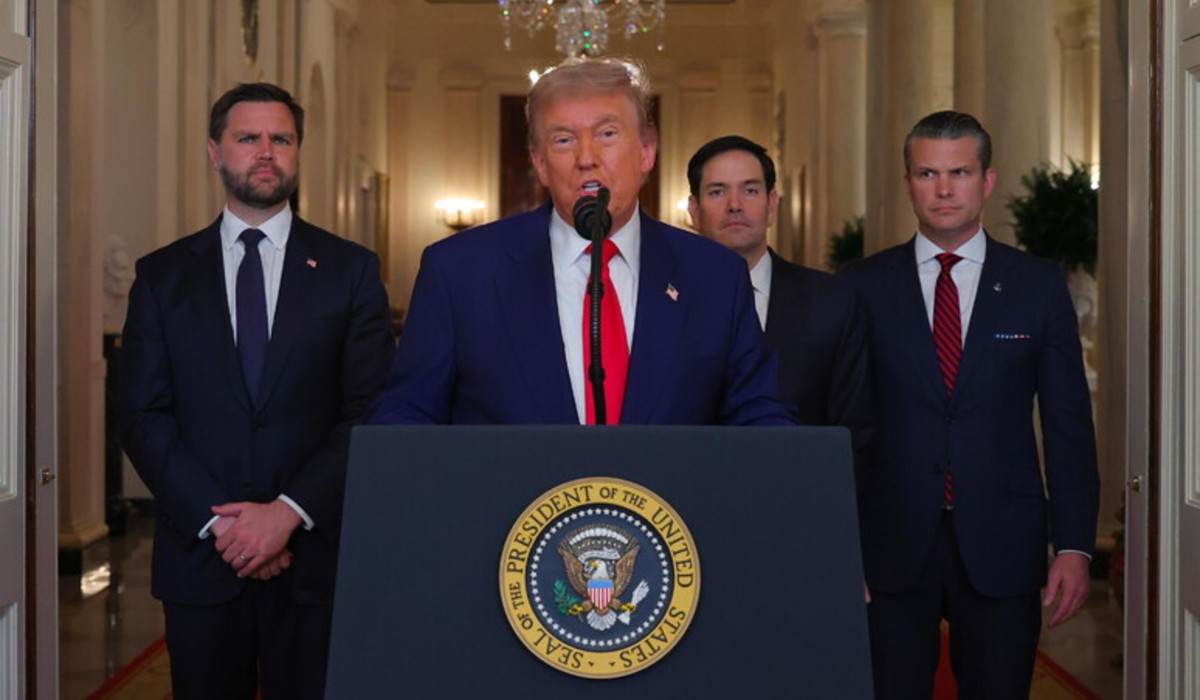
 Donald Trump giving a statement after bombing Iran. Photo: Public Domain
The effect of the US strikes on Iran are still unknown, but the chances of escalation and a bloody war of attrition are high, with no guarantee of success for the US and Israel, argues Chris Bambery
The jubilation of Donald Trump and Benjamin Netanyahu following the US air strikes on Iranian nuclear facilities at Fordow, Natanz, and Isfahan hide deep uncertainties over the ability of the US and Israel to win this war.
In an address to the nation, Trump said Iran’s key nuclear-enrichment facilities were ‘completely and totally obliterated’, adding that any future attacks would be ‘far greater and a lot easier’. The US military have been far more measured in their claims of the damage done. Trump thanked Netanyahu and the Israeli army in his speech: ‘We worked as a team like perhaps no team has ever worked before, and we’ve gone a long way to erasing this horrible threat to Israel.’
B-2 bombers flying from Whiteman Air Force Base in Missouri, carried out the attack on the three Iranian sites, dropping a massive ordnance penetrator, or a ‘bunker buster’, which is tens of thousands of pounds in casings that can penetrate deep below the Earth’s surface before detonating.
Iran’s nuclear-enrichment sites at Fordow, Natanz and Isfahan are built deep underground. Estimates suggest that Fordow for example could be eighty metres beneath the surface, and capped with layers of reinforced concrete and soil. The US dropped fourteen GBU-57 Massive Ordnance Penetrators, or Mops, which weigh around 13.5 tonnes. It has only some twenty Mops, so it has little in reserve. US military figures pointed out that it will take two days before they know how much damage was done.
Whether or not the US destroyed or damaged the three sites is a matter of conjecture not fact, although that did not get in the way of Trump’s hyperbole. It has been widely reported that satellite images had shown a fleet of trucks at Fordow, fitting with Iranian government statements that they had dispersed material. Israel does not possess such weapons as the Mop, nor do they have the B-2 bombers capable of carrying them.
Within the US administration, the strikes, we are told, were designed to pressurise Iran back to negotiations over its nuclear programme. It’s a strange argument given that the US and Iran were due to meet in Oman last Sunday to do just that. Those negotiations were scuppered by Israel’s assault on Iran and Trump’s support for the attack.
Leaving that aside, and the fact that the promise of those talks lulled Iran into a false sense of security, allowing Israel to gain total surprise, Iran is not going to agree to Trump’s demand that it gives up its entire nuclear programme and its ballistic missiles. To accept those conditions is to cease to be a sovereign state and in its recent history Iran has experienced imperial domination at the hands of Britain, Russia and the USA. This history has left deep scars and Iranian nationalism runs deep. On yesterday’s demonstration in London in solidarity with Palestine and against the war on Iran, I was struck by how many Iranians who did not support the regime were on the streets opposing the war on the Iranian people.
Ambitions for regime change
However, given the number of unreformed neocons in the Trump administration, it is also apparent that the US, like Netanyahu, seeks regime change in Iran. Netanyahu has sought US involvement in a war on Iran for four decades. The US neocons see the Islamic Republic as the last man standing on a list of states US Vice-President Dick Cheney drew up a quarter of a century ago where Washington planned regime change.
Both Netanyahu and Trump claim the attacks have been necessary because Iran is on the cusp of building a nuclear bomb, despite both the US Secretary of Intelligence, Tulsi Gabbard, and the CIA stating on record that this is not the case. If it was true, and the US has not destroyed Iran’s stocks of enriched uranium, might not Iran now be going full out to do just that, build a nuclear bomb? Neighbouring states such as Turkey and Saudi Arabia have denounced the US attack but will do nothing practical, except they must be considering building nuclear bombs, knowing Israel could turn on them at any moment.
Russia is treaty bound to Iran. However, its hands are full in Ukraine and Putin is not going to intervene directly in Iran. Even so, he cannot allow Iran to be degraded. He and the Chinese are aware this episode is designed as a warning to them. I suspect both will give Iran key military supplies.
There is another reason why Trump stepped into the breach. Israel’s assault on Iran got off to a strategically effective start because Iran was caught napping, but the war has since devolved into bombing civilians and the occasional assassination.
Iran is not Hamas. The latter’s missiles were not ballistic or hypersonic, unlike Iran’s, and were relatively easy for Israel to detect and destroy in such a small territory as Gaza. Iran is a huge country with a significant arsenal of modern missiles Israel finds difficult to locate and which can penetrate its air defences, as we saw immediately after the US strikes.
Danny Citrinowicz, a non-resident fellow with the Atlantic Council’s Middle East Programs and a member of the Atlantic Council’s Iran Strategy Project working group, points out that: ‘Trump hopes that this attack will end the military campaign against Iran. But it raises the likelihood that the campaign will expand, depending on the Iranian response. Netanyahu hopes that the latest attack will lead to significant US involvement in achieving the goal of overthrowing the Iranian regime, and that US involvement will not end at Fordow, Natanz, and Isfahan. Netanyahu’s problem is that if Trump does not broaden the operation, and Iran doesn’t agree to comply with the administration’s dictates, Israel could slide into a war of attrition with Iran, with the United States standing by and refusing to join Netanyahu’s ambitions to expand the campaign.’
Doubtful outcomes
A war of attrition is not something which Israel is in a good position to wage. Its economy has suffered since the war on Gaza began: ‘According to the business survey company CofaceBDI, roughly 60,000 Israeli companies closed in 2024 due to manpower shortages, logistics disruptions and subdued business sentiment. In addition, tourist arrivals continue to fall short of pre-October 2023 levels. Those trends could be aggravated in the event of a full-fledged war with Iran. S&P Global Ratings issued a stark warning about the vulnerability of the Israeli economy on Tuesday.
The agency stated that a continued Israeli war campaign, particularly if met with a sustained and strategic Iranian response, could lead to a downgrade of Israel’s credit rating from A to A-. Were that to happen, it would likely raise borrowing costs and soften investor confidence in the Israeli economy.’
You might counter that Iran is in no better position, but it has coped with decades of US-led sanctions, a ‘soft’ war of attrition. Before the war with Israel began, some half a million Israelis had quit the country. Ben Gurion airport is now shut and there are no civilian flights out but there are reports of Israelis fleeing by yacht to Cyprus and Greece.
Netanyahu has imposed tight censorship on what is happening domestically; so much for Israel being the only democracy in the Middle East. However, the civilian population is having to spend a great deal of time in shelters. Iranian missiles are targeting its one remaining major port, Haifa. If it closes, that would be a major blow. So, in a war of attrition, it might come down to which state can take the most pain.
Would the US intervene? Trump says these attacks are a one off and a land war is ruled out. That is designed to reassure his Maga (Make America Great Again) base, but he is now in uncharted waters and the pressure will be on to intervene again and again.
If the US is pulled into a war with Iran, it cannot be won simply by air power, unless Trump nuked Tehran. Any war on Iran would be deeply unpopular in the USA, even more so than the 2003 Iraq war.
Lastly, how will Iran respond? It can quite easily target the 90,000 US personnel in the Gulf and the warships there, it can close the Straits of Hormuz while the Houthis close the Red Sea. I suspect, however, that the Iranian leadership will carefully assess the situation and choose its moment in regard to the US. In regard to Israel, Iran will keep striking because it can and it knows it is inflicting damage.
Before you go
The ongoing genocide in Gaza, Starmer’s austerity and the danger of a resurgent far right demonstrate the urgent need for socialist organisation and ideas. Counterfire has been central to the Palestine revolt and we are committed to building mass, united movements of resistance. Become a member today and join the fightback.

Chris Bambery
Chris Bambery is an author, political activist and commentator, and a supporter of Rise, the radical left wing coalition in Scotland. His books include A People's History of Scotland and The Second World War: A Marxist Analysis.