
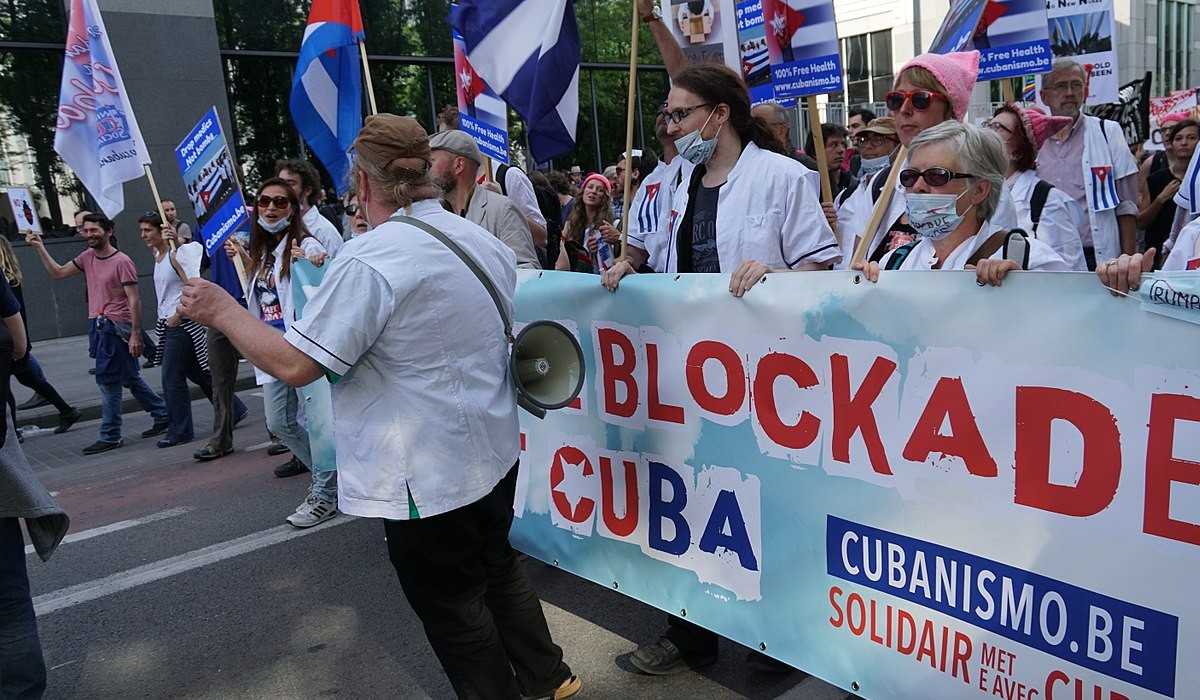
 Cuba solidarity protest. Photo: Miguel Discart / Wikimedia Commons / CC BY-SA 2.0
Resistance to the US siege on Cuba will find its best allies in the international solidarity movement, finds John Rees
US President Donald Trump has told reporters that ‘Cuba is ready to fall’.
He is certainly working to make sure that happens. Trump added, ‘Cuba’s a failing nation. It has been for a long time, but now it doesn’t have Venezuela to prop it up. So, we’re talking to the people from Cuba… I want the people that came here and were horribly treated by Cuba to be taken care of, to be able to go back and do what they have to do… So, I think we’re going to make a deal with Cuba. It’s in bad shape. Cuba is in bad shape.’
This is essentially a threat to restore US colonial overlordship and to that end, Trump is trying to strangle the Cuban economy. Adding to the sanctions that already exist, Trump has cut Cuba off from its main oil supplier, Venezuela.
The Caribbean island nation has not received any crude or refined oil from its closest ally since mid-December, when the U.S. moved to block the South American nation’s exports.
Trump has since vowed Cuba would receive no more oil from Venezuela and has threatened to slap tariffs on any nation sending fuel to Cuba, effectively cutting off the island’s supply.
Mexican President Claudia Sheinbaum also confirmed that, under the threat of US tariffs, she had ordered a halt to oil exports to Cuba. Mexico was Cuba’s largest supplier after Venezuelan shipments ceased.
The US led blockade has begun to bite. Air Canada said last Monday that it’s suspending flights to Cuba after the island cautioned that it is running out of jet fuel.
Fuel shortfalls are not new to Cuba, which has long struggled with supply issues, and many airlines already have plans in place to deal with them. Similar crises have prompted many carriers to refuel in nearby countries, including Panama, the Bahamas, the Dominican Republic and the U.S.
It’s not just international flights that are affected. A taxi worker told the Reuters news agency that the fuel situation has become chaotic, with only a handful of cars operating where dozens once worked. Another taxi driver, Damian Palmeras, said that fuel is now rationed by tickets, with drivers limited to just 20 litres at a time.
Long queues were seen at gas stations due to fuel shortages, with fewer buses running and longer power cuts affecting homes, hospitals and other state institutions.
Cuban authorities say what fuel is available will be reserved for essential services like healthcare, agriculture, education and water systems, while tourism and export industries continue operating to protect foreign currency earnings.
Cuba’s peso has lost more than 10 percent of its value against the dollar in three weeks, pushing up the price of groceries. The blockade is pushing up food prices and transportation costs, prompting hours of blackouts, even in the capital Havana.
At Havana’s Oncological Hospital, the blackouts affect patient care and potentially threaten lives. ‘Our professionals only want to offer health quality, medical protocols, technical procedures, research, and drug production. But these things need energy, which comes from oil. So, this is a measure aimed to affect the Cuban people by limiting the performance of our health workers,’ said Carlos Martinex, head of the Cancer Control Division of Cuba’s Ministry of Public Health.
Local special education authorities said the US oil embargo is making student transportation much harder, and limiting their ability to use electrical equipment for training and therapy. ‘These measures adopted by the Donald Trump administration and the executive order, in particular, worsens the current situation of the Cuban people in an inhumane manner, I would say, and with a significant impact on our special education system,’ said Beatriz Roque, director of special education at the Cuban Ministry of Education.
Cuba’s foreign minister declared an ‘international emergency’ in response to the U.S. tariff warning, which he said constituted ‘an unusual and extraordinary threat.’
The US siege of Cuba is fast becoming an international crisis. The UN has said, ‘The secretary-general is extremely concerned about the humanitarian situation in Cuba, which will worsen, if not collapse, if its oil needs go unmet’.
China is suggesting it may intervene. ‘China firmly supports Cuba in safeguarding its national sovereignty and security, and opposes foreign interference,’ said Lin Jian, a foreign ministry spokesperson ‘We will always provide support and help to the Cuban side to the best of our ability.’ Kremlin spokesman Dmitry Peskov told reporters that Russia was talking to Havana, a longtime partner, about how to solve the problems.
Many Cubans are ready to resist despite the economic hardship they face. This resistance will be essential. As the Axis of Resistance in the Middle East has shown there is only so far that even those states that find themselves at odds with the US are willing to go in support of anti-imperialist struggles. Cubans, like Palestinians, will no doubt be aware that their resistance to the US siege will find its best allies in the international solidarity movement.
Before you go
The ongoing genocide in Gaza, Starmer’s austerity and the danger of a resurgent far right demonstrate the urgent need for socialist organisation and ideas. Counterfire has been central to the Palestine revolt and we are committed to building mass, united movements of resistance. Become a member today and join the fightback.

John Rees
John Rees is a writer, broadcaster and activist, and is one of the organisers of the People’s Assembly. His books include ‘The Algebra of Revolution’, ‘Imperialism and Resistance’, ‘Timelines, A Political History of the Modern World’, ‘The People Demand, A Short History of the Arab Revolutions’ (with Joseph Daher), ‘A People’s History of London’ (with Lindsey German) and The Leveller Revolution. He is co-founder of the Stop the War Coalition.