
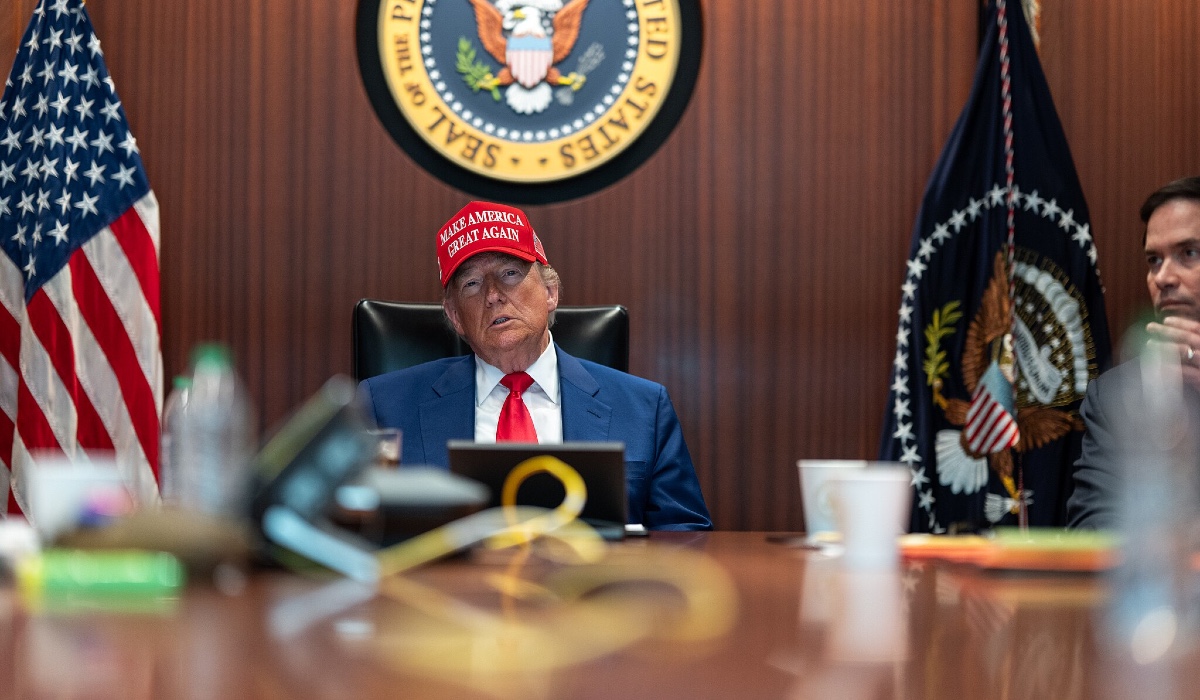
 Trump and his National Security Team, July 2025 / The White House, Public domain, via Wikimedia Commons
The war on Iran is the latest in a succession of highly problematic situations the Trump administration has careered into, and it may signal serious internal crisis, argues John Clarke
It has been widely suggested that the second Trump administration starkly reflects the challenges and contradictions confronting US imperialism, as its relative power in the world declines. This can be seen in both its authoritarian and deeply reactionary domestic agenda and in its crudely pragmatic and brutal ‘America First’ effort to redefine the US role on the world stage.
As the administration blunders forward with its ill-considered adventure in Iran, facing the prospect of a catastrophic quagmire or an ignominious retreat, there are significant signs that Trump and his inner-circle are themselves starting to take on the dimensions of a regime of crisis.
The degree to which the administration is being buffeted by the destabilising consequences of the situation in Iran is already highly significant and there is room for things to become very much worse.
Yahoo Finance offered its readers a very restrained but telling assessment of the situation when it noted, on 6 March, that ‘Iran is turning out to be a more effective enemy than many thought … The U.S.’s allies in the Gulf are beginning to complain about the collateral damage they are sustaining in the conflict. And Iran has turned out to be surprisingly effective at causing trouble for its attackers.’
Sustained Iranian resistance brings with it severe regional and global economic consequences. Israel’s population faces ongoing attack from the air, the Gulf States and their oil-producing facilities face major disruption, and there are strong indications that stockpiles of US weaponry and its defensive capabilities may not be as robust as many assumed.
It is glaringly obvious that the attack on Iran has become a source of crisis for the Trump administration and that things are likely to get very much worse. However, problems were accumulating at a rapid rate well before the US set in motion its Operation Epic Fury and began raining death on the Iranian population.
Trump’s travails
In the weeks leading up to the attack on Iran, headlines across the world reflected Trump’s travails with regard to the furious immigration crackdown on which his administration places so much emphasis. While the political spectacle of the ICE raids is doubtless to the liking of Trump’s core support base, the repressive excesses involved have produced a backlash, particularly as powerful community-based resistance has emerged. Polling shows that a majority in the US feel the ICE crackdown has simply gone too far.
In January, CCN observed that the all-out attack on immigrant communities is ‘causing political problems for the administration. The polling suggests a narrative of overreach and over-aggression has clearly set in, with a growing volume of videos and images likely hardening those perceptions.’
Before the attack on Iran generated major new risks of economic dislocation, the US economy was already showing signs of intensifying problems that Trump’s bluster couldn’t conceal. This month, as reported by Yahoo Finance, ‘we learned that the US economy shed some 92,000 jobs last month — a far cry from a predicted gain of 50,000 and a signal about the overall health of the economy.’
The direct experience of working-class people in the US, involving rising prices, inadequate wages and the threat of unemployment, is in line with these economic indicators. Now, Trump’s risky and unpopular war against Iran is creating a situation where rising fuel costs don’t ‘just mean short-term pain for consumers; unchecked, rising oil prices could both boost inflation and slow economic growth.’
After the Supreme Court ruled against Trump’s tariff policy, the administration doggedly vowed to proceed with this approach, central as it is to the whole America First strategy. However, it faces a very difficult road as it presses ahead. Indeed, as Associated Press reported on 5 March, a New York federal judge has now ruled ‘that companies that paid tariffs struck down last month by the Supreme Court are due refunds.’ The administration ‘could ultimately be on the hook for refunds worth $175 billion.’
Polls continue to show that Trump’s popularity is plummeting and unlikely to turn around. The Daily Beast suggests that ‘Trump is underwater on a range of key issues critical to midterm voters, including the economy and inflation, as well as immigration and the war in Iran.’
Even worse than his general unpopularity, is a weakening of support within his political base. Newsweek has reported that new ‘findings from the Pew Research Center point to softening among Republicans and Republican-leaning independents on whether they back Trump’s policies.’
Such a lack of enthusiasm among right-wing voters increases the already strong possibility that hostility to Trump will go over in the November midterms to a desire to punish Republicans, as they seek re-election to the Congress and Senate. Loss of Republican control of the legislative institutions would greatly undermine Trump’s ability to proceed with his agenda.
Bloodletting
The second Trump administration has, up until now, involved considerably less internal discord than we saw during the first term in office. Up until recently, only Trump’s falling out with Elon Musk had indicated rifts within his inner circle. It is entirely likely, however, that this relatively harmonious period is now about to come to an end.
On 5 March, Trump finally accepted the reality that his Homeland Security secretary, Kristi Noem, had become an enormous political liability and he removed her from that position. In an interview with NBC News, an anonymous administration official spoke of ‘a culmination of her many unfortunate leadership failures including the fallout in Minnesota, the ad campaign, the allegations of infidelity, the mismanagement of her staff, and her constant feuding with the heads of other agencies, including CBP and ICE.’
Doubtless very little will change under Noem’s replacement, Republican senator Markwayne Mullin, but her ignominious departure is an indication of the rough road that Trump’s reactionary agenda is now travelling over. The prospects for further bloodletting of this kind within the top ranks of the administration are strong and intensifying.
While Noem’s role in the ICE crackdowns was considerable, it is widely accepted that the notorious deputy chief of staff, Stephen Miller, wields enormous influence within the administration. He is a venomous racist ideologue and a frank proponent of a ‘might is right’ approach to international relations. His zeal and relentless pressure to accelerate the process of deportations and border restrictions are well-known.
The ‘moderate’ Republican senator Thom Tillis has emerged as something of a dissident figure in the last period. Recently, he focused criticism on the conduct and role of Stephen Miller. As reported by the Independent, Tillis has expressed the view that Miller exercises ‘outsized influence on the Cabinet’ and that he is ‘a big problem in this administration, he has been from the beginning.’
Tillis may be exceptionally outspoken but he certainly reflects misgivings that are shared more widely with Republican ranks. Miller’s prominence and his zealous and uncompromising promotion of the most reactionary instincts within the administration make him a very promising candidate for the role of sacrificial lamb, as the midterms grow closer.
If the removal of Miller in the days ahead is a distinct possibility, the expendability of defence secretary Pete Hegseth is even more glaring. As Trump’s ‘war of choice’ on Iran becomes ever more of a liability, Hegseth is simply the obvious scapegoat. Even before the attack on Iran, he was grating on the nerves of conservatives that Trump can’t afford to alienate.
Already last December, the Independent was able to inform us that it ‘isn’t just the left that is outraged about Pete Hegseth’s role in the lethal “double-tap” airstrike of a suspected drug boat that killed all remaining survivors. A growing chorus of conservatives has joined them in describing the defense secretary as a potential “war criminal” who is “incompetent” and should be prosecuted.’
The status of the Trump administration as a regime of crisis is becoming ever more clearcut. At root, it constitutes an authoritarian and internationally belligerent response to the diminishing strength of US imperialism. It draws behind it the most reactionary elements within the US establishment and an enraged right-wing social base but it by no means expresses a ruling-class consensus on the way forward.
This administration, however, is no model of ruthless efficiency, even if it remains enormously dangerous. Its track record is viciously reactionary but it includes no end of blunders and retreats. Now the conditions of crisis that gave rise to the Trump phenomenon are compounding and producing a level of inner crisis within the administration itself. The adventure that has been undertaken in Iran can only compound its instability and internal discord.
Though a dangerous enemy, the Trump administration is far from invincible. A powerful level of opposition and resistance had already emerged, most clearly in the determined challenge on the streets to the brutal and repressive ICE raids. The Trump regime of crisis can be defeated.
Before you go
The ongoing genocide in Gaza, Starmer’s austerity and the danger of a resurgent far right demonstrate the urgent need for socialist organisation and ideas. Counterfire has been central to the Palestine revolt and we are committed to building mass, united movements of resistance. Become a member today and join the fightback.

John Clarke
John Clarke became an organiser with the Ontario Coalition Against Poverty when it was formed in 1990 and has been involved in mobilising poor communities under attack ever since.