
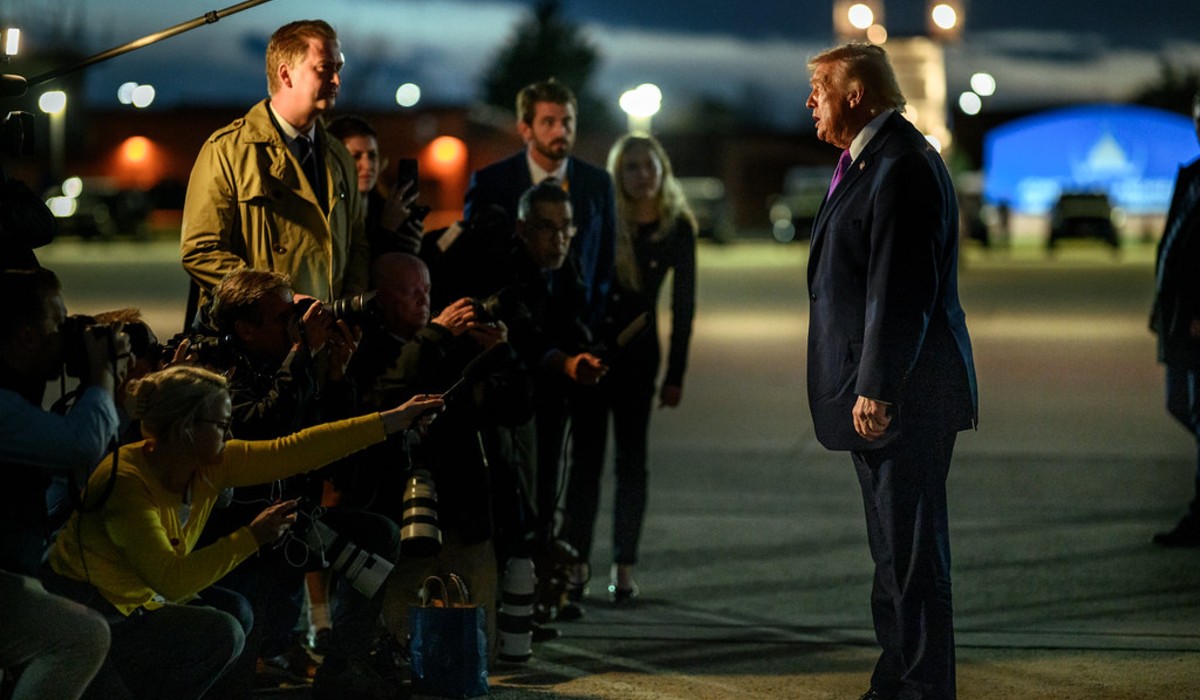
 Donald Trump speaking to media. Photo: The White House / Flickr
Vladimir Unkovski-Korica argues that the US-Israeli war in Iran signals major changes in the geo-political shape of the Middle East. The reputation of the US and the collective West has taken a blow internationally, with it’s brazen gunboat diplomacy as another sign that the world is returning to the law of the jungle.
The US-Israel war on Iran is not just about Iran itself. It reflects, rising multipolar competition, declining US regional dominance and shifting alliances in the Middle East, with the Gulf states caught between the US and Iran. In the US there is a switch from institutional hegemony to gunboat diplomacy.
In the short-term, Iranian weakness and long-term hostility to the Iranian regime post-1979 partly explains the current war. The US-Israeli assault is the pinnacle of a creeping, but often chaotic, offensive by the US, Israel and other Western-allied regional powers against the Iran-led ‘Axis of Resistance’ after October 2023.
A critical element of this favourable conjuncture for the West is that Russia is bogged down in the war in Ukraine. It is also not clear that Israel’s genocidal war in Gaza, major Israeli strikes weakening Hezbollah, US-Israeli bombing of Yemen, and US-Israeli assassinations and strikes targeting Iran would have led this far without the regime change in Syria supported by Turkey in late 2024.
China is also critical to the situation. While China’s economic rise is not yet matched by its military power, the Middle East is important to China. Half of China’s crude oil, and a third of its gas, comes from the Persian Gulf. Moreover, the US lost its position as Saudi Arabia’s top trade partner to China in recent years, with Saudi Arabia becoming China’s top trade partner in the Middle East.
To the US, Iran’s geopolitical importance lies in its strategic position at the crossroads of Central Asia, South Asia and the Middle East. It serves as a major bridge for trade and as a significant energy hub. Iran controls the Strait of Hormuz through which around a fifth of global oil and gas pass. Take that away from potential rivals and the global picture is more favourable to Washington.
Russia’s military role in the region is diminishing and China’s is still far from sufficient to allow it to aid Iran. We have not seen these two powers able to aid Iran in the way that, say, NATO aided Ukraine against Russia. Although Russia and China will most likely send aid, this will be nothing like the scale that the West has been able to afford to Ukraine. We will see whether that now shifts in Ukraine, as the US needs more firepower in the Middle East, but that’s for now a separate question.
Gulf Cooperation Council
There also seems to be something of a split within the Gulf Cooperation Council. Although the Gulf states publicly warned against an attack on Iran in the early months of 2026, the Washington Post reported on 28th Feb that Saudi Crown Prince Mohammed bin Salman Al Saud privately phoned Trump in the run-up to the invasion urging him to strike Iran.
How long the Gulf states will stand with the US over this war is an open question. It is not something the US can take lightly in its long-term competition with China. Iran-orchestrated attacks on major Saudi oil refineries in September 2019 led to the perception in the Gulf that their investment in the US for security to defend them from economic damage could no longer be taken for granted. The current war is perhaps straining this alliance even further, despite Gulf antipathy towards Iran.
The stability of US allies, regionally and more broadly, is also a worry. The Gulf states and the wider region, not to mention the imperial metropolis, have seen rising popular anger over the West’s backing of Israel’s genocide in Gaza. The return of the Arab spring, of which we have seen glimpses in Bahrain, would be dangerous for their stability. The wider economic fallout could also threaten European stability or the stability of countries further out. We are already seeing deep splits in Europe between supporters and detractors of Trump’s war.
Moreover, it is not clear that the US and Israel are bound by identical pressures. Broadly speaking, the US has wider strategic interests at play than Israel. It has an increasingly sceptical public, which means it has tended to be more cautious in terms of how far it’s willing to go in Iran. Israel is likely to ultimately have to bow to the US, on which it depends. But it has found in Trump a president willing to go further on Iran than any predecessor. But how far are they willing to go?
End game
The big question is, indeed, what the end goal is. We have heard calls for regime change and talk of a Venezuela-style regime subordination. There has even been talk of the US mobilising the Kurds as proxies to break up the Iranian state on the Syrian or Libyan models. Some are even speculating that weakening Iran sufficiently to claim military control of the Strait of Hormuz, without regime change, would suffice for Trump to succeed in reining in Iran.
Whether or not the Trump-Netanyahu gamble succeeds, the reputation of the US and the collective West has taken another blow internationally. Initiating a major war during Ramadan and while negotiations were ongoing, causing devastation for civilian populations in Iran and wider, destabilising the regional and world trade and ignoring the rules of war may not be new for Israel or indeed the US. However, these are bad coming on the back of decades of creeping US departure from the postwar consensus. Trump’s willingness to systematically jettison the institutions of the so-called ‘international liberal, rules-based order’ in favour of ever more brazen gunboat diplomacy will be read among ruling classes in multiple countries as another sign that the world is returning to the law of the jungle, where might is right. They will draw conclusions.
If the attack is unsuccessful, however, this will go down in history as even worse for the US than Suez in 1956 was for Britain and France. When these declining imperial metropolises, in cahoots with Israel, launched a war against Nasser’s Egypt they won military victories, but lost face internationally and suffered major domestic fallout. With the oil price reaching $100 dollars a day, and Khamanei’s son being named his successor, the headlines underline what is at stake for Washington. The worse the headlines, the more Trump will come under scrutiny in the US and among allies. Netanyahu will become more isolated at home and abroad, causing major problems for Israel.
That is why it is so important for anti-war sentiment everywhere to be channelled into real pressure on the warmongers. To stop the criminal war before it spreads and escalates further, causing more death and destruction in its wake, may not just save millions from the aftershocks, but also hasten the day these war criminals face justice.
Before you go
The ongoing genocide in Gaza, Starmer’s austerity and the danger of a resurgent far right demonstrate the urgent need for socialist organisation and ideas. Counterfire has been central to the Palestine revolt and we are committed to building mass, united movements of resistance. Become a member today and join the fightback.

Vladimir Unkovski-Korica
Vladimir Unkovski-Korica is a member of Marks21 in Serbia and a supporter of Counterfire. He is on the editorial board of LeftEast and teaches at the University of Glasgow.