
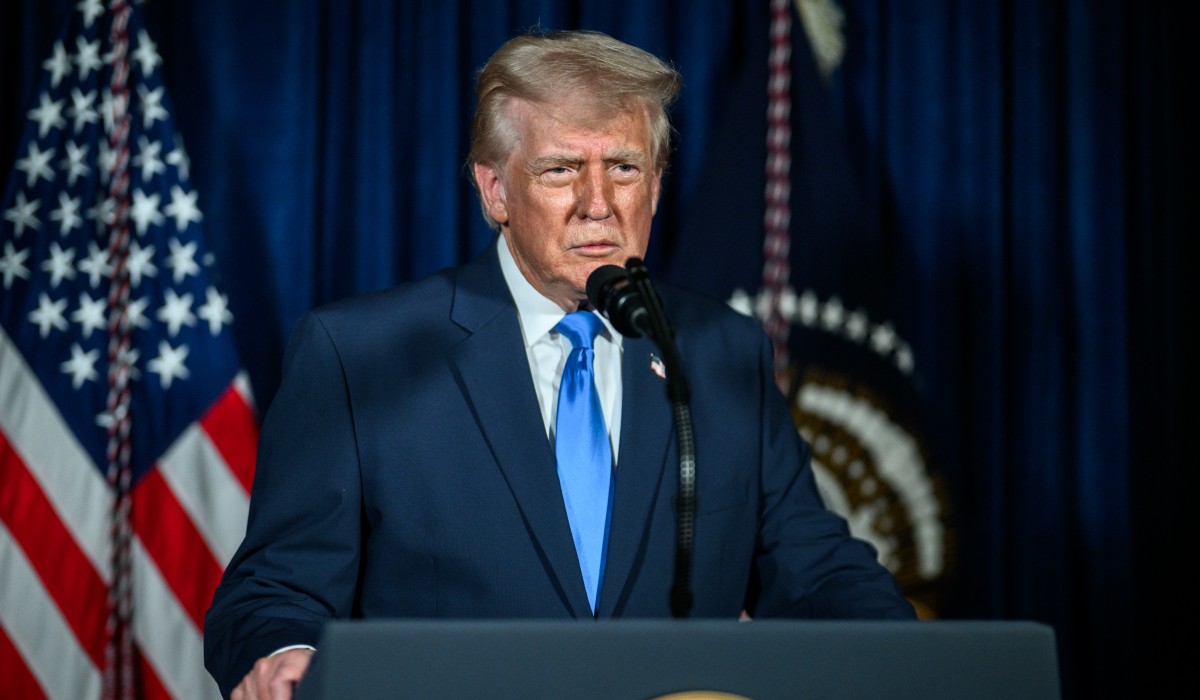
 Donald Trump. Photo: The White House / Public Domain
Trump’s US ss abandoning so-called ‘rules-based’ imperialism, but its traditional hegemony over Latin America is being enforced with renewed brutality, argues John Clarke
With its America First turn, the Trump administration can be said to have ended the role of the United States as the cornerstone of a ‘rules-based’ post-war global order but this should not be taken to mean that the agenda of domination and exploitation has been abandoned. Nowhere is this more evident than in the administration’s dealings with Latin America. Under Trump, the infamous ‘Ugly American’ approach has actually become even more threatening and dangerous for the countries south of the Rio Grande.
An article in the Conversation on 20 February noted that ‘the US has had a long history of invading, meddling, supporting coups and offering clandestine support to violent non-state actors in [Latin America].’ However, it also argued that Trump was focused on ‘a return to the paternalistic era of US foreign policy’ throughout the region.
In this regard, Washington under Trump places an increased emphasis on the concept of Latin America as ‘the US’s backyard,’ an idea that goes back to the Monroe Doctrine of 1823, which was used to advance US domination throughout the region at the expense of a series of European rivals.
The deployment of US military power in the service of the economic exploitation of Latin America that so brutally marked this approach was famously captured in the confessions of senior US Marine officer, Smedley Butler. In 1935, he acknowledged that, ‘I spent 33 years and four months in active military service and during that period I spent most of my time as a high-class muscle man for Big Business, for Wall Street and the bankers. In short, I was a racketeer, a gangster for capitalism.’
Regime change
As I write this, the final result in this week’s election in Honduras has still not been settled. Newsweek reports that, after taking a narrow lead, the Trump endorsed right-wing candidate, Nasry ‘Tito’ Asfura, is now slightly behind Liberal Party’s Salvador Nasralla, who has campaigned against the corruption of the ruling establishment, in a remarkably tight race that requires the recounting of ballots.
Trump took a considerable interest in this election and did all he could to ensure a victory for the right. Prior to the vote, he went out of his way to exert as much pressure as he could in support of Asfura and made it abundantly clear that his support for the democratic process was entirely conditional on the people of Honduras voting in accordance with his wishes.
In a Truth Social post, Trump suggested, as is his standard practice, that the close vote was evidence of a rigged election. He declared that it: ‘Looks like Honduras is trying to change the results of their Presidential Election. If they do, there will be hell to pay!’ He has threatened to discontinue US aid to impoverished Honduras if the final vote goes against him, stating that he ‘will not be throwing good money after bad, because a wrong leader can only bring catastrophic results to a country.’
With this effort to influence the Honduran election, Trump ‘echoes the tactic he used to get behind his ally in Argentina, the libertarian President Javier Milei, who faced tough midterm elections and came out on top. And it forms part of a broader strategy to reshape the leadership across Latin America.’
As the US administration is fully aware, a close electoral result will create great political volatility and conflict, as was the case when the corrupt Juan Orlando Hernández claimed victory in 2017. Hernández, a member of the same party as Asfura, ‘was later sentenced to a 45‑year U.S. jail term for drug trafficking’ but Trump, hammering home his support for the Honduran right, recently pardoned and released him.
Trump defended this move by claiming that ‘Hondurans believed Hernández had been “set up,” even as prosecutors argued he protected drug traffickers who moved hundreds of tons of cocaine through the country.’ Very clearly, the ‘pardon cuts against Trump’s aggressive counter-narcotics push that has triggered intense controversy across Latin America.’
It must be stressed that the threat to cancel aid to Honduras is a very severe one indeed. Al Jazeera notes that for ‘one of the poorest countries in the region – and a major source of migration to the US – aid is far from just symbolic. It supports critical state functions in areas where violence, poverty and climate disasters drive migration.’ In this context, ‘abrupt cuts to funding to Honduras would likely worsen insecurity, weaken already strained public services and accelerate migration.’ Trump’s threats have been carefully calculated and impactful.
Venezuela targeted
The Trump administration’s interest in regime change has been taken to even more dangerous and brutal lengths in the case of Venezuela. With glaring cynicism, the well-used accusation of drug smuggling into the US has been employed and Venezuelan president, Nicolas Maduro, has been accused of controlling drug cartels. There has been a massive US naval deployment off the coast of the country and Trump has declared that airspace ‘above and surrounding Venezuela’ should be considered closed.
A report in the Guardian details a remarkable phone conversation that Trump had with Maduro on 21 November. The US president warned his foe that: ‘You can save yourself and those closest to you, but you must leave the country now.’ An offer of safe passage was made but it was conditional on Maduro’s immediate resignation and this was rejected. With considerable justification, Maduro claimed that Washington sought to ‘appropriate Venezuela’s vast oil reserves – the largest on the planet – through the lethal use of military force.’
The use of extra-judicial killing on the high seas has been linked to the effort to drive Maduro out. CNN notes that, since 2 September, the ‘US military has killed 83 people in strikes that have destroyed 22 boats as part of a campaign that Washington says is aimed at curtailing the flow of drugs into the United States.’
This killing spree has, of course, been conducted without a shred of evidence that those who have been attacked were actually shipping drugs. Moreover, the administration’s claim that it is somehow at war with ‘narco-terrorists’ has no legal basis. Even if a state of war existed, US Secretary of Defence, Pete Hegseth, is now embroiled in a scandal over allegations that he intervened during the first attack to ensure that survivors would be slain, which is a clear violation of the rules of war.
Trump, of course, didn’t invent the militarised US death squad and other presidents have blood on their hands in this regard, including Democrats. However, his present lawless conduct and his concerted efforts to tighten the US grip on Latin America are highly instructive.
As I suggested at the outset, the America First strategic shift, for all its bluster about focusing on the domestic front, has nothing whatever to do with curtailing the imperialistic role of the United States. In the context of declining US hegemony and in the face of major rivals, especially China, the post-war brand of US ‘world leadership’ has been jettisoned but the focus on domination and exploitation is just as keen as ever.
The countries to south of the Rio Grande have always been a core priority for US imperialism and it is hardly surprising that the pragmatic and ‘transactional’ Donald Trump sees the need for this massive region to be a key priority. He wants to intensify the levels of economic domination and political control. He makes no pretences about being a ‘good neighbour’ and openly rejects any right of Latin American nations to chart their own course. He is ready to use methods of political disruption, economic coercion and direct military force to obtain compliance and subservience.
For the working-class populations of Latin America, the threat posed by US imperialism isn’t at all in decline. On the contrary, under the Trump administration, the imperialist domination that they have resisted so bitterly and for so long is actually intensifying.
Before you go
The ongoing genocide in Gaza, Starmer’s austerity and the danger of a resurgent far right demonstrate the urgent need for socialist organisation and ideas. Counterfire has been central to the Palestine revolt and we are committed to building mass, united movements of resistance. Become a member today and join the fightback.

John Clarke
John Clarke became an organiser with the Ontario Coalition Against Poverty when it was formed in 1990 and has been involved in mobilising poor communities under attack ever since.