
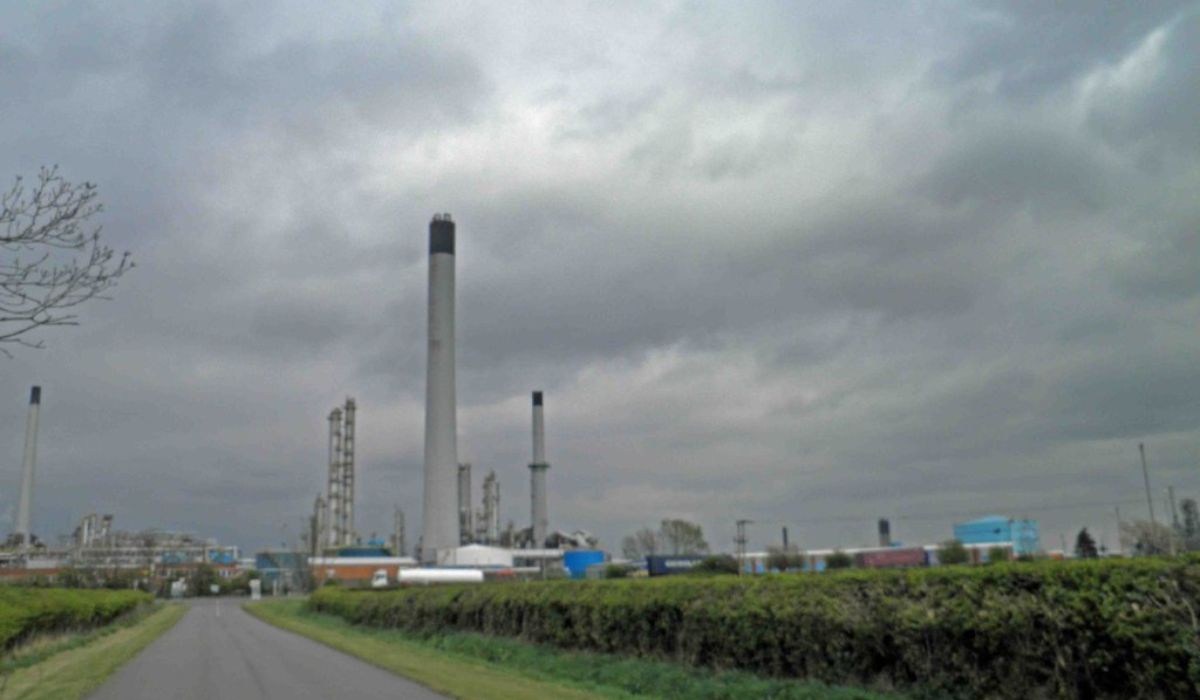
 Lindsey Oil refinery from Nicholson Road, North Killingholme. Source: Steve Fareham - Geograph Britain and Ireland - Wikicommons / cropped from original / CC BY-SA 2.0
A just transition for the climate needs to put workers first, or it will be Reform that gains, so we need a real fight to save the Lindsey Oil Refinery, argues John Westmoreland
The Unite rally to save Lindsey Oil Refinery (LOR) was impressive. Some 200 workers attended, including sacked workers, and those still employed at the beleaguered plant who walked out to be with their mates.
The story of the LOR dispute shines a light on corporate greed and corruption; a Labour government that should be measured in units of uselessness; and a trade union wrestling with affiliation to the Labour Party, gung-ho employers and a desperate membership who look ready to fight all out.
The platform of Unite speakers all pledged to fight the closure of the refinery, which if it happens, will lead to the loss of jobs in dependent industries and the impoverishment of another working-class community.
Ponzi capitalist
The first villain in this story is one Sanjeev Kumar, the oil tycoon who owns LOR. The Prax Group, created by Kumar from the humble origins of owning a filling station, has been built through what looks like a series of ‘irregularities’ around a huge loan. After the parent company, State Oil, received information about £783 million in credit, the collapse of Prax was spectacular.
As rumours began to spread about Prax, Kumar told government ministers all was well until the last minute when ‘material irregularities’ were discovered in the finances. As Prax went into receivership, Kumar, who had taken out over £11 million in pay and fees, skipped out of the country.
Among details disclosed by Teneo, which is serving as the administrator for State Oil and five other group companies, is a £70m debt owed to HM Revenue and Customs by Prax Petroleum. Teneo described the loans amassed by Prax as a ‘house of cards’.
Despite the apparently damning case against Kumar, the best Labour can come up with has been to ask him ‘to do the right thing’ and compensate the 125 workers who face redundancy at the end of October. Kumar has failed to reply. The government’s weakness in its treatment of corporate financial arrangements is what allows these kinds of scandals to happen.
Labour policy: do nothing, say nothing
The second villain in the story is the Labour government, with Ed Miliband playing the role to perfection, although it’s more tragedy than panto. All five speakers at the rally spoke of someone who was either unable or unwilling to engage with the concerns of the union and its members, and all five called for him to go.
Net Zero, Miliband’s pet project, was in the firing line from the off. Kyle Griffiths, a shop steward on the North Sea rigs, put it best. ‘I don’t deny the reality of climate change, and I support a just transition, but I oppose Net Zero when it means sacking workers like us, to justify Labour’s green credentials. The truth is that Labour’s Net Zero means our Jobs Zero, and we’re not having it’
Mick Simpson, Unite steward, said, ‘I have sat opposite Ed Miliband and Energy Minister Michael Shanks, and spelled it out to them. The UK is importing refined oil from other countries, why can’t we refine our own oil here? The facts are on our side. I challenged Miliband to a public debate but he can’t deal with the facts. They have nothing to say apart from how sorry they are, and it’s not our fault. But what is the point of a Labour government if it won’t step in and offer a solution to a crisis affecting working people?’
Let’s fight
The mood among the workers is extremely militant. There were calls from the audience for immediate action. Sharon Graham, Unite general secretary, recognised the mood when she said, ‘This Labour government has let Grangemouth refinery go and now they are doing the same here. There are now just four refineries left and our members don’t want to be picked off one by one. That is why I am considering balloting all our members in refineries for industrial action.’
The workers cheered the call for action, but will it happen?
Unite is in the frustrating position of waiting for Labour to decide the fate of LOR. The obvious thing to do would be to nationalise it, but instead Labour has committed to take bids from companies who promise to keep the refinery working and protect jobs.
Unite smells a rat. There has obviously been talks with LOR’s neighbouring plant Phillips 66, which would turn the refinery into an import facility only. Unite has been contacted by rival bidders who want to preserve LOR as a refinery. After all, LOR does refine over a quarter of the diesel sold in the UK, so it is a viable concern.
When asked, Labour ministers refuse to comment on what is happening behind the scenes, and this is stoking more anger. Unite do not think calls for immediate nationalisation are going to move Labour, so they are pursuing a two-pronged strategy that will break through government intransigence on the one hand, and find a responsible investor on the other.
This came across in Sharon Graham’s speech. She articulated the militancy of the workers and used it to batter Labour, Miliband and Net Zero. Graham is very popular with Unite members and she played a clever game of talking up the militancy, praising the stewards and members and blasting Miliband in particular.
It was a great speech, but there was no clear plan of action. The best LOR workers can hope for is a future vote for action across UK refineries, unless Labour changes course, and with their record to date of dancing to the tune of corporate power that is extremely unlikely. The power of Graham’s reasoning: that the energy sector lacks any plan for investment; that infrastructure is decaying; that there is no plan for a just transition; that Labour is in danger of destroying the livelihoods of the thousands of workers in the energy sector; all this is true and needs saying over and again.
However, the workers have to have a plan, and a vision of what the future holds for them. We need to connect the militancy for real change and an end to job insecurity to a viable and just transition. Workers on the platform spoke about this political demand, and it goes beyond the business-friendly solutions on offer.
Reform lurks at the edge
As Sharon Graham laid into Labour, she asked rhetorically, what do we want? A lone voice from a worker at the back shouted ‘Reform’. And without intending it, this is where her argument was heading.
It is impossible to lay into Labour, the traditional voting choice of the workers at the rally, without looking at the future political implications. And, there in the corner of the rally was one Andrea Jenkins, Reform’s Mayor of Greater Lincolnshire. She was completely isolated by the trade-union militancy, but she was the only mainstream politician who turned up.
When the rally ended, guess where the BBC headed for an interview? All Reform has to do when Labour’s abandonment of working-class communities is transparent is turn up, and hey presto! a political alternative is at hand. Jenkins made no headway at the rally, but that is not how it will appear in the media.
Sharon Graham should have said something about Reform trying to wheedle their way into a working-class dispute. She should have damned Reform’s anti-trade union politics, their racism and their backing for super-rich crooks like Sanjeev Kumar, but there was nothing.
Kyle Griffiths, the oil-rig shop steward, was the only speaker who referred to Reform’s presence when he said, ‘I don’t trust any politicians or the opportunists who are trying to get in on the act’. Unite seems to have had a policy of not engaging with Reform.
Kyle spoke to Counterfire after the rally. He spoke about the hostility to trade unionism on the rigs, and how activists can get blacklisted after a contract ends. He wanted to say more about Reform, and talked about how it is a constant discussion on the rigs, where many of his mates are falling towards Reform as Labour’s star falls. ‘I tell them Reform are anti-trade union and not on our side at all.’
Kyle is bitter about the portrayal of workers like himself in the liberal media. ‘I understand climate change, and I am sympathetic to environmental activists, many of whom I have sat down with. But we are not knuckle-dragging, selfish environmental polluters. We have to work, and if we stop working, what then? Climate change is not down to us alone, and Britain will just import oil and the products that come from it if we lose our jobs. I am fighting for working-class people to have a voice. If there is to be a just transition, the most important people in that discussion is the working class’.
He is right.
Class and class consciousness
The Unite rally at LOR was uplifting. The workers at the rally were young and old, men and women, all united as workers against the vagaries of a rigged system, but not united about the political solution we need.
If the workers fight and win, Starmer’s Labour will take a well-deserved beating, and Reform will struggle to nurture their politics of hate and division. If Unite doesn’t act quickly, to spread the action and use the collective strength of our class to secure victory, it will be a different story.
The union leadership will deflect any criticism coming their way onto Labour, Miliband and Net Zero. And Reform will gladly gather up the invective and use it to oust Miliband, demonise climate science and pose as the answer to the crisis facing the working class.
Leon Trotsky once remarked, ‘Doctrinaires think schematically. Masses think with facts.’ The arguments around Labour’s Net Zero and the real-life experience of the workers at LOR make Trotsky’s point.
The Labour Party operates in a world of managerial wizardry. One clever scheme cobbled together from the musings of tech nerds, business advisers and spin merchants looks oh-so clever on paper, but it comes crashing down once it makes contact with reality. Kyle is right. We need to start with the workers and derive our visions and plans from them.
The missing element at the LOR rally was Your Party, and although this might be expected at this stage, we should take heed. We need a workers’ party that is committed to changing the world in line with working-class demands: work and pay; a safe and clean environment; peace not war; education and health care as our right. That the party is shaped in this way is in itself a working-class demand.
The clock is ticking.
Before you go
The ongoing genocide in Gaza, Starmer’s austerity and the danger of a resurgent far right demonstrate the urgent need for socialist organisation and ideas. Counterfire has been central to the Palestine revolt and we are committed to building mass, united movements of resistance. Become a member today and join the fightback.

John Westmoreland
John is a history teacher and UCU rep. He is an active member of the People's Assembly and writes regularly for Counterfire.