
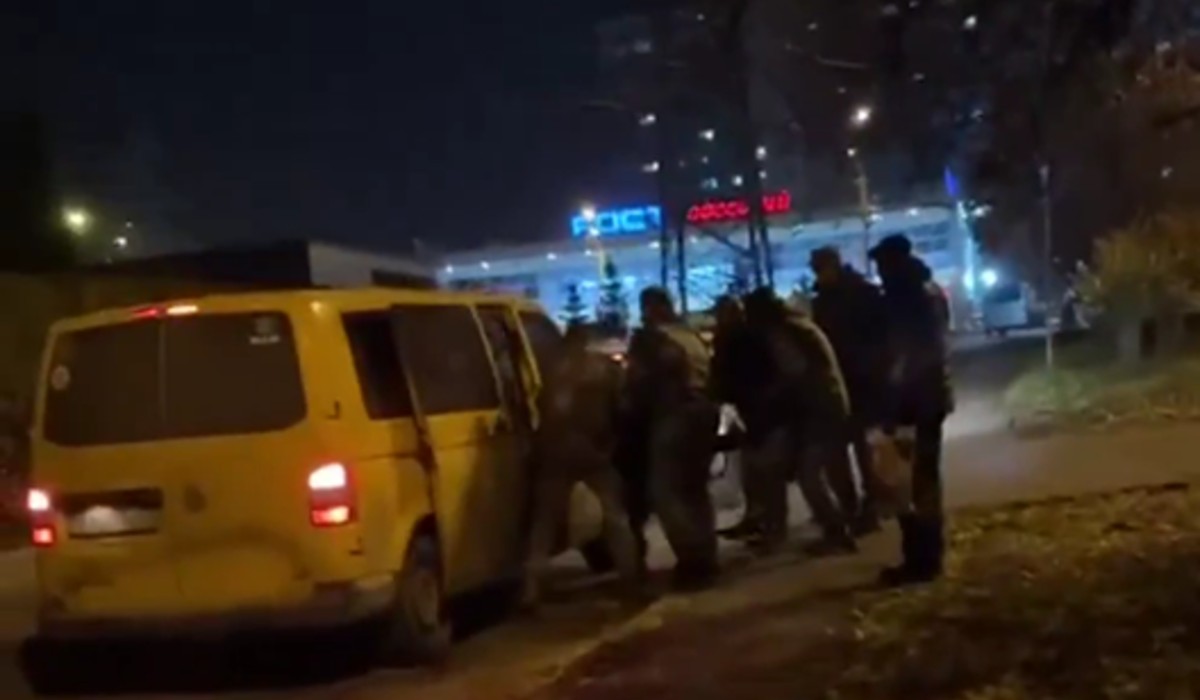
 Forced conscription: another Ukrainian man snatched off the street and bundled into a van. Photo: social media via Bebo TG channel
The Ukraine war has been lost, and needn’t have started or been so prolonged, to such deadly effect, but for the actions of the West, argues Robert Dale
This remembrance Sunday I will be thinking about the war in Ukraine. The generals know it is lost. Field Marshal Lord Richards, Britain’s most senior army officer, said so two weeks ago. It was clear long ago. So why do our leaders keep the fighting going? Why do they insist on feeding thousands more Ukrainians into the mincer? Are they evil or are they stupid? Or are they both?
I will be thinking about the many thousands of Ukrainian soldiers sent to their deaths since the West blocked the peace deal of April 2022. Reliable figures are not to be had, but, by now, it’s likely hundreds of thousands.
I will be thinking about the Ukrainian elites living the high life abroad, the spivs and profiteers raking it in at home.
I will be thinking about the Ukrainian men trying to flee the country and the draft. They are not permitted to leave legally. They drown in the Tisza river and die of exposure in the Carpathian mountains and suffocate packed into lorries.
I will be thinking about the obscene amounts of money poured into the slaughter: £20 billion from Britain, €170 billion from the European Union, $175 billion from the United States.
I will be thinking about the openly fascist formations in the Ukrainian armed forces, numbering several tens of thousands. Funded and armed by the West. Amidst all the talk about fascism these days, the Azov and its ilk are the ones that makes my hair stand on end. There will be blowback.
I won’t be thinking too much about the scary Russians. What concerns me is what my government is doing in my name. The entire discussion about Russia is so detached from reality that I wouldn’t really know where to start. Suffice to say, Russia is no greater a threat to peace than Nato. Arguably less.
Anti-war voices silenced
I’ll also be wondering why the anti-war sentiment that does exist is so invisible. It’s bad enough in Germany, worse in the UK. I can’t remember anything like it. I guess it’s down to the propaganda of the powerful and our own lack of strength and numbers. The more important the issue, the higher the pressure on the information front. When it’s war they give it you with both barrels.
Which brings me to the so-called journalists who have fed us a sewer of lies and half-truths. Have they no shame? The misinformation in politics and the media is so comprehensive that it is simply impossible to have a meaningful discussion about the war on that basis.
Sure, they’ll report any incident that serves to fuel outrage, and give endless coverage to whatever PR stunt the Ukrainian forces and their Western handlers come up with next. Much of the problem lies in the underlying assumption that this is a ‘good war’. Any ‘on-the-ground’ reporting, which generally comes from the safety of Kiev rather than the front lines, is slanted and tailored to fit that narrative.
At the level of detail, it’s journalistic dereliction of duty all round. We are shown next to nothing of the killing and dying in the mud and the bunkers. The war cemeteries stretching as far as the eye can see. The executions of Ukrainian civilians by Ukrainian drone operators. The men snatched off the street and sent to the front. The women who try to defend them, sometimes successfully. The exchanges of corpses, most recently 1,000 Ukrainian for 31 Russian. The S*N newspaper did recently learn about forced conscription, though, when their journalist’s driver was taken away by the recruiters mid-journey.
I will be thinking about how isolating it can be to oppose the madness. How hard it has been to pull any kind of anti-war movement together around the Ukraine misadventure. The lack of pushback spotlights the importance of organisation and structures. Looking across Europe, it seems to me that where action has come about, it has generally been associated with parties and other organisations that have a (little) bit of clout and a collective understanding of the need to stand up and be counted. In Germany, that has been Sahra Wagenknecht and her small left-populist party. Demonstrations of thirty thousand or so once or twice a year, and the moves to introduce conscription are causing grumbling even among some who’ve been ‘supporting’ ‘plucky little Ukraine’.
Virtually nothing in the UK as far as I’ve seen. The difference is not entirely surprising. Let’s just say, the idea that ‘our wars have always been splendidly good, except for a teensy mistake here and there’ gets less traction in Germany. I can’t help wondering about the vague but apparently very deep-seated British attitude that ‘our’ armed forces are fundamentally good. The way it is simply taken for granted that the British military can interfere, intervene and invade anywhere, anytime. I think it tends to be overlooked just how unusual – bizarre – that is in international comparison.
Recently I saw someone with a badge that just said: ‘I am not at war with Ukraine.’ It’s funny, when we think about responding politically to a development like the current war, we tend to think first of demonstrations and meeting with other people. And of course that’s important. But I kinda wish somebody had started handing out those badges three years ago.
An avoidable war
On remembrance Sunday, I will also be thinking about the history, all the points where the West could have avoided this conflict if it had wanted to. To name but the most obvious:
In 1990, during the talks about the Soviet withdrawal from eastern Europe, US Secretary of State James Baker promised Mikhail Gorbachev that Nato would not expand eastward. The memo is public. The promise was broken in 1999, when Nato added Poland, Hungary and the Czech Republic. And again in 2004 with the rest of the former Warsaw Pact. Damn impertinent of those Ruskies, to keep moving their country closer to Nato’s borders.
In 2014, Washington was instrumental in channelling a popular anti-corruption movement in Ukraine into a putsch by extreme nationalist and fascist forces. That led directly to the secession of Donetsk and Luhansk in the Donbass.
In February 2015, the Minsk II Agreement codified a ceasefire between Ukrainian government forces and the Donbass separatists. It was supposed to lead to a broader settlement including special status for the region. Angela Merkel and Francois Holland both later admitted that their participation was a charade, simply buying time to rearm Ukraine. There’s a reason why Russian has its own word for ‘not-agreement-capable’.
In autumn 2021, the Kremlin communicated its security concerns to Washington and proposed comprehensive treaty arrangements. Washington wasn’t interested.
Only weeks after the February 2022 invasion, peace talks were held in Istanbul. A provisional deal was on the table, and the Russian forces pulled back from the outskirts of Kiev as a sign of good faith. Then Boris Johnson, at the time still prime minister, flew to Kiev and all of a sudden the deal was off. Davyd Arakhamiia, a top advisor to Volodymyr Zelensky said in November 2023 that: ‘The war could have ended in the spring of 2022 if Ukraine had agreed to neutrality.’ Former Israeli prime minister Naftali Bennett, who was involved as a mediator, said that the West decided ‘to crush Putin rather than to negotiate’.
Looking at the sequence of events, it is hard to avoid concluding that this war resulted from a catastrophic miscalculation by Western leaders. They apparently believed war with Russia would be a walkover. In 2015, US Senator John McCain called Russia ‘a gas station masquerading as a country’. Instead they have created a military, economic and political debacle for the West in general, especially the European Union.
None of those details really matter, though. Right now, the argument is brutally simple. The war is lost. Even its supporters know that it should stop. The Nato powers have been pulling the strings all along. It’s long past high time they pulled the plug.
Robert Dale lives in the Berlin region, where he has been active in socialist politics since the 1980s.
Before you go
The ongoing genocide in Gaza, Starmer’s austerity and the danger of a resurgent far right demonstrate the urgent need for socialist organisation and ideas. Counterfire has been central to the Palestine revolt and we are committed to building mass, united movements of resistance. Become a member today and join the fightback.
