
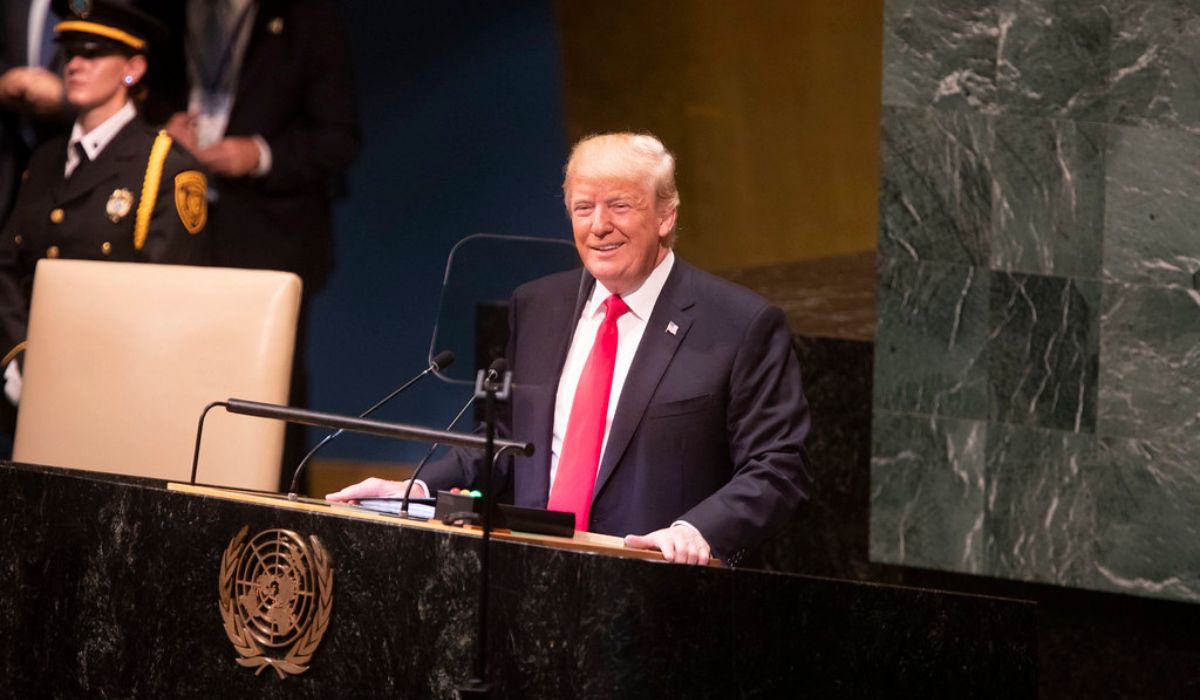
 President Donald J. Trump addresses the 73rd session of the U.N. General Assembly Tuesday, Sept. 25, 2018. Source: Joyce N. Boghosian - Trump White House Archived - Flickr / cropped from original / Public Domain
Trump’s contemptuous speech at the UN underlined how the US believes it no longer needs its legitimation, but the UN is unlikely to refashion itself in response, argues John Clarke
Trump’s speech at the UN General Assembly, on 23 September, was a rambling and bizarre attack on a ‘rules-based world order’ for which his administration has no respect or concern. He is hardly known for subtlety at the best of times, but, on this particular occasion, Trump’s contempt for the UN itself could not have been hammered home more explicitly.
The president used his time at the microphone to denounce and denigrate the efforts of the UN and its member countries to address international problems for which he considers them responsible, insisting all the while that he knew what was best.
Trump draws a line
On the question of immigration, the president, according to CNN, ‘spent much of his time in the General Assembly hall offering criticism of other nation’s immigration policies, accusing the UN of “funding an assault on Western countries” due to insufficient migration controls and warning the fabric of the West was being destroyed.’
Trump warned that: ‘If you don’t stop people that you’ve never seen before, that you have nothing in common with, your country is going to fail.’ He added that: ‘You’re doing it because you want to be nice. You want to be politically correct, and you’re destroying your heritage.’
After this racist diatribe, Trump went on to denounce the UN for its role in addressing the issue of climate change. He told the delegates that the very notion of climate-induced global heating was ‘the greatest con job ever perpetrated on the world.’ He added that: ‘All of these predictions made by the United Nations and many others, often for bad reasons, were wrong.’ He claimed: ‘They were made by stupid people.’
The president moved on to addressing the role of the UN itself, asking: ‘What is the purpose of the United Nations?’ He followed this by claiming dubiously that: ‘I ended seven wars, dealt with the leaders of each and every one of these countries, and never even received a phone call from the United Nations offering to help in finalizing the deal.’
Even as Trump drew a line by openly expressing his contempt to the UN, his administration was prepared to use the fact that the meeting was taking place in New York as a means of excluding international representatives not to its liking.
An article in Politico noted that ahead ‘of the week of meetings in New York, the Trump administration took the rare step of denying visas for aides from a litany of countries over policy disagreements.’ This ‘included all representatives from the Palestinian Authority, including President Mahmoud Abbas.’
In addition to these measures, the ‘U.S. also blocked some officials from Iran and Brazil from attending — the Iranians for alleged terror ties and Brazil’s health minister over a partnership with Cuba to hire Cuban doctors to work in the country’s remote poor regions.’ Finally, and most seriously, the ‘State Department revoked Colombian President Gustavo Petro’s visa to enter the United States over comments he made at a pro-Palestinian protest in New York, signalling that the U.S. may apply visa scrutiny widely for future gatherings.’
Michael Roberts recently captured some of the essential elements of the crisis of relevance that the UN is experiencing in an article marking the eightieth anniversary of the institution. He noted that the ‘demise of the United Nations mirrors the decline of all the international institutions formed by the agreement of the major powers who won the Second World War.’
As Roberts pointed out, however, the notion of a law-governed international order that brought countries together under conditions of equality ‘was always an illusion.’ The UN and other international bodies ‘were really formed to work under the hegemonic leadership of the US, backed by its junior partners in the top capitalist economies.’
In the case of the UN, the kind of direct control that the US was able to assert over bodies like the IMF or the World Bank wasn’t entirely possible, and the ‘interests of US imperialism could not always be approved.’ The Security Council system that was established, however, ensured that initiatives that directly opposed US interests could always be vetoed and that the will of the bulk of the member countries, mainly those in the Global South, could be thwarted. At the same time, the US could, and frequently did, act unilaterally and without UN endorsement.
Changed terrain
Since its inception, the UN has lived a lie in which it has purported to be something akin to an international parliamentary body, while providing cover for the reality of US global domination. Discredited by this deceptive role and, with its power and influence greatly limited, the UN is now being buffeted by the huge shock waves that flow from the America First turn and the mercilessly blunt form it has taken under the second Trump administration.
This greatly changed terrain on which international affairs are now being conducted reflects a decline in US power that has accumulated over a long period. However, the abruptness of the change has been shocking, and there is still nothing remotely approaching a consensus of what can replace the now discarded world order that emerged in the 1940s.
It is not simply that the US is no longer interested in bodies like the UN but that, in abandoning the role of cornerstone of world order, it has gone over to the pursuit of immediate interests without regard for international stability. This, of course, has included the effort to reframe world trade through the application of US protectionism and trade wars.
The imperialist junior partners, who have shared a place at the table with the US, have no clear sense of how to reorientate and survive these altered circumstances. The Canadian prime minister, Mark Carney, for example, has recognised the enormity of what has taken place but, when it comes to a meaningful response, has only blustered. Back in April, Fortune magazine quoted him as asserting defiantly that: ‘President Trump is trying to break us so America can own us. That will never … ever happen. But we also must recognize the reality that our world has fundamentally changed.’
Yet, despite such bold talk, the Carney government is desperately hoping it can appease the Trump administration and cut a reworked trade deal with Washington that doesn’t come at too steep a price. Carney even went so far as to cancel counter tariffs that had been adopted in the face of US measures.
As Trump gratuitously insulted the UN and most of its member countries, the humiliation was endured passively for the most part. As the BBC rather aptly expressed it, over ‘almost an hour, he took aim at his opponents and their ideas, picking them off one by one as he toured the world,’ as he delivered ‘a defence of America and the nation state, an assault on multilateralism and globalism.’
In the face of this, however, while seven ‘years ago, Trump’s audience at the UN laughed at his at times non-factual assertions; this year they listened largely in silence.’ Even so provocative a statement as ‘I am really good at this stuff. Your countries are going to hell’ didn’t lead to any display of indignation.
The measures that the UN could take in this situation are not hard to discern. After two years of genocide in Gaza, in which the US veto on the Security Council has played a huge role in perpetuating it, decision-making power could be shifted to the General Assembly. If the US is systematically going to deny entry to UN delegates it disapproves of, the relocation of meetings in order to prevent this would be entirely in order.
Yet, no such measures can be expected and the emergence of the UN as a genuine expression of the views and objectives of its member countries is out of the question. The changed role of the US has greatly destabilised the imperialist global system, but we can’t expect a meaningful challenge to that system to emerge from the very institutions that were established to legitimise and sustain it.
A human lifetime after it was formed, the UN has been abandoned by the dominant world power that once had use for its services. It may well share the fate of the old League of Nations and disappear, or it may drag on as an empty shell. Either way, the alternative to the grim future that Trump and his cohorts seek to impose won’t be turned back on the floor of the UN but through working-class struggle and global resistance.
Before you go
The ongoing genocide in Gaza, Starmer’s austerity and the danger of a resurgent far right demonstrate the urgent need for socialist organisation and ideas. Counterfire has been central to the Palestine revolt and we are committed to building mass, united movements of resistance. Become a member today and join the fightback.

John Clarke
John Clarke became an organiser with the Ontario Coalition Against Poverty when it was formed in 1990 and has been involved in mobilising poor communities under attack ever since.