
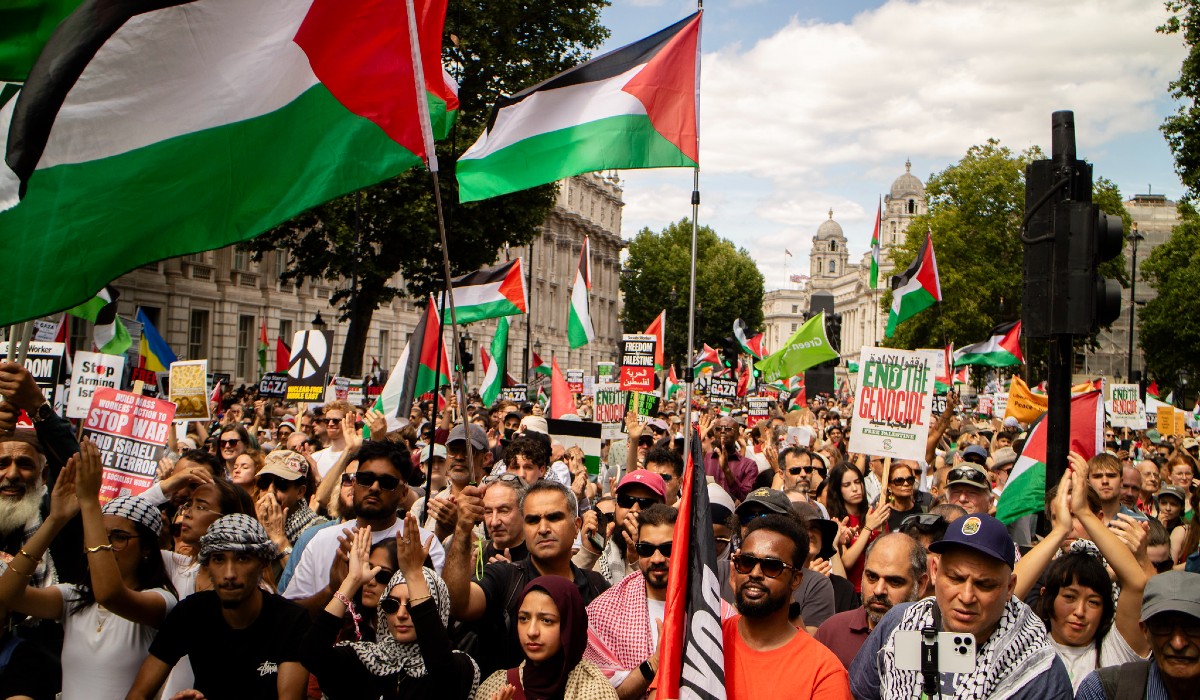
 Palestine national demonstration, 9 August. Photo: Steve Eason / CC BY-NC 2.0
John Rees on the new phase of resistance
As the Israeli government prepares even more extensive and brutal ethnic cleansing in Gaza, a new phase of the Palestinian solidarity struggle has opened in the UK.
The first sign of change came with the declaration of the UK, French, and Canadian governments back in May. That statement marked the beginning of the ideological collapse of the pro-Zionist front in the UK.
Since then, there have been splits in the Board of Deputies, the wholesale desertion of the media from outright defence of Israel, and several subsequent half-hearted and self-serving publicity operations by the government, concluding with the undertaking to recognise a Palestinian state in September.
Of course, as many Palestinian supporters have repeatedly pointed out, much of this is too little, too late, and mere words, although it has produced a highly unusual rupture between the US and UK governments.
But although these developments have a limited effect on the actual plight of the Palestinians, they have had a dramatic impact on the scale of pro-Palestinian sentiment in the UK.
The Palestine movement has always been huge in the UK, and sustained over almost two years now. And it has had previous political victories, from, notably, ending the career of Suella Braverman as Home Secretary in November 2023, to defending the right to protest and the use the slogan ‘from the river to the sea’, and inflicting a humiliating defeat on the far right on the Armistice weekend demonstration.
It has, however, always been a huge social movement battling the headwind of determined establishment opposition which polarised opinion in wider society.
The recent collapse of the establishment position has created the space in which pro-Palestinian sentiment has rolled out across very large swathes of the whole of society, becoming hegemonic at street level.
From the stages at Glastonbury, to the stage of the Royal Opera to the front pages of the Daily Express, the cause of Palestine has become a sort of zeitgeist. The movement and the national demonstrations remain its centre, but the mood has generalised across society and is visible in corners far removed from the organised core of the movement.
The establishment, of course, has not given up. And here we come to the second defining characteristic of the new phase of the struggle: increased state reliance on coercion. As it loses the ideological argument, the state is now relying more heavily on police methods to control opposition.
The use of terrorism legislation against Palestine Action is the most obvious sign of this. The mass arrests of people under legislation clearly never intended for use against a peaceful direct-action group has two aims. One is obvious: to close down protests which have discomfited the arms industry and the UK supporters of Israel. This much is obvious from the lobbying that the former head of the British army, Lord Richard Dannatt, carried out in favour of the ban.
The second aim is less obvious, but at least as important, as the Judge who granted Palestine Action a Judicial Review recognised in his judgement: to encourage the intimidatory impact of the terrorism legislation to bleed over into the main body of the Palestinian solidarity movement.
This is especially true as, quite contrary to Home Secretary Yvette Cooper’s assurances that she is not trying to criminalise the entire Palestine movement, that is exactly what the state is attempting, piecemeal, to do.
Resist the closing vice
The British establishment is a very old and experienced ruling class. It knows how to apply force discriminatingly. It has moved, not without some internal dissent, to proscribe the most easily isolatable element of the movement but it is also squeezing the main body of the movement as well.
The arrest, charging, and delayed trials of the Director of the PSC, the general secretary of CND, and the chair and vice chair of the Stop the War Coalition are a direct attempt to disable a key section of the leadership and to intimidate every activist in the movement.
Moreover the constant application of ever-more restrictive conditions on the national Palestine marches is a direct attempt to reduce their visibility and effectiveness and to introduce a heretofore unimaginable level of state control over the right to protest.
This draconian interference in the protest movement will be given even greater force of law if the new Crime and Policing Bill passes into law.
But, in effect, the Metropolitan Police are behaving as if it is already law. In recent edicts, they have told the organisers of the national demonstrations that although theoretically they are not banned from marching to the Israeli embassy, in practice there is no route from central London that does not pass the vicinity of a synagogue and so no such march is possible.
The effect is to ban marches to the Israeli embassy, the only embassy in the city to which you are de facto unable to march to.
In this new situation two things are very clear.
Firstly, although it is sometimes said that if the movement campaigns over defending its right to protest, it will distract from campaigning over the plight of the Palestinians, in fact the two are mutually dependent. The whole point of the creeping criminalisation of the movement is to make it ineffective as a solidarity movement. Defending our own rights is fundamental to being able to provide meaningful solidarity for Palestinians. This is so blindingly obvious that it should barely need stating.
Secondly, the movement cannot simply exist in the tighter and tighter limits imposed on it by the state.
The 18 January protest for which the leaders of the movement now face trial was actually very effective at challenging the limits imposed on the protest after the police banned it from assembling at the BBC.
The symbolic confrontation of the limits imposed on the demonstration was a highly effective, mass, way of registering political opposition to the police’s plans to control the protest.
Now, more than ever, we need that spirit. Simply marching in a more and more restrictive space is not only counterproductive for the Palestine solidarity movement, it is also destructive of rights on which every protester, campaigner, activist, trade unionist, indeed citizen, depends.
The force of public opinion has never run so strongly in favour of Palestine solidarity, the state cannot be allowed to put the genie back in the bottle.
Before you go
The ongoing genocide in Gaza, Starmer’s austerity and the danger of a resurgent far right demonstrate the urgent need for socialist organisation and ideas. Counterfire has been central to the Palestine revolt and we are committed to building mass, united movements of resistance. Become a member today and join the fightback.

John Rees
John Rees is a writer, broadcaster and activist, and is one of the organisers of the People’s Assembly. His books include ‘The Algebra of Revolution’, ‘Imperialism and Resistance’, ‘Timelines, A Political History of the Modern World’, ‘The People Demand, A Short History of the Arab Revolutions’ (with Joseph Daher), ‘A People’s History of London’ (with Lindsey German) and The Leveller Revolution. He is co-founder of the Stop the War Coalition.