
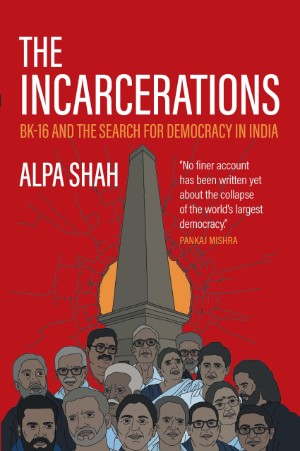
 Alpa Shah, The Incarcerations: BK-16 and the Search for Democracy in India (William Collins 2024), 672pp.
The case of a group of writers and activists unjustly imprisoned in India starkly reveals the exploitative nature of Indian capitalism and its international connections, finds Nandita Lal
Alpa Shah’s The Incarcerations is an investigation into the imprisonment of the BK-16, a group of poets, lawyers, professors, and activists wrongfully incarcerated on the pretext of conspiring against the Indian state. Their stories unravel a vast web of transnational surveillance (including the Israeli spyware Pegasus), neoliberal repression through Financial Action Task Force mandates, the rise of Modi’s crony capitalism epitomised by the Adani empire, and ‘internal’ colonialism in Kashmir.
Some of the evidence used for these incarcerations is downright comical, as the book reveals a letter detailing plans to assassinate Modi ‘Rajiv Gandhi-style’. Shah observes, ‘The Bhima Koregaon case was never about evidence—it was about punishing those who dared to unite India’s oppressed: 200 million Dalits, 100 million Adivasis, and 200 million Muslims under a common vision of justice’.
Nowhere is this clearer than in her analysis of Gautam Adani’s empire. Fuelled by Modi’s brand of crony capitalism, Adani has devastated India’s ecological and social fabric. After resistance to his coal ventures in Australia, he turned to India’s biodiverse forests such as Hasdeo Aranya, where ‘841 hectares of ancient trees and elephant corridors [were] sacrificed for profit’. Shah notes that Adani’s wealth surged 1,600% after Modi took power between 2014 and 2022, while his private jets shuttled the Prime Minister across the globe to ink deals.
One of the BK-16, Sudha Bharadwaj, saw that dispossession of the indigenous (Adivasis) for mining was central to capitalist accumulation. Shah praises her as a ‘people’s lawyer’ who stood with those most affected by extractive capitalism. She challenged multinational giants like Adani, Tata, Essar, and others in court.
Bharadwaj was not the only one in this regard. As Shah notes, others like Father Stan Swamy were also calling out the deep collusion between corporate greed and state violence, in particular, standing ‘in the way of Adani’s expansionist project’. Swamy was an octogenarian when he was picked up by India’s National Investigation Agency. He had spent his entire Jesuit life working alongside the Adivasis of Jharkhand in their land-rights struggles. He was transported without notice across thousands of miles to Taloja jail in Mumbai during the Covid pandemic. He was then denied a sipper cup for fifty days which he needed as he had Parkison’s disease. Swamy’s custodial death is an institutional murder.
The hypocrisy is glaring: while bulldozing Adivasi lands, Adani Green Energy sponsored a climate exhibit at London’s Science Museum. ‘A “green” facade for a coal baron’, Shah writes, as global protests exposed this hypocrisy.
State violence and international architecture
This pattern of criminalising resistance extends into Kashmir. Shah spotlights Gautam Navlakha, another BK-16 accused, whose decades-long documentation of Kashmir’s ‘internal colonialism’ made him a state target. Co-author of the 2012 report Alleged Perpetrators, which named over 500 Indian security officials implicated in torture and extrajudicial killings, Navlakha challenged state violence using facts sourced from official records.
Among the BK-16 were also members of Kabir Kala Manch (KKM). KKM was formed by working-class youth from low-income Dalit and Bahujan caste communities in Pune as a response to the 2002 pogrom in Gujarat. They use songs and street plays to develop caste and class solidarity.
Many of the BK-16 were active critics of the UAPA, the very legislation used to incarcerate them. For example, Navlakha wrote analyses of its dangers. Surendra Gadling, a human-rights lawyer also among the sixteen accused, had been picking apart the flimsy case built by the state to incarcerate the late Professor GN Saibaba under UAPA. Saibaba was a polio-affected wheelchair-bound academic and vocal critic of the state’s systematic exclusion of Adivasis in the name of development. Shah dryly notes, ‘Not ironic at all. Just the system working as designed’.
This crackdown isn’t isolated. Under pressure to meet FATF’s post-9/11 counterterrorism mandates and attract foreign capital, India expanded the UAPA in 2012, turning it into a catch-all tool for criminalising dissent. Shah powerfully connects these dots, showing how neocolonial frameworks, like IMF-linked institutions, enable authoritarianism under the guise of financial security to power extraction in the Global South.
The use of Israeli spyware (Pegasus) and FBI-verified malware in the investigation underscores the transnational architecture of surveillance. The book shows how Modi’s 2017 Israel visit coincided with Pegasus spyware attacks on Indian activists, including BK-16 accused Rona Wilson. The Indian state’s attacks on Amnesty International (which exposed the hacking) reveal a grim truth: in Modi’s India, surveillance is a pervasive tool of censorship.
While the BK-16 arrests began in 2018, as of 2025, six of the BK-16, including Gadling, remain in jail without conviction, caught in indefinite pre-trial limbo. Wilson and Bharadwaj have been released on bail after years of incarceration. Navlakha remains under house arrest. Their trials drag on, a testament to a system where the process becomes punishment.
In the asymmetric struggles that characterise our late capitalist moment, storytelling might just be the closest to a level playing field that still exists. Shah leverages this terrain to great effect, weaving intimate personal narratives with a sweeping structural critique.
One of the most moving threads is the account of Sagar Gonsalves, son of Vernon Gonsalves, now on bail, a writer, trade unionist, and one of the BK-16, whose incarceration captures the emotional toll of repression. Even while battling dengue and pneumonia in prison, Vernon wrote letters to Sagar that turned pain into resistance. ‘I saw you walking with everyone … with a spring in your step’, he wrote during a rare court visit, transforming his son’s anxiety about going to the UK to study into a gesture of hope and purpose. From these tender glimpses, Shah expands her lens to show how state repression reaches far beyond prison walls.
Before you go
The ongoing genocide in Gaza, Starmer’s austerity and the danger of a resurgent far right demonstrate the urgent need for socialist organisation and ideas. Counterfire has been central to the Palestine revolt and we are committed to building mass, united movements of resistance. Become a member today and join the fightback.
