
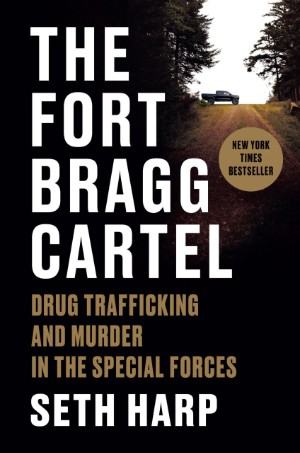
 Seth Harp, The Fort Bragg Cartel: Drug Trafficking and Murder in the Special Forces (Penguin Viking 2025), 368pp.
Seth Harp’s investigations into murders and drug dealing at a US army base leads to a wider consideration of the sinister and murderous role of US special forces, finds Kevin Crane
Donald Trump and Pete Hegseth’s absurd all-hands meeting of the American military leadership in Virginia was a horrific display of deep political reaction, but it was also a massive revelation of ignorance. Trump looked visibly disappointed that the assembled generals and admirals weren’t whooping at his speeches like the 6 January rioters, which was a deeply stupid thing for him to expect.
What Trump and Hegseth likely also demonstrated through all their ranting about the armed forces having ‘gone woke’ and needing to return to ‘the highest male [sic] standards’, was a very distorted view of the real conditions inside America’s war machine. Most Americans, in fact, only have a very partial, and partisan, grasp of what their military really does, as whole structures of it are so secret that only a very small number of senior figures have a complete picture. This in-the-know group certainly excludes almost all elected politicians, and most of the generals and admirals stuck in that museum auditorium will have been fully aware that they were being given a lecture by a pair of loudmouths unaware of what they were talking about, and who famously never bother to read the briefings that the military actually does give them.
If even the inhabitants of the American Congress can’t see the secrets of the most powerful armed forces in human history, is there any way that ordinary people could? In The Fort Bragg Cartel, journalist Seth Harp, himself a former US soldier and Iraq-war veteran, sets out to prove that there are ways to scrutinise what actually goes on behind barracks walls. Unfortunately, to get there you have to be prepared to rummage through the wreckage left by much shocking criminality and harrowing tragedy, the causes of which trace right back to the dark heart of twenty-first-century US imperial strategy.
Lives defined by killing
The inciting incident of this book’s central story occurred in December 2020. It was the murder of two already-disgraced veterans: one discharged from the army for corruption, the other confined to desk duty as a result of his own deadly shooting of another solider. Both men were found, shot dead, next to a gloomy artificial reservoir on the extended grounds of Fort Bragg: the home of the US army’s special forces. The one grisly discovery quite naturally drew Seth Harp’s attention to the others that preceded them and rounded off a year in which 55 suspicious deaths were associated with the Fort. So, he began on a journey trying to disentangle a mess of crime and madness that only seemed to get more confusing and mysterious the further he investigated.
The sheer volume of stories of woe emerging from Fort Bragg is dizzying in itself. Some of the horrific events are utterly bizarre and feel like plot points from some sort of overcooked psychological horror film. One such incident involves a young soldier who disappeared off base, only for his severed head to wash up on a beach. Another concerned a young man from the fort who plummeted into a suburban garden; somehow ejected from an unknown plane on an unknown flight without a parachute. Most of the crimes, though, are simply bleak: murders over feuds, murders of wives (amongst every other sort of violence against women), regular suicides and a lot of deaths that go unexplained entirely. Three common themes link everything: drugs, trauma and the eagerness of the authorities to conceal crime rather than prevent or punish it.
The path through the wall of institutional silence went through talking with the many still-living people, mostly civilians or people who’ve left the forces, who have been affected by the insanity emanating from the fort. Accounts come from abused ex-wives, grieving mothers and children, frustrated prosecutors and a few incarcerated co-conspirators. By listening to their stories, the author was able to piece together the horrible puzzle of what was going on.
The war you see by day, and the war you don’t by night
The intense corruption at Fort Bragg is a direct and consequential result of its intense secrecy. That secrecy is there to protect the US special forces from any sort of democratic or legal oversight. What this book exposes, in some cases for the first time, is just how divergent the real nature of these monstrous fighting machines is from the image that is presented in sanctioned, establishment journalism and glossy Hollywood fiction.
America’s special forces, Harp writes, have undergone a process of mutation since the Vietnam war, one that accelerated after turn of the millenium. It was once the case that special forces were simply a smaller, more elite wing of the army and marines. They were focused on fighting in war behind the established front line between the Americans and their enemies. A series of restructures from the 1980s onwards caused that to change.
Within the special forces, there were even more specialised units established, and this process was the repeated to create a Russian-doll effect of a military-within-the-military. The initial driving force behind this was a combination of the strategic backfoot that America found itself on after defeat in Vietnam – it being difficult to do ‘behind-the-lines’ operations if there’s no actual frontline to begin with – along with a crisis of credibility that was affecting the CIA in the 1980s that saw it cede many of its functions to the military. The line between solider and spy was deliberately blurred with the creation of units like Delta Force, that were created to be more elite even than the already mythologised Green Berets and Navy Seals.
In 2001, the development began to hasten as George W Bush’s ‘Global War on Terror’ (GWOT) saw the American state pump far more resources into its military and give it far more leeway to operate in any ways that it liked. Special forces ‘operators’ were on the ground in Afghanistan straight away, utilising their long-standing relationships with warlords and heroine traffickers to sweep the Taliban out of power. The resulting ‘Islamic Republic’ that America put in charge was instantly the world’s foremost example of a so-called ‘narcostate’, as virtually all economic activity was brought to a halt in the country other than the growing of poppies to export as opiates.
The collapsed social and political infrastructure of Afghanistan created a playground for contracting and consulting companies to get lucrative jobs supposedly reconstructing the country. Harp argues that the real reason America’s war in Afghanistan lumbered on for twenty years, its aims and strategy long since forgotten, is that between drug profits and cash for supposed humanitarian work, it was just too profitable for too many interests in America to let the thing end. In any case, while this was not the origin of the US using illicit drug money as an active part of its dirty-war strategy, it was a huge expansion of that policy. It was the direct way that a lot of US military personnel would become both heroin users and heroin dealers.
It was to be in Iraq, however, that the operators developed the methods and tactics that have become standard for them. Although the Saddam Husain government fell rapidly after the 2003 invasion, Iraqis did not quietly acquiesce to Western occupation. Resistance networks formed rapidly, mainly organised by former Iraqi army officers whom the Americans had idiotically purged out of all levels of the state. US and British troops found the determination and clever guerilla tactics of the resistance much too hard to fight by conventional means. So, the special forces devised a new type of warfare.
Regular soldiers continued to parade in full uniform by day, making a great public show of following robust procedures and winning the approval of the various embedded journalists. These reporters would then write effusively about how committed the modern army was to human rights and the rule of law, supporting US propaganda. By night, however, operators looking more like the Hells Angels than recognisable troops would emerge from their secret bases. Harp recalls that as a normal soldier, he had been mostly obvious to this at the time.
These desperados would descend on the homes of suspected resistance fighters, kill all and any men found within, and then rifle through the house searching for papers and electronic devices for the identities and locations of their next targets. Whoever was unlucky enough to implicated would likely then be attacked that very night, and then their home similarly raided to see who the squad would move on to next. Operators repeated this process of daisy-chained assassination raids night after night for months on end, working in staggered deployments. This became the new normal of a US military occupation and once the Taliban had reorganised back in Afghanistan, the exact same operations were carried out there.
The end of the Bush era did not see these death-squad tactics curtailed; in fact, Barack Obama was very enthusiastic about them. When he came into office in 2008, he made a sop to anti-war sentiment amongst his voting base by reducing the visibility of the war-by-day. Deals were cut with various factions in Iraq (prominently including organised crime in the country) to reduce regular American troop numbers, but the special forces continued to do their grisly work.
Obama saw the special forces as a vital component of his ‘smart-war’ concept. There’s been some pretty interesting writing over the years about the way he used new technology, significantly drone warfare, to make military aggression look much more politically and legally untroubling to the Western public, but I think Harp makes a reasonable case that the use of secretive boots on the ground was just as important to his vision. Obama was also the president, much more than Bush, responsible for pushing the ‘global’ aspect of GWOT. He quietly enabled American special forces to move into basically any country of America’s choosing, regardless that the US had never been in any official state of war with those countries. This obviously includes countries the West very openly devastated, like Syria and Libya, but also some of which you’d barely even think. For example, Tajikistan was where Delta Force was widely active for no publicly disclosed reason. We basically only know that they were there to do their one job: killing people as efficiently as possible.
We fought the war
The special forces are a sinister world, populated by people – mostly men – who inevitably have themselves become sinister. The extreme physical and psychological demands of their work inflict massive damage to the operators’ minds and bodies for which drugs of all kinds are the only available remedy. They abuse steroids to meet fitness requirements, they abuse sedatives to cope with annihilated sleep cycles, and they abuse stimulants and psychedelics to distract themselves from the reality of a job that consists of murdering people to order.
The leadership of the forces sees all this simply as a necessary evil and thus facilitates it. Corruption is built in to how these structures function, with embezzlement and defrauding of public funds being a day-to-day norm. The integration of drugs into their relationship with their shadowy allies makes smuggling almost as institutionalised, and many operators have extensive sidelines dealing drugs into the USA and dealing weapons out of it. It’s no exaggeration to say that the special forces are the American state committing crimes against itself and the whole of the rest of the world.
Next year, it will be a quarter of a century since Bush began the GWOT. Obviously, many of us were active in protesting against the invasions of Afghanistan and Iraq, and for my generation of activists that was essentially our formative experience of politics. There’s a certain ironic sadness that we were completely right about what we said about the war: that it would lead to more terrorism, that it would spread tyranny and not democracy, that it would lead to greater repression at home, and it could be seen as somewhat exhausting that we have to refight some of the same ideological battles. Even the supposedly ‘radical’ Green Party, for instance, has actually grown less critical of the military-industrial complex. Its former leader, Carla Denyer MP, regularly posts on social media about the necessity of Britain maintaining its alliances with American-led Nato. She, and people like her, are able to do this by maintaining the fantasy that this alliance is purely the military machine that America shows people by day. The clean-cut, normal armies that march before the world’s TV cameras.
While it would be possible to read The Fort Bragg Cartel as a particularly scandalous piece of true-crime literature, it is both more useful and truer to the author’s intent to see it as a presentation of evidence of the gory truth about the US military. At the heart of the empire’s military might is a sprawling and deadly criminal enterprise. And that is what being an ally to American imperialism attaches you to.
Before you go
The ongoing genocide in Gaza, Starmer’s austerity and the danger of a resurgent far right demonstrate the urgent need for socialist organisation and ideas. Counterfire has been central to the Palestine revolt and we are committed to building mass, united movements of resistance. Become a member today and join the fightback.
