
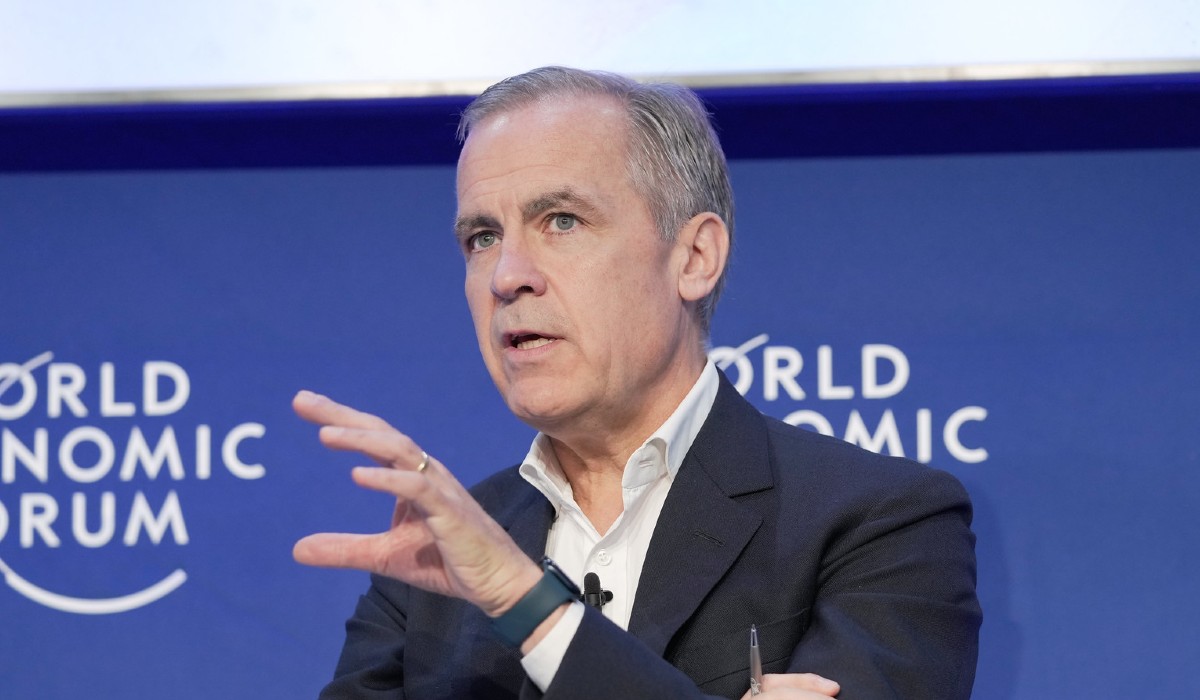
 Mark Carney. Photo: World Economic Forum / Valeriano di Domenico / CC BY-NC-ND 2.0
The Canadian PM’s response to Trump’s tariffs is austerity and environmental destruction that puts Indigenous communities on the frontline of resistance, explains John Clarke
One of the key elements of the response of Canada’s ruling establishment to the US protectionist turn and the impact of Trump’s tariffs has been a drive to unleash destructive fossil-fuel projects and mining operations. This is linked to a broader effort to increase Canadian capitalism’s international ‘competitiveness’ and to diversify export markets in order to lessen reliance on trade with the US.
This environmentally destructive course, undertaken even as climate-induced wildfires burn out of control across the country, puts the federal and provincial governments on a collision with Indigenous communities on whose land these projects will be imposed. Sharp confrontations on this front are all but inevitable and the first indications of this have already emerged.
Indigenous protest camp
On 26 June, the Aboriginal People’s Television Network reported that members of Attawapiskat First Nation and Neskantaga First Nation, two Indigenous communities in northern Ontario, are establishing an encampment near the site of a proposed bridge over the Attawapiskat River that would be central to ‘Ring of Fire’ mining development in the area.
One of those involved in this act of resistance, Jeronimo Kataquapit, stated that this ‘is our home. This is our own territory, not just Attawapiskat’s, but every nation in the area … we are going to get there to stand with Neskantaga for all First Nations.’ Chief Gary Quisess of Neskantaga FN added that: ‘our message is simple: no one will cross the Attawapiskat River without our free, prior and informed consent.’
Quisess also pointed to the deep-seated grievances of the Indigenous communities that are now facing intensified pressure from resource-extraction operations. He noted that Neskantaga FN has no supply of clean drinking water and it ‘holds a notorious record — it has been living under a boil-water advisory for 30 years.’ As he put it, ‘We live in a third world’.
The encampment by the Attawapiskat River will place great emphasis on challenging two pieces of legislation. At the federal level, it confronts a particularly dangerous initiative, Bill C-5, ‘the Building Canada Act’. This legislation, as the Ecology Action Centre explains, ‘would give the Government of Canada the power to bypass crucial checks and balances contained in the Impact Assessment Act (Bill-69) for projects deemed to be “nation-building projects”.’
Bill C-5 ‘could fast-track risky energy and resource extraction infrastructure, undermine Canada’s duty to consult with First Nations and give government the power to avoid necessary impact assessments for potentially harmful projects.’ Moreover, the Centre argues, ‘with devastating wildfires, biodiversity loss and more frequent and severe storms already at our doorstep, we simply cannot afford the fast-tracking of environmentally disastrous, short-sighted projects.’
The Carney government leaves no room for doubt as to the destructive course it is pursuing and the threat that this poses to the environment. It proclaims that it ‘is in the interests of Canada’s economy, sovereignty and security to urgently advance projects that foster the development of economic and trade corridors, and enhance the development of Canada’s natural resources, as well as its energy production and infrastructure.’
In addition to the federal legislation, the Indigenous protest camp is confronting what Environmental Defence refers to as ‘the Ontario government’s extreme and anti-democratic Bill 5.’ Using the powers that this legislation provides, the Conservative provincial premier, Doug Ford, has made clear that he ‘plans to declare the Ring of Fire area in northern Ontario as the first “Special Economic Zone,” where companies will be allowed to violate any and all provincial laws that his cabinet chooses in order to push through mining projects.’
With the Carney Liberals in Ottawa leading the pack, a veritable political consensus has emerged among provincial governments and a reckless drive to generate ‘resource extraction infrastructure’ is underway across the country. Global News reports that, in British Columbia, where the social-democratic NDP forms the government, ‘First Nations leaders are calling on Premier David Eby to immediately “kill” two pieces of legislation that would fast-track projects in response to U.S. government tariffs.’
With considerable justification, ‘the Union of British Columbia Indian Chiefs says the government is asking them to trust that it won’t misuse the powers the bills provide, but it’s unclear what the trust would be based on because it failed to adequately consult First Nations on the two bills.’
CBC News reports that, in Manitoba, NDP premier Wab Kinew has ‘sent a letter to Prime Minister Mark Carney to pitch five major resource projects in the province that could be fast-tracked.’ The report informs us that at ‘the top of Kinew’s list was a project he called the “One Canada Trade Corridor,” which would create a potential hub for critical minerals and fossil fuel exports through northern Manitoba’s Port of Churchill to diversify Canada’s trade relationships.’
Collision course
Indigenous resistance is an explosive factor in the political life of Canada, as might be expected within a state that was established as an exercise in colonial dispossession. The present drive to extract resources from Indigenous land or to drive pipelines or transportation routes through it, puts Canadian governments on a collision course with Indigenous communities all across the country.
In 2020, a police raid on an encampment set up by Wet’suwet’en land defenders challenging a major pipeline development sparked a massive wave of Indigenous-led resistance across Canada, that involved the blockading of ports and railway lines. It was massively economically disruptive and it generated a political crisis of major significance.
I wrote for Counterfire at the time that the pipeline project that sparked the confrontation was ‘the harbinger of much more to come and the resistance of Indigenous people and their allies poses a threat to all their plans.’ I could not have known at the time just how true that prediction would prove to be.
Under the impact of Trump’s trade war, oil and gas production and major mining projects have become a central element of a strategy designed to stabilise Canadian capitalism and preserve its profitability. The events of 2020 may well be only a prelude to a far greater confrontation, as Canadian governments advance these destructive projects in complete disregard for Indigenous rights and sovereignty.
It must also be stressed that, in addition to an assault on the environment and an all-out attack on Indigenous communities, Carney’s pursuit of the ‘national interest’ involves a series of other initiatives that constitute a class-war response to the trade crisis.
In an article I wrote for Canadian Dimension on 17 June, I argued that ‘Carney has the background and experience to advance a ruthless political agenda in the present unstable context.’ I looked at the rampant measures of deregulation, the assault on immigrants, the drive to increase military spending massively and the greatly intensified austerity agenda that he is now beginning to unleash.
Whether the Carney Liberals reach an accommodation with the Trump administration and pay a price to avert trade war or whether they are forced to take sustained retaliatory measures, while seeking to secure new export markets, the costs will be imposed on the working class. This will undoubtedly spark resistance from workers and communities under attack.
At this point, the focus on recklessly expanding the scale of extractive projects is creating a situation where Indigenous resistance will be the flashpoint in a wider struggle that can and must be unleashed on a massive scale. Vigorous solidarity actions must be taken up as Indigenous communities defend their land and their rights in the face of encroachment by fossil-fuel and mining interests. Carney’s class-war agenda must be challenged and defeated.
Before you go
The ongoing genocide in Gaza, Starmer’s austerity and the danger of a resurgent far right demonstrate the urgent need for socialist organisation and ideas. Counterfire has been central to the Palestine revolt and we are committed to building mass, united movements of resistance. Become a member today and join the fightback.

John Clarke
John Clarke became an organiser with the Ontario Coalition Against Poverty when it was formed in 1990 and has been involved in mobilising poor communities under attack ever since.