
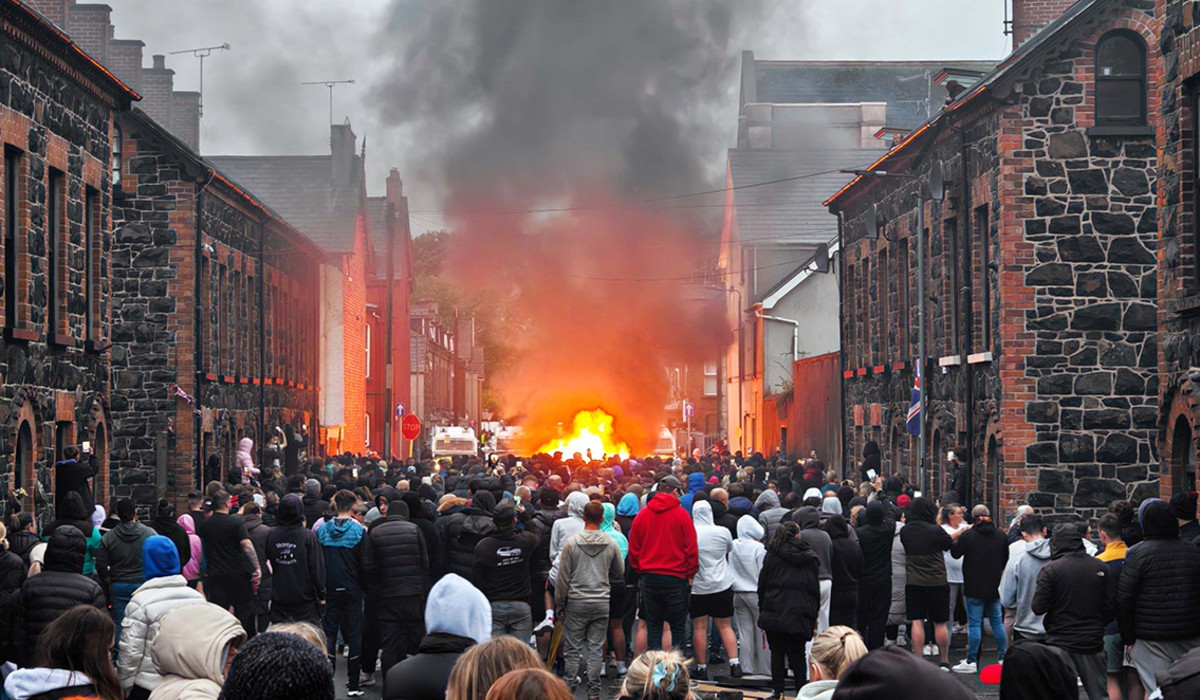
 Ballymena riots. Photo: Pacemaker / Fair Use
Northern Ireland needs more anti-racist organising, not meaningless platitudes from the mainstream political parties, argues Chris Bambery as he dissects the outburst of racist violence in Ballymena
Northern Ireland has witnessed, as I write, two nights of racist rioting.
Disturbances erupted in Ballymena on Monday night – when 15 police officers were injured – after a vigil for a teenage girl allegedly sexually assaulted by two 14-year-old boys. The boys had appeared in court earlier that day charged with attempted rape, where a Romanian interpreter read them the charges.
The riot followed a protest by hundreds of people in the Clonavon Terrace part of the town, which was the area in which the serious sexual assault on a girl is alleged to have occurred over the weekend.
Police said the unrest turned into racially motivated attacks on foreigners that left families cowering in their homes as mobs broke windows and tried to set fire to curtains. Police fired plastic baton rounds and used water cannon to try to disperse the crowds on Tuesday.
One house was burned out. The homes of people from the Roma Community were targeted. In one image, a mural of King William of Orange stares down at the rioters.
On Tuesday night, smaller disturbances broke out in Lisburn, Coleraine, Newtownabbey, Carrickfergus and Belfast.
Jim Allister, the MP for North Antrim (which contains Ballymena), representing the hardline Traditional Unionist Voice party, claimed the “very distressing” scenes were a product of unhappiness at “significant demographic change in the area” caused by “unfettered immigration.”
Allister claimed that there was “growing local concern about unchecked immigration into the town.”
Those words will only lay the basis for future racist violence.
Many of the migrants, from countries like Romania or the Philippines are Catholic, adding extra sectarian venom to the racist rioting.
In Ballymena, Union flags and signs saying residents are British have been appearing in windows.
A Bulgarian mother of two, Mika Kolev, told BBC News Northern Ireland she was leaving Ballymena.
On Tuesday night, rioters broke into her house and ransacked it. “We don’t have anything inside – the TV, sofa, table, everything we have [is destroyed],” she said.
Her family had left the house before the incident – fearing for their safety – and watched live streams of disorder in the area on TikTok.
“We have been here for 10 years and we have worked and paid rent for 10 years, gone to school normally, we never make a problem.”
Keven Rous works for Wrightbus, and has lived in the town with his wife and young children for two years. The exterior of his property was left burnt with a car completely destroyed. Speaking to the Belfast Telegraph yesterday, he said: “I was on night shift last night, and I got a call from my wife. I went home because she said there was a fire… My two kids at that time were asleep and they all rushed outside. Someone had thrown a bottle of kerosene. The policeman said he saw two bottles there that had already been shattered.”
Northern Ireland saw racism-fuelled disorder in August last year after similar riots in English towns and cities triggered by the fatal stabbing of three young girls in Southport, northwest England. Businesses, homes and people have been targeted by anti-immigrant protesters across Belfast. A petrol bomb was thrown at a mosque in a town 10 miles from Belfast. The attack in Newtownards in County Down was described by police as racially motivated.
Last summer also saw a loyalist gang target Catholic and African residents in a spate of sectarian and racist attacks in Antrim Town that forced at least one family to flee. A campaign of paint bombs, smashed windows, graffiti and threatening posters took place in the Craighill area.
The posters declared “Attention landlords, NIHE [Northern Ireland Housing Executive], housing associations, we have had enough of undesirables and immigrants being placed in our community,” said one poster, adding “the time has come for locals only. No multiculturalism, no sex offenders. Action will be taken.”
Paint bombs were thrown at the homes of two Catholic families, including a bungalow adapted for a nine-year-old boy, Jessy Clark, who uses a wheelchair because of spina bifida and other conditions.
This occurred at the height of the Orange Order’s marching season with Union Jacks, unionist and loyalist symbols across areas like Craighill.
Ballymena is in the heartland of unionism in Northern Ireland. But there has been a noticeable growth among younger people in support for the various loyalist paramilitary organisations (which, unlike the Provisional IRA, still exist and operate).
In part, this reflects the alienation in traditional Unionist communities from the various Unionist political parties and even the Orange Order, with a growing feeling that the Six-County state is on the road to a united Ireland. The emergence of Sinn Féin as the biggest party in Northern Ireland, with Michelle O’Neill as First Minister, underlines this.
Unionists and Loyalists are well aware that the identity they espouse is a British one, loyal to the crown; Northern Ireland Unionists never tried to create a Northern Irish nationalism. But their version of Britishness is alien to the vast majority of those living in modern Britain.
Central to this “Britishness” is sectarianism, or more accurately anti-Irish racism. That can seamlessly shift over into anti-migrant or Islamophobia.
Add that all into the feeling, common to those areas of England which saw last August’s racist riots, that these communities have been left behind, and you have an explosive mix.
Political parties across Northern Ireland to denounce these latest riots but there statements contain a strong smack of middle class superiority appealing for all good people to stand together against these low lives. That is not going to undercut racism in places like Ballymena.
Last summer saw significant anti-racist protests in Northern Ireland in response to racist attacks. That is needed once more.
Chris Bambery is the author of of ‘A Clear Divide’ A History of Sectarianism in Scotland, to be published by Tippermuir Press later this summer
Before you go
The ongoing genocide in Gaza, Starmer’s austerity and the danger of a resurgent far right demonstrate the urgent need for socialist organisation and ideas. Counterfire has been central to the Palestine revolt and we are committed to building mass, united movements of resistance. Become a member today and join the fightback.

Chris Bambery
Chris Bambery is an author, political activist and commentator, and a supporter of Rise, the radical left wing coalition in Scotland. His books include A People's History of Scotland and The Second World War: A Marxist Analysis.