
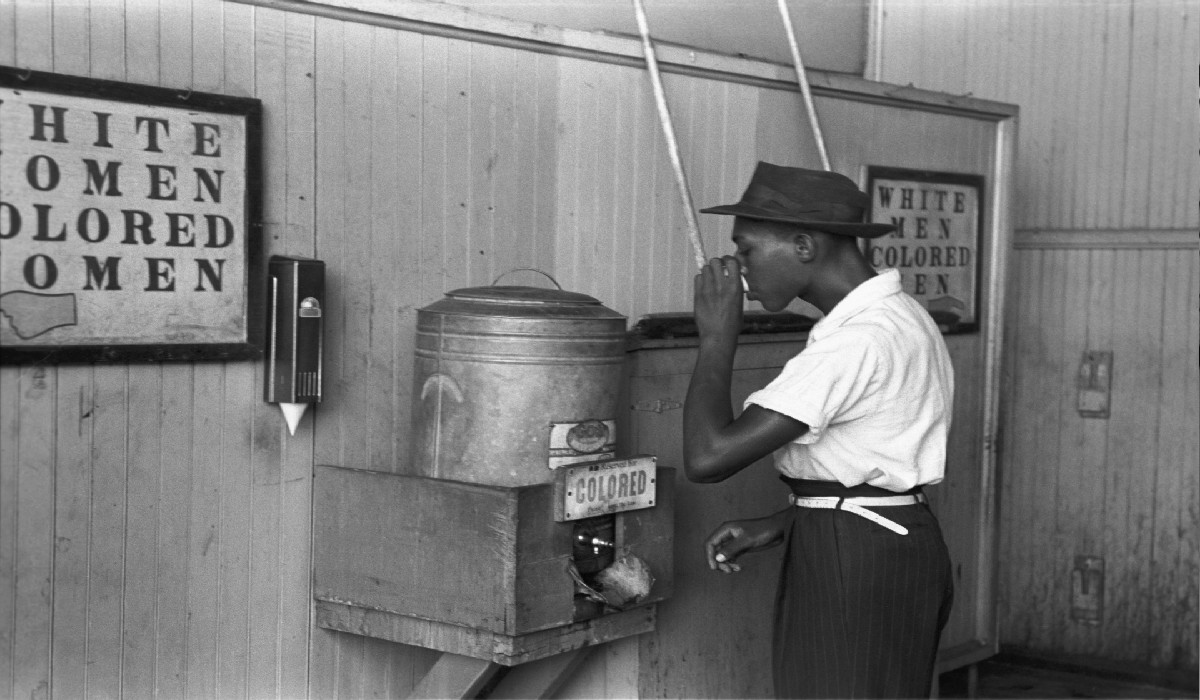
 Image of an African-American man drinking from a segregated water fountain. Photo: Russell Lee / Wikimedia Commons / Public Domain.
As the Labour leadership tries to shut down debate over the nature of racism, Kevin Ovenden looks at how ruling classes have long sought absolve themselves from blame
The Canadian state in the 1970s faced two insurgencies that seriously threatened it. One was the militant fight by First Nations people for land rights and restitution that would, if fulfilled, threaten the violently exploitative and extractive capitalist heart of the Canadian system. The second was an insurgent fight for independence in Quebec. It too posed a challenge to the Canadian capitalist class as a whole and its federal state.
Along with methods of violent repression, the Canadian political system responded with a politics of incorporation: a version of what would be called multiculturalism. It was not the kind of thing that most people mean when they say ‘multiculturalism’. They mean by that usually something positive referring to a racially, ethnically mixed reality in which people by and large get along and varied cultures blend and comingle, finding great commonalities despite superficial difference. A ‘lived multiculturalism’ of the cosmopolitan city.
The Canadian state’s multiculturalism was instead a deliberate intervention aimed at diluting the incendiary political struggles by First Nations people and French-speaking Quebec into a melange of all sorts of issues to do with ‘different cultures’, sometimes communal tensions and sites of prejudice. The solution was a politics of recognition and civility. A changed culture but a recalcitrant state, repressive apparatus and capitalist order.
So Canadians ‘recognised’ the ‘heritage’ of First Nations people and of the Quebecois. We didn’t do anything much by way of restitution and justice. And we extended the politics of recognition to include all sorts of groups. The Greek-Canadian (and the prejudices they had faced, which were real), the Italian-Canadian, the Irish-Canadian (looked down on historically by the Anglo-Scottish elite), the Asian-Canadian, the Chinese-Canadian and so on, until you had the Scottish-Canadian, or the Anglo-Canadian or German-Canadian who had faced no ethnic disadvantage whatsoever, but were equally entitled to ‘cultural recognition’.
In this way – and despite the fact that, for example, East Asians did face racialised prejudice – the actual core struggles that threatened the integrity of the Canadian capitalist state (land rights and Quebec independence) were diluted into a swirl of hyphenated identities and polite recognition of historic prejudices or ethnic particularities with a verbal commitment to embrace diversity.
This was as if the centuries of settler-colonial violence carrying right through to the enormous abuses of the residential-school system against First Nations Canada and policing today were of the same order as disparaging and bullying remarks to someone on account of their Greek name. As if the incendiary issue of national independence in Quebec was really about having parity of esteem for ‘French-Canadians’.
In this way, these questions were depoliticised. The state was taken out, except in so far as some rotten apples held ideas that were taken to be the true source of the problem and which the extractive capitalist elites maintained were the preserve of ignorant ordinary people, in all their hyphenations.
So racism was not an apparatus of racial and national oppression, but rather a sea of popular layers who needed to be guided away from their prejudices. Like an enlightened imperial governor dealing with savages.
Racism relativised
This relativisation and depoliticisation came to Britain in the 1980s. In part, it was a response to the insurgent struggles against racism and fascism, and for black liberation that ran into the Thatcher period with its intensification of the war in Ireland and the class war at home.
I recall how Tory, and some Labour, politicians seized on the crisis in India over the storming of the Golden Temple and then the assassination of Indira Gandhi, and the spillover into Indian communities in Britain. These events enabled them to claim that Hindus hate Sikhs and Sikhs hate Hindus. Racism was transmuted into a problem of communalism. There wasn’t really a question of an overriding racism in Britain, you see. Look at the Hindu and Sikh youths fighting in Southall.
If anything, the poor British state is left holding the ring (as we tried to do in India but we get blamed for it). There may be some prejudice among some police officers or some thugs on council estates, but it is totally unfair to talk of British racism or institutional racism. Because there are prejudices all over the place. There is no overarching racism.
The same logic was applied with the playing up of tensions between Asians and Afro-Caribbeans. Thatcher sought explicitly to counterpose the ‘hard-working’ Asian shopkeeper to the ‘feckless, fatherless’ black youth. Two decades later, we had an inversion with the claim by, among others, the egregious Trevor Phillips that Afro-Caribbeans were a model of integration while Muslims were self-segregating and refusing ‘British values’. Then in 2011, riots erupted against police racism and collapsing life chances for many young people, and we were back to honest hard-working Asian and Turkish and Kurdish shopkeepers, versus feral black youth. Racist prejudices can morph and shift in intensity and focus. But they are never fully retired.
Over the last thirty years in Britain, there has been a deliberate effort to cite the relative ‘success’ of some newly arrived Africans against the continued lower standard of living and social position of most people of Caribbean descent.
That goes alongside the exaggeration of ‘intercommunal’ tensions or prejudices. So you get the racism-denier saying: the Nigerians look down on the Jamaicans and they both look down on the Somalis. ‘You should hear what they say about them. It’s racist! Racism is not a white issue or a British issue. They are more prejudiced about each other than we are about them.’
If you look at the US, with its exquisitely perfected divide and rule and graduated racialisation of society, you see it more grotesquely. ‘Well, you see, the blacks in LA are racist against the Korean shopkeepers. Or the Hasidic Jews in Crown Heights and the blacks hate each other. Racism on both sides. Poor old NYPD is just trying to keep the peace.’
And on and on and on.
Racism is led by the state
Now none of this means that there are not what you might call communalist tensions at times. It certainly does not mean that there are not different groups subjected to racism in different ways throughout history and continuing to today. Nor does it mean, unfortunately, that being subjected to one form of racism inoculates you from absorbing racist ideas about another group of people subjected to a different face of racism.
That said, the very deliberate effort to turn racism in Britain into a matter of conflicting prejudices and group interests does absolve the state, the bosses, the outright racist political forces of the far right and the way in which mainstream politicians constantly concede or of their own accord regenerate racism daily.
This all leads to a depoliticisation of racism trivialising it instead with questions of interpersonal recognition. It is true that there are some mutual prejudices between Greek and Turkish north Londoners. Yet, there is vastly more shared life and solidarity, as seen by the collections in the shops on Green Street when there have been major earthquakes in Turkey or in Greece, for example.
To say that these kinds of issues are somehow characteristic of racism in Britain or that they significantly complicate the fundamental understanding of how that racism works or what the social and political realities are is absurd. We need an ongoing and sophisticated understanding of racism, its shifting patterns, accumulating targets and especially its political deployment. I think that is inseparable from our understanding of capitalism and its dynamics, and of the state and politics.
It also cannot escape the past and present of Empire, imperialism and class exploitation. That evasion is something glaringly apparent in how the government and mainstream parties and media try to restrict and police discussion of racism and anti-racism. Calls to glorify the British Empire trip off the tongues of those who want us to think that there is no real anti-black or anti-Muslim racism, just some prejudices among many others.
Let’s develop our understanding, including over sometimes complex and difficult questions. We must not lose sight of the fundamental and basic reality of what racism is in Britain, given the living consequences of its colonial past. The disproportionate use of stop and search on black people by the police does not involve them looking at the finer phenotypical details of what boy looks Somali and which Nigerian.
Racialist sophisticates may propose essentially racial, culturalist distinctions between Indian Hindus and Bangladeshi Muslims to explain varied social outcomes, but to the enraged mob of white racists they are all ‘P*kis’ or ‘terrorists’. Hence the large number of Sikh men attacked post 9/11 in the US and in Britain for being supposed ‘Muslim terrorists’.
I am for a good faith and sincere discussion on the left about understanding racism and the politics, strategy and tactics of fighting it. That means debate and at times argument.
I don’t, however, think any of us should entertain those who want to ignore the racist reality of Britain or seek to relativise how that cuts short lives and life chances by claiming it is all very complicated and ‘everyone has a bit of prejudice, don’t they?’
One of the great shocks for working-class Protestant men from Northern Ireland who had absorbed anti-Catholic ideas and Loyalism was to find when they opened their mouths in London, where they’d gone to work in the 1970s, that they were still often regarded as ‘thick Paddys’ or potential ‘terrorists’. The ‘complexities’ and ‘nuances’ of the sectarian divide in Northern Ireland didn’t alter that, or how the police responded.
Racism in Britain may be about many things, but it is above all about the imperialist British state.
Before you go
The ongoing genocide in Gaza, Starmer’s austerity and the danger of a resurgent far right demonstrate the urgent need for socialist organisation and ideas. Counterfire has been central to the Palestine revolt and we are committed to building mass, united movements of resistance. Become a member today and join the fightback.

Kevin Ovenden
Kevin Ovenden is a progressive journalist who has followed politics and social movements for 25 years. He is a leading activist in solidarity with the Palestinian struggle, led five successful aid convoys to break the siege on Gaza, and was aboard the Mavi Marmara aid ship when Israeli commandoes boarded it killing 10 people in May 2010. He is author of Syriza: Inside the Labyrinth.