
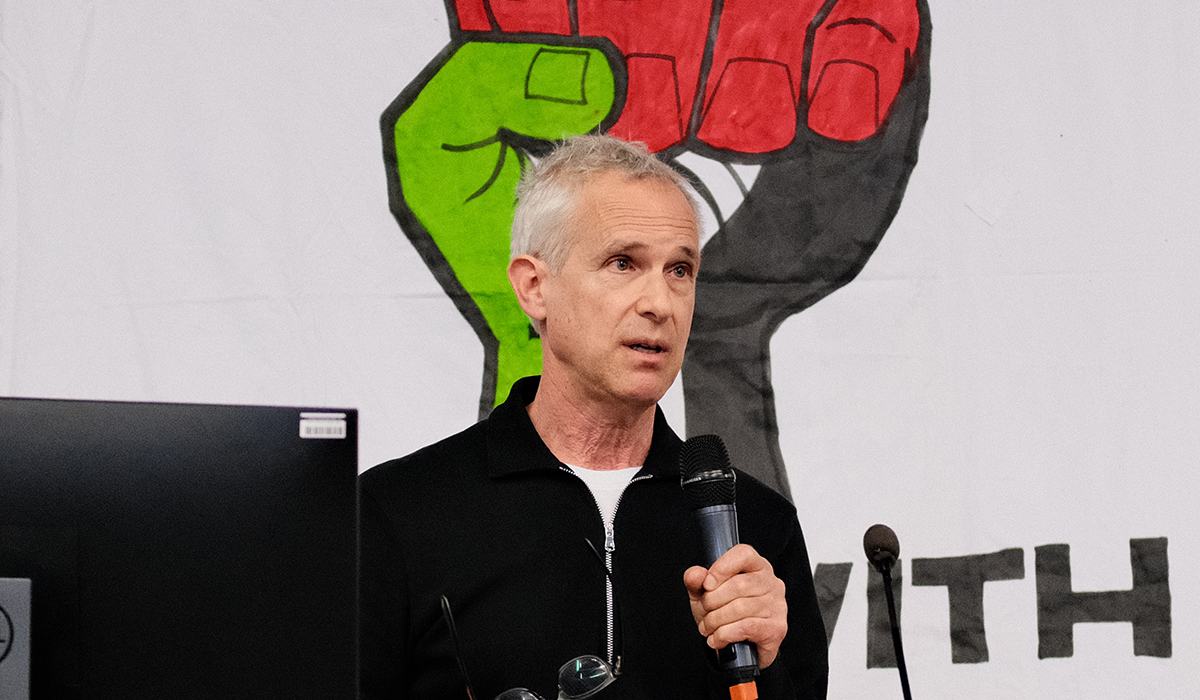
 Photo: Ciaran Elliott
Michael Lavalette spoke to Des Freedman, Professor at Goldsmiths University, a long-term trade-union activist and author of the recently-published Capitalism and the Media, about the state of the media and higher education
Could you tell us a little about yourself and your background?
I’m currently a Professor at Goldsmiths University, but I have a long history as a trade-union activist at ITN, in Further Education and at Goldsmiths, where I have had many union roles. I write on media issues in several places including Declassified UK, the London Review of Books blog, and Counterfire. I was one of the founding members of the Media Reform Coalition, which is a media activist group.
Why did you write Capitalism and the Media? What are its main arguments?
I’ve been interested in the media for a long time. Too often, people talk about this area of social life as if it were separate from the main drivers of contemporary capitalism. I found it really frustrating that, in all the discussions about the impact of the media, capitalism barely gets a mention.
In the book, I want to emphasise that all aspects of the media from newspapers to television, from podcasts to social-media platforms, are all shaped by contemporary capitalism. Capitalism shapes and distorts our media and communications landscapes.
So the book explores concepts including accumulation, exploitation, ideology, oppression, commodification and colonisation and discusses the impact of these processes on everything from our experiences online and the dynamics of algorithms to the power of oligarchs and the media’s role in the escalating environmental crisis.
The major media and communications outlets are owned and controlled by the fabulously wealthy, or the companies of the fabulously wealthy, and of course sometimes by the state. They are tied to the interests of other sectors of capitalism (the influence of advertising companies is an obvious one).
They are shaped by, and are opinion formers for, the dominant ideas of the ruling class in society. Their starting points are shaped by acceptance of class inequality, of racism and sexism and all forms of oppression, of imperialism and colonialism, and of war – all of which they portray as ‘normal’ or as an inevitable ‘part of life’.
For example, we know that, in Britain today, there is support for Palestine, for an end to the genocide and to isolate the Israeli state, but where does this appear in the mainstream media?
It’s true that the new owner of the Daily Telegraph made it clear that their journalists had to reflect the pro-Israel position that he demanded in all its coverage. But more generally, the terrible coverage of the genocide isn’t just down to biased journalists, but to the legacy of colonialism, Britain’s role, over many years, in policing the Middle East and to the emergence of capitalism as a global system of competition between companies (or what we might call ‘units of capital’) and between states. You need to have a bigger vision of the system that is generating the kind of journalism and the kind of media coverage that we get.
In the past, we seemed to have more radical journalists – has that space now gone?
We can all remember a Paul Foot or a John Pilger, but we shouldn’t exaggerate the numbers of radical media journalists in the past – the space was always quite small.
But I do think that space has narrowed even further.
It’s worth thinking about where the space for radical journalism in the mainstream comes from. People sometimes hark back to the journalism of the Vietnam War, but the space for this grew out of the long, sustained anti-war movement.
The media, in general terms, promote the ruling ideas, but this doesn’t mean that people just accept these ideas. There are competing ideas, people’s experiences can challenge what we are being told, and through broader collective struggles some spaces can be opened up.
But again, to understand this, is to understand the conflicts, the contradictions and the contested nature of the modern capitalism.
You work in Higher Education and are an activist in your union. Can you tell us what is happening in the HE sector in Britain?
People sometimes have this idealised view of HE as being staffed by people who exist in an ‘ivory tower’ where they read, research, write books and do a little teaching. But it really isn’t like that!
Like the media, the HE sector exists within the world of capitalism. Universities are massive employers (and not just of academics, but administrators, cleaning and catering staff, maintenance workers, porters etc) and they have been subjected to massive processes of marketisation, privatisation, wage cuts and the undermining of working conditions.
The funding of HE in Britain is almost completely dependent on huge student fees and, as a result, universities have been competing with each other to attract more and more students. This market-based competition is forcing a significant number of institutions to the point of bankruptcy. And so numerous universities are cutting courses and making staff redundant.
The system really is in an existential crisis.
What is needed to defend Higher Education and the University sector in the UK?
A number of universities (including my own) are on strike against cuts and job losses. We need to generalise and spread this. But we need to link academics with all the other groups of workers in the university, and with students who are being forced into a lifetime of debt by the costs of student fees. And we also need to make local communities aware that, if their local university goes bust, then the impact on the local community will be massive.
The HE sector in Britain is in a disastrous position due to the madness of the market. We need to stand together as workers, students and communities to defend the sector, defend jobs and working conditions and make sure that going to university is a right for all our children and not just a privilege enjoyed by the rich.
From this month’s Counterfire freesheet
Before you go
The ongoing genocide in Gaza, Starmer’s austerity and the danger of a resurgent far right demonstrate the urgent need for socialist organisation and ideas. Counterfire has been central to the Palestine revolt and we are committed to building mass, united movements of resistance. Become a member today and join the fightback.
