
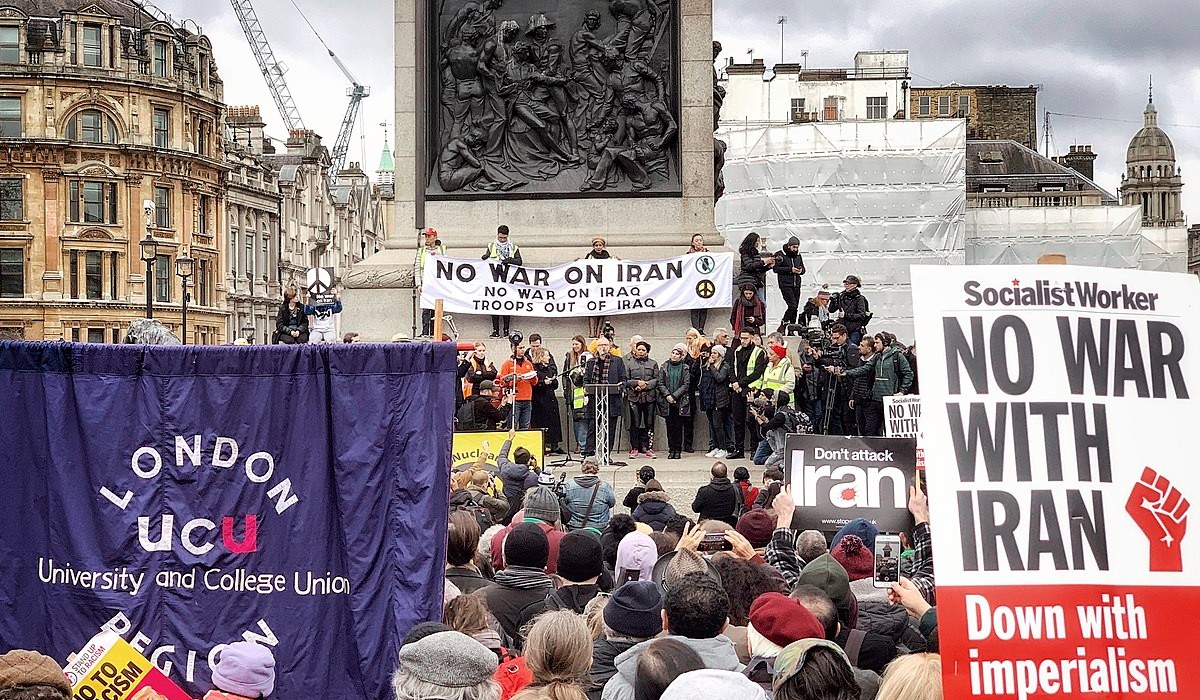
 Stop the War protest against war with Iran. Photo: Garry Knight / Flickr / Public Domain
Even as US imperialism runs amok elsewhere, it is preparing another attack on Iran. This won’t help Iranian protestors, and the anti-war movements must respond, argues John Clarke
We are very understandably focused at the present time on the brutal US assault on Venezuela and the threat that this poses to all of Latin America. The America First brand of US imperialism is now being employed to impose a greatly intensified domination on the region that it has always considered its ‘back yard’.
The predatory role of the US, however, while it may be much more focused on its interests in the western Hemisphere, still has decidedly global dimensions. In this regard, in combination with Israel, the Trump administration is setting the stage for another assault on Iran.
When Trump and Netanyahu met at the end of December, the US president put aside previous frustrations with Israel’s efforts to impede the ceasefire process and took a highly supportive approach when it came to the continuing assault on Gaza and plans for regional aggression. Al Jazeera reports that he intensified calls for Hamas to disarm and ‘heaped the blame solely on Hamas for the delay in moving towards the second phase of the truce.’
At the same time, Trump ‘went on to suggest that Iran may be working to restore its nuclear programme after the US air strikes in June damaged three Iranian nuclear facilities.’ He declined to offer any evidence to support this but made it clear that his administration was ready to back another attack on Iran. ‘Trump’s comments also suggest that he is willing to risk additional hostilities related to Gaza and Iran, even as the US president has taken credit for resolving Israel’s wars in both places.’
US priorities
As I previously suggested, a major US offensive is now underway in Latin America that is aimed at ensuring compliant political leaderships and excluding rivals, especially China, from the region. This is fully confirmed in the National Security Strategy of the United States of America that was released last November.
This plan for a refocused US imperialism also includes a very seriously revised approach to the Middle East. It is highly critical of a situation where for ‘half a century at least, American foreign policy has prioritized the Middle East above all other regions’ (p.27). It suggests that, with greatly diversified energy supplies and rivalry with the former Soviet Union consigned to the past, a reappraisal of this priority is long overdue.
On this basis, the document argues for a focus on ensuring stability in the region, so that it can be downgraded to an important but no longer preeminent object of US attention within the world. In advancing this position, its appraisal of the present situation and the prospects for sustained regional calm seem remarkably unrealistic. The writers suggest that ‘President Trump’s successful revitalization of our alliances in the Gulf, with other Arab partners, and with Israel’ have greatly advanced regional stability’ (pp.27-8).
Trump’s strategists are convinced that ‘America’s historic reason for focusing on the Middle East will recede. Instead, the region will increasingly become a source and destination of international investment, and in industries well beyond oil and gas— including nuclear energy, AI, and defense technologies’ (p.28).
Yet, while Israel remains a vital strategic asset for the US and Trump’s recent meeting with Netanyahu projected an image of a completely solid alliance, it is obvious that very major tensions exist between the US goal of a trouble-free region of lucrative investment opportunities and Israel’s present trajectory.
A 29 December article in the Nation notes pointedly that one ‘of the biggest hurdles to Trump’s vision of a new Middle East is that Israel is having none of it. While Trump touts his ceasefire, Israel has continued to bomb Gaza, Lebanon, and Syria.’ It goes on to argue that ‘Netanyahu has no interest in the Middle East becoming a place of “partnership, friendship and investment.” Rather, the Israeli leader’s strategy is clearly one of maintaining regional hegemony by promoting chaos.’
While the role that Israel plays still significantly bolsters the interests of US imperialism, it is nonetheless true that the evermore belligerent pursuit of Greater Israel, with all the conflict and instability this brings with it, is clearly at odds with the shifting priorities of a declining imperial power looking to preserve its dominant place in the world.
The strategic thinkers around Donald Trump can proclaim the objective of profit-laden stability in the Middle East but the realities of a region torn by massively destabilising factors can’t be wished away. These flow in very large measure from the destructive pursuit by Israel of the colonial project that brought it into existence.
Washington has no problem at all with the weakening of the Iranian government and its replacement by a more compliant regime has been a cherished goal ever since the revolutionary overthrow of the Shah in 1979. In that sense, there is a partial alignment of interests, as Israel seeks to intensify the confrontation with Iran. However, the problem for the Trump administration is that such a course of action threatens to spin out of control and ensure that its reordered priorities are massively undermined.
The regional enforcer and its main imperial sponsor may have divergent interests to a significant degree but the erratic Trump, with his administration divided on unqualified support for Israel, will find it hard to find a way through these contradictions in ways that don’t involve massive economic and military outlays and the threat of regional conflagration. Another more devastating attack on Iran remains highly likely in this context, whatever the misgivings of the Trump strategists.
Iranian government weakened
At present, the Iranian authorities are being challenged by yet another wave of protests that are sweeping the country. Al Jazeera reports that the ‘nationwide demonstrations, which have seen dozens of people killed so far, ignited at the end of last month when shopkeepers in Tehran’s Grand Bazaar shuttered their businesses in anger over the collapse of Iran’s rial currency, against a backdrop of deepening economic woes driven by mismanagement and punishing Western sanctions.’ Then: ‘University students soon joined the protests and they began spreading to other cities.’
For decades now, workers in Iran have struggled for basic union rights, women have challenged regressive legislation and government policies and oppressed national minorities have fought back. These have been vital struggles and there is no reason to suggest that the present protests are unjustified or driven by reactionary objectives.
The challenge that has been taken up against acute economic hardship, in the face of severe repression, has actually forced even judiciary chief, Gholamhossein Mohseni Ejei, to acknowledge that those taking to the streets ‘legitimately and rightly have concerns about their livelihood and social and economic welfare.’
At the same time, there is no doubt that both Israel and the US are cynically attempting to use the protests to advance the prospects for a new attack on Iran. Trump ominously warned that, if the Iranian government ‘violently kills peaceful protesters, which is their custom, the United States of America will come to their rescue.’ For his part, Netanyahu suggested that it ‘is quite possible that we are at a moment when the Iranian people are taking their fate into their own hands.’
The just demands of workers and oppressed people in Iran will most certainly not be advanced by US imperialism or another attack on the country by the US and Israel. Yet, this is exactly the threat that is being posed and the dangers are acute at the present moment.
Israel has become a profoundly destructive source of regional instability and US imperialism has entered a volatile and enormously dangerous phase, as it pursues what Trump laughably calls ‘peace through strength’. In this situation, the need for resistance and international anti-war mobilisation have never been greater.
Before you go
The ongoing genocide in Gaza, Starmer’s austerity and the danger of a resurgent far right demonstrate the urgent need for socialist organisation and ideas. Counterfire has been central to the Palestine revolt and we are committed to building mass, united movements of resistance. Become a member today and join the fightback.

John Clarke
John Clarke became an organiser with the Ontario Coalition Against Poverty when it was formed in 1990 and has been involved in mobilising poor communities under attack ever since.