
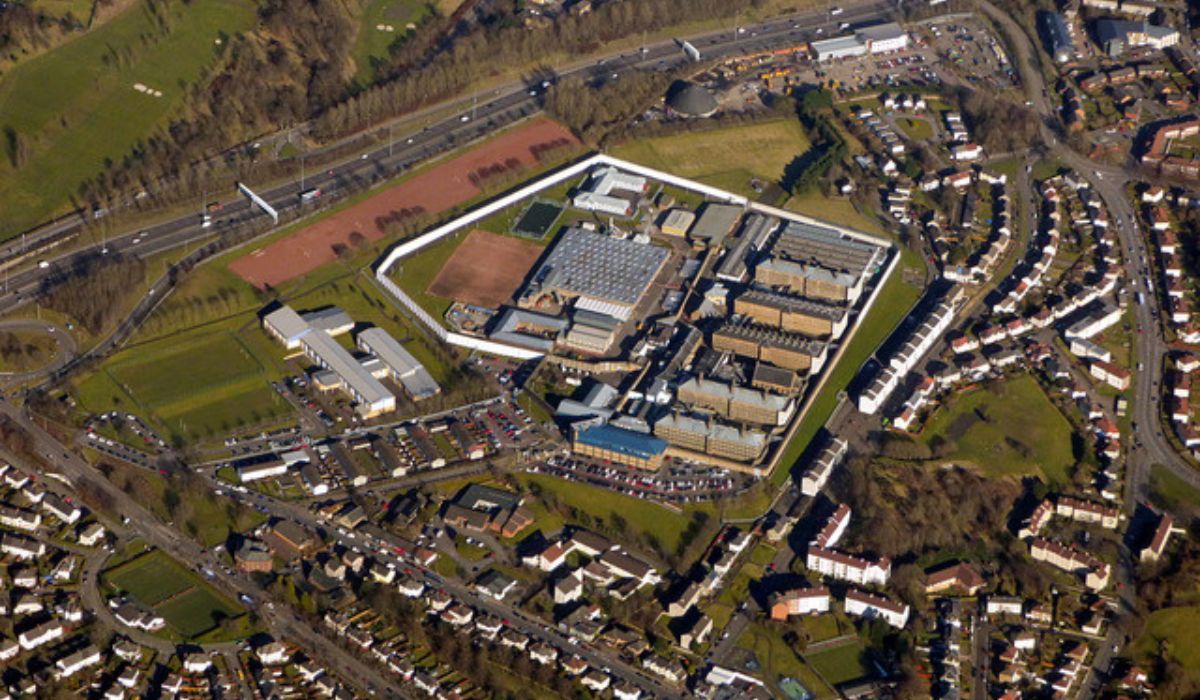
 HMP Barlinnie from the air. Source: Thomas Nugent - Wikicommons / cropped from original / CC BY-SA 2.0
Prisons are in crisis and the answer is a different approach to ‘law and order’ not building more prisons, says Terina Hine
The UK is in the midst of a severe prison crisis. Prisons across the country are operating at 97.5% capacity, while attacks on prison officers and inmate deaths have soared.
According to Ministry of Justice figures, the number of people dying in prison rose by almost a third, with 401 deaths in the twelve months to the end of June 2025. Of those, 86 were recorded as ‘self-inflicted’ and seven as homicide.
Overcrowding, inexperienced staff, drugs, gangs, and escalating levels of violence all go hand-in-hand. For the twelve months to March 2025, there were 30,846 cases of assault: a 9% rise on the previous year, with assaults on staff increasing by 7%. During the same period, there were 77,898 incidents of self-harm; that’s one incident every seven minutes. It is clear something has to change.
A recent independent review by Anne Owers, former Chief Inspector of Prisons, found that England’s prison estate came within days of collapse several times between 2023 and 2024. Things are no better today. The UK’s prison estate and criminal justice system is failing every single possible constituent: prisoners, guards, governors, courts, criminals, and victims.
Law and order is a right-wing hobbyhorse and the collapse of the justice system is playing directly into their hands. Reform is having a heyday pushing for the deportation of foreign criminals to reduce costs and free up cell space. The government has capitulated and announced new legislation will be brought before parliament so that foreign criminals can be deported immediately on conviction. The government has also announced its intention to expand its ‘deport now, appeal later’ programme, so those convicted will be deported before an appeal can be heard.
Right-wing news outlets are decrying the fact that more than 26,000 prisoners have been released early from jail, including a number of serious offenders. Tory justice spokesman Robert Jenrick said, ‘the public are sick of soft justice’ seemingly forgetting that the early release scheme to deal with gross overcrowding in our prisons was first used by his former boss Rishi Sunak.
By using early-release schemes and housing prisoners in police cells for longer and longer, the government has been able to ease some of the pressure. However, systemic problems remain, including the deplorable state of prisons themselves, the excessive use of custodial sentences, and the length of time prisoners are remanded in custody awaiting trial. Owers’ damning report revealed that it cost the state £70 million to keep prisoners in police cells between February 2023 and January 2025. The government response: a prison-building programme for 14,000 new places ‘so our jails never run out of space again’. However, just as motorway building increases car use, prison construction will likely result in greater use of custodial sentencing.
As Pia Sinha, chief executive of the Prison Reform Trust, said, ‘We cannot afford to indulge in the fantasy that building more prisons will solve this crisis – history shows it won’t. Instead, we must confront the reality: reversing the long-term rise in sentence lengths and investing in rehabilitation are the only sustainable ways forward.’
A cursory glance at Scandinavia and the Netherlands show how this might be achieved, if only our politicians would look. The Netherlands has one of the lowest incarceration rates in the world, is repurposing its prisons as cinemas and shopping centres, and leasing empty cells to neighbouring countries. In the decade from 2014-2024, when our prisons were filling up and Britain recorded the highest level of incarceration in Europe, more than twenty Dutch prisons were closed as their prison population decreased by more than 40%. How? By tackling health issues, particularly mental health, both inside and outside jail, and by focussing on rehabilitation rather than retribution. The Dutch prison system provides good healthcare, with particularly high inmate-healthcare to worker ratios, alongside education, training, and employment.
In the Netherlands, it is accepted that a stay in prison may do more harm than good. Prisons are seen as places where inmates are introduced to new criminal networks and become dehumanised. There’s an understanding that time inside reduces employability, increases homelessness and family breakdown, all of which exacerbates mental-health issues and reoffending rates.
Yet here in the UK, non-violent protesters are held on remand for almost two years without trial, the government has dug-in over the proscription of Palestine Action, and arrested 532 peaceful, mainly elderly protestors and threatens supporters of the proscribed group with ‘the full force of the law’. No wonder the courts are clogged and prisons are full.
From this month’s Counterfire freesheet
Before you go
The ongoing genocide in Gaza, Starmer’s austerity and the danger of a resurgent far right demonstrate the urgent need for socialist organisation and ideas. Counterfire has been central to the Palestine revolt and we are committed to building mass, united movements of resistance. Become a member today and join the fightback.
