
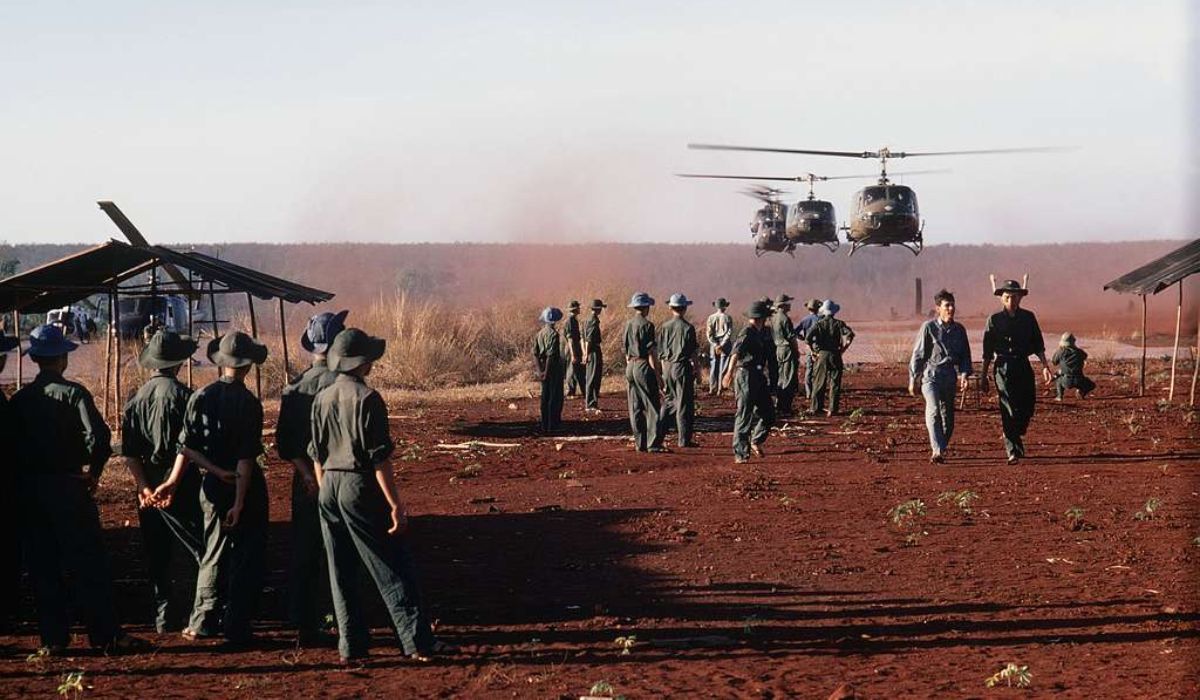
 UH-1 helicopters, carrying the members of the International Commission of Control and Supervision tol observe prisoner exchange, approach the location at Loc Ninh. Source: U.S. Navy - Wikicommons / cropped from original / Public Domain
Chris Bambery explores the parallel stories of the USA’s wars in Vietnam and in Iran
Quite simply, yes, they have forgotten. It is perhaps interesting to compare how in its recent war with Iran, the United States went onto to repeat so many of its Vietnam mistakes.
Imperialism is a hierarchy of power – economic, financial and military. Within that hierarchy, there is a deep racism among the great powers towards their lesser rivals. That lulls the imperialists into a false confidence.
So, it was in Vietnam that the Americans simply dismissed their opponents and portrayed them as cardboard cutouts, creatures of the Soviet Union and the People’s Republic of China. In fact, the leadership of North Vietnam had developed in the fight against the Japanese occupation and in the war against French colonialism. Ho Chi Minh was a skilled political operator and strategist, and General Vo Nguyen Giap a military mastermind, the architect of the decisive battle against the French at Điện Biên Phủ.
Donald Trump allowed himself to be persuaded by the head of Mossad, David Barnea, that if they took out the Supreme Leader, Ali Khamenei, and a few other key leaders, then the Islamic Republic would collapse like a house of cards.
That did not happen, but it demonstrated a racist dismissal of their opponents by the US combined with a wilful ignorance of how powerful nationalism is in both Vietnam and in Iran.
Vietnam
In the case of Vietnam, there had been a long struggle against colonialism. When the Second World War ended, the British occupied southern Vietnam, re-armed the Japanese to fight the Vietminh (the Communist led resistance) and restored French colonial rule. There followed a nearly decade-long war of national liberation.
The defeat of France led to an international conference at Geneva, where a supposedly temporary military demarcation line was agreed along the 17th Parallel. This was only supposed to be until all-Vietnam elections took place. They never did. The US, fearful that Ho Chi Minh would win, set up a puppet government in Saigon, the capital of a new state, South Vietnam.
Vietnam was partitioned, with Ho Chi Minh and the Vietminh taking control of what became North Vietnam. The vast majority of Vietnamese abhorred the division of the country, and the South Vietnamese regime had little popular support.
Opposition to the French-imposed system of landholding assured what would become the National Liberation Front of popular support as it began a guerrilla war in South Vietnam.
The same in Iran
America brushed all this aside. It did the same in Iran. There is a bitter legacy of resentment against both US and British imperialisms’ actions there. Particularly the 1953 CIA-MI6 coup, which overthrew the democratically elected government of Mohammad Mosaddeq, for daring to nationalise the British-owned company which controlled Iran’s oil.
In Mosaddeq’s place, the Americans gave full dictatorial power to the Shah, a brutal autocrat.
When the US began bombing Iran, many who had previously protested against the regime opposed Trump’s war because of that deep sense of nationalism. Israel’s involvement, fresh from genocide in Gaza, only added to that.
The Americans in both wars relied on their superior technology, firepower, and large-scale combat operations. In Vietnam, when they intervened on a major scale in 1965, they believed airpower could win the war. The head of the US Air Force, Curtis Le May, promised to “bomb North Vietnam back to the stone age” (that’s where Trump got that line from).
Bomb them back to the stone age
US bombing caused huge civilian casualties – as in Iran- but it did not break the morale of the people, just as in World War Two. In Vietnam, President Lyndon B. Johnson chose to escalate by sending in ground troops, with the numbers quickly swelling. In the case of Iran, Trump faces a deeply unpopular war at home and opposition from his own commanders to putting boots on the ground.
America found itself dragged into an asymmetric war in both cases. In Vietnam, it was one against guerrillas who knew the terrain and had popular support in which to swim.
In the case of Iran, the huge armada Trump sent never entered the Persian Gulf because it would be too fat a target for Iranian missiles and drones. The US aircraft carrier, the Abraham Lincoln, sailed away deep into the Indian Ocean.
Iranian missile and drone attacks took out the US radar stations along the southern coast of the Persian Gulf and forced the evacuation of many of the US bases in the region.
Neither the Vietnamese nor the Iranians could militarily defeat the Americans but they could politically defeat them. The Tet Offensive in early 1968 was eventually a military defeat for the Vietnamese but the sight on US mainstream TV of American GIs having to fight to retake the US embassy in Saigon convinced millions of Americans that the war was unwinnable.
President Johnson would decline nomination in that year’s presidential race, opposition on the streets mushroomed, and the US army in Vietnam began to disintegrate. A friend of mine was an electrician who was drafted into the Navy. Twice the aircraft carrier he was on sailed for Vietnam, twice it developed electrical faults and had to return to California!
In the case of Iran, their ability to close the Straits of Hormuz, despite all Trump’s huffing and puffing, was a humiliation for the USA
Neither the Vietnamese nor the Iranians destroyed US military power, but they badly damaged Washington’s ability to project that power. For instance, in 1975-1976, the US felt unable to send ground troops to Angola, where they were desperate to stop the MPLA from taking control after the Portuguese had granted independence.
After the war with Iran, Trump will not want any military adventure to become a protracted war, as it did in the case of Iran.
There are many differences between Vietnam and Iran, but many similarities between the two wars. Trump ignored lessons from history and is paying a high price.
Before you go
The ongoing genocide in Gaza, Starmer’s austerity and the danger of a resurgent far right demonstrate the urgent need for socialist organisation and ideas. Counterfire has been central to the Palestine revolt and we are committed to building mass, united movements of resistance. Become a member today and join the fightback.

Chris Bambery
Chris Bambery is an author, political activist and commentator, and a supporter of Rise, the radical left wing coalition in Scotland. His books include A People's History of Scotland and The Second World War: A Marxist Analysis.