
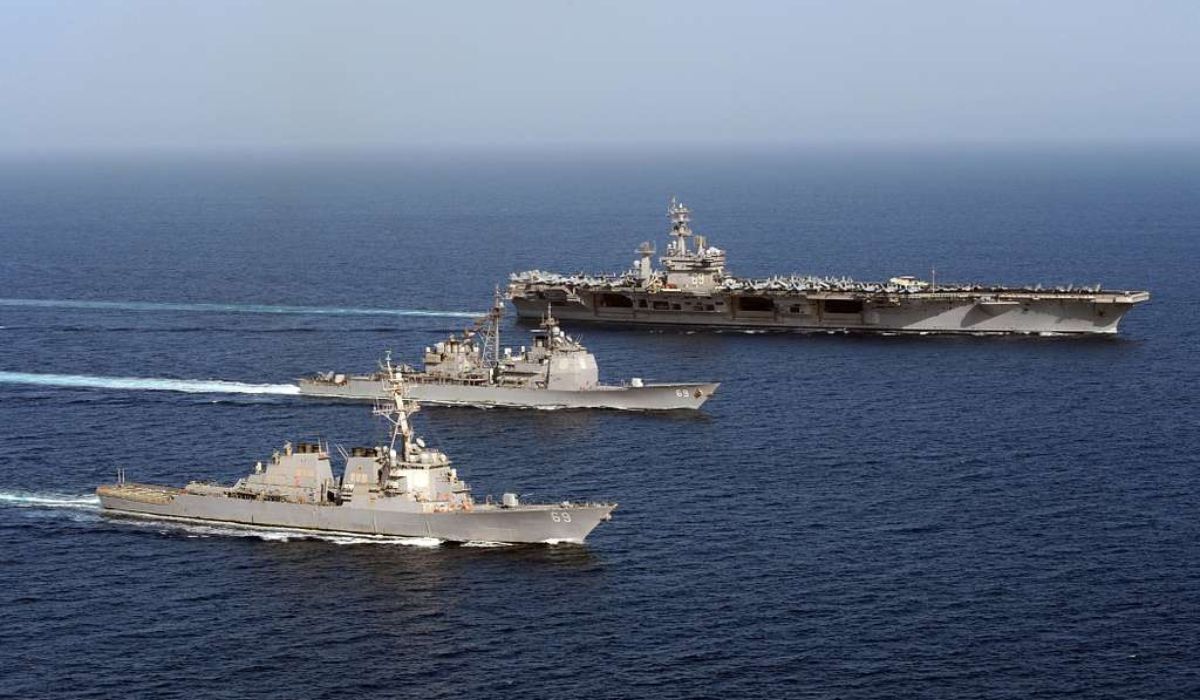
 Three U.S. Navy ships sharing the same hull number in formation in the Arabian Sea in 2009. Source: Rafael Figueroa Medina - picryl / cropped form original / public domain
Trump’s regime is using the same old pretexts in its attempt to reassert American power in Latin America, argues Orlando Hill
Time and again, US imperialism resorts to familiar narratives, such as the fight against communism, terrorism or the need to restore democracy, to justify its interventions. This time, it is the fight against narcotrafficking. We have seen this film before. Washington is not even hiding its intentions. Trump announced to the world that he was ordering covert operations inside the sovereign territory of Venezuela. His excuse is that large amounts of drugs are entering the US from Venezuela. Trump has not presented any evidence to support his claim.
That has not stopped Washington from deploying the largest US naval forces off the coast of Venezuela in the country’s history since the First Gulf War (1990-1), and according to predictions from American military officials, a missile attack on Caracas is most likely.
Following the arrival of the USS Gerald Ford aircraft carrier strike group, expected next week, the US will have eight warships (six of them destroyers), three amphibious ships, and one submarine. A total of thirteen naval units, something that did not even occur during the 1989 invasion of Panama or the 1983 invasion of Grenada.
The Ministry of Foreign Affairs of Trinidad and Tobago, just two hours on a ferry from Venezuela, let it be known that the destroyer USS Gravely is docked in the capital Port of Spain last Sunday, 26 October, for military training.
In a statement, the Ministry confirmed ‘that the USS Gravely will visit Trinidad and Tobago from October 26 to 30, docking in Port of Spain, while the 22nd United States Marine Expeditionary Unit will conduct joint training with the Trinidad and Tobago Defence Force during the same period. The presence of U.S. military services in Trinidad and Tobago underscores the United States’ commitment to regional security and cooperative efforts in the Caribbean.’
In response, Venezuela suspended on Monday the energy agreement it had with the island. In parallel, the National Assembly of Venezuela approved, this Tuesday, 28 October, unanimously, a bill that declares the Prime Minister of Trinidad and Tobago, Kamla Persad-Bissessar, as persona non grata in the country.
The treaty between the two countries was signed in 2015. In addition to the sale of gas to Port of Spain, the agreement also provides for the joint exploration of natural resources in the maritime borders between the nations. ‘Both countries sought to carry out a joint exploration of the deposits because hydrocarbon reserves, whether gas or oil, are located at the maritime border between the two nations, which are very close. To avoid conflicts over control of the area, these agreements were signed. The idea was to share information, technology, and, of course, also the potential profits from drilling these wells. This is what is currently suspended and, probably, between the two nations, economically, it is the most important point,’ explained Adrian Bonilla, Professor of International Relations at the Latin American Faculty of Social Sciences (Flacso) in Ecuador.
The Episcopal Conference of the Antilles, a congregation that brings together bishops and archbishops from the Caribbean region, issued a statement last Saturday in which it noted with ‘grave concern [the] recent build-up of naval and other military assets in the Southern Caribbean.’ It condemned the disregard for the sovereignty of nations. ‘War or the threat of war is never the right solution. To quote Pope Leo … “We must never become accustomed to war”.’
‘The presence of warships and the disruption of marine livelihoods within our Caribbean waters represent real and immediate threats to regional stability and to the welfare of our nations. As peoples united by a shared heritage and collective identify, we must continue to reject aggression and intimidation as means of resolving conflict or ideological differences. Our history has shown that discourse and negotiation have served us well as independent nations united in community and cooperation.’
On Wednesday 29 October, Venezuela’s Interior Minister, Diosdado Cabello, stated that the country had thwarted actions promoted by the CIA with the aim of removing President Nicolás Maduro. The operation would have involved three areas of action: sabotage of the Venezuelan energy system; attacks on military posts; and the establishment of fake drug laboratories in rural areas to justify an international military aggression against Venezuela under the pretext of combating drug trafficking.
These come after Venezuela had dismantled three other CIA actions. In Con Maduro+ broadcasted by the Venezuelan state television (VTV), Maduro stated that, ‘Between Saturday night (25) and early Sunday morning, a series of captures of what could be a group of mercenaries financed and trained by the CIA took place. This led us to uncover a plan of self-attack that the CIA would carry out against its military ships positioned off the coast of Venezuela, in Trinidad and Tobago.’
On Tuesday 21 October, the President of Ecuador, Daniel Noboa, advocated for the establishment of foreign military bases in the Galapagos Islands, also under the justification of combating drug trafficking in the region. The installation of foreign military bases on Ecuadorian soil has been prohibited since 2008. Noboa, however, called for a referendum, scheduled for 16 November, to try to overturn the legislation.
The Argentine journalist Gabriel Vera Lopes explained that the military manoeuvres and the siege of Venezuela are part of a broader process of military and political reoccupation of the continent, which also includes economic and diplomatic pressures on countries attempting to maintain autonomy. ‘The military movement they are undertaking targets Venezuela, but it also allows for the remilitarization of Panama, Puerto Rico, and other Caribbean territories,’ he emphasised.
Among these diplomatic pressures is Trump’s intervention in the recent mid-term elections in Argentina and the slapping of tariffs on Brazil’s exports in an attempt to blackmail the country to stop the judiciary procedures against his friend ex-president Jair Bolsonaro.
Before you go
The ongoing genocide in Gaza, Starmer’s austerity and the danger of a resurgent far right demonstrate the urgent need for socialist organisation and ideas. Counterfire has been central to the Palestine revolt and we are committed to building mass, united movements of resistance. Become a member today and join the fightback.

Orlando Hill
Orlando was born in Brazil and was involved in the successful struggle for democracy in the late 1970s and 80s in that country. He teaches A level Economics. He is a member of the NEU, Counterfire and Stop the War.