
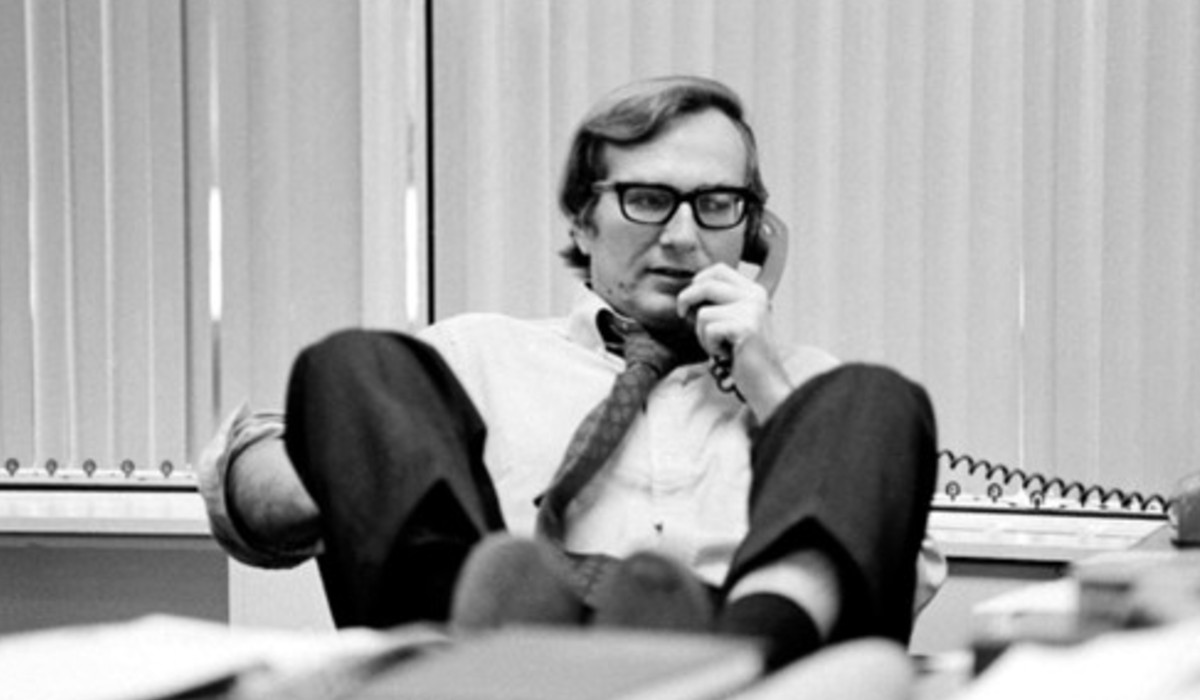
 Seymour Hersh.
This film stands out for Seymour Hersh’s tenacity and ferocity in tackling power, Des Freedman discovers
At one level, the American investigative journalist Seymour Hersh epitomises the liberal dream of the media as a ‘fourth estate’. This is when journalists scrutinise the activities of elites and ‘hold power to account’ through their dogged pursuit of facts, no matter how awkward for the establishment. Governments can fall and wars can be ended when brave reporters, uncontaminated by their connections to any vested interests, actually do their jobs.
Hersh’s reports on the US military’s massacre at My Lai during the Vietnam War, his revelations of systematic torture by US troops at Abu Ghraib in Iraq after 2003 and his 1977 expose of corruption at the giant multinational Gulf & Western are all seminal examples of journalism that shines a light on corporate, military and political power.
On the other hand, Hersh also represents a real challenge to the idea of the mainstream media as fearless ‘truth-tellers’. Often pushed to the margins of his profession and deeply sceptical of the priorities of commercial bodies, Hersh ploughed a lone furrow, committed less to major newspapers or broadcasters than to the sources at the heart of his stories who he fiercely protected.
A new documentary on Netflix about the life and work of Hersh, Cover-Up, shows both these angles. Directed by Mark Obenhaus and Laura Poitras (who also made Citizenfour about Edward Snowden and All the Beauty and the Bloodshed about activist and photographer Nan Goldin), it reveals a character who is utterly absorbed with not letting the powerful get away with their dirty deeds.
Through a series of interviews, archive footage and plenty of clippings, the film shows just how much of a debt we owe to journalists like Hersh who don’t buckle under pressure and whose loyalty is to getting to the truth, no matter how inconvenient, difficult or risky it may be to do so.
Hersh himself is less interested in finding out why armies, governments and corporations do bad things – an objective that would force him to address more systemic questions about things like capitalism, imperialism and the ‘war on terror’ for example – than he is in showing just how bad these things can be.
His stories were often based on single and anonymous sources – a highly controversial practice in the journalism world. On the other hand, this was inevitable as he depended on brave and frustrated individuals to whistleblow on some of the world’s most powerful people.
Perhaps the most dramatic original moment in the film – obviously excluding the horrors of My Lai and Abu Ghraib – is when Hersh threatens to quit the film (Poitras has claimed that he actually did leave the project for 24 hours) because he feels that the safety of his sources has been compromised by the filmmakers. Source protection, for Hersh, is the absolute cornerstone of his journalistic commitment.
Strengths and weaknesses
Cover-Up shows both the strengths and potential weaknesses of Hersh’s approach. He certainly wasn’t a man who just hung round the briefing rooms of the White House or the US military’s briefing tents in Afghanistan or Iraq. Just as he didn’t see his role as providing comment, he was also a million miles away from doing the stenography with which so many mainstream lobby journalists are associated.
For Hersh, journalism meant righting wrongs, giving voice to the sources who put their trust in him and never deferring to authority.
Well, almost never deferring to authority because, in fact, the film does include his own admission that he wasn’t sufficiently sceptical of the then Syrian president Bashar al-Assad when reporting that the 2013 sarin attack at Ghouta was carried out by the Syrian opposition and not the Syrian government. Even here, however, this was likely motivated by his distrust of the Obama administration rather than any support for the brutal Assad regime.
The film makes it clear that Hersh didn’t get everything right and that ultimately his politics are underpinned by an anti-authoritarianism which makes him see a potential cover-up in every situation. Hersh doesn’t appear to be driven by the anti-imperialist politics of John Pilger or the socialist principles of Paul Foot, the UK’s two leading left-wing investigative journalists, even if his instincts generally pointed him in the right direction: that there is something profoundly rotten in the current system.
Compared to the massed ranks of mainstream journalists who faithfully reproduce the foreign policy agendas of their own governments, Hersh stands out for his tenacity and ferocity in tackling power.
Back in 1969, Hersh’s reports on the cover up at My Lai were published in leading US newspapers. Today, most mainstream outlets have cut back on their investigations budgets and are reluctant to rock the boat, particularly when it comes to defence and military affairs. Hard-hitting and critical journalism in these areas is far more likely to be seen in smaller outlets like Declassified UK or in the work of open-source sites like Forensic Architecture and Airwars.
None of this diminishes Hersh’s huge contribution to journalism and the role he played in opening the eyes of millions of viewers and readers to the crimes committed by our rulers at home and overseas.
Directed by Laura Poitras and Mark Obenhaus (118 minutes)
Cover-Up is showing on Netflix in the UK.
Before you go
The ongoing genocide in Gaza, Starmer’s austerity and the danger of a resurgent far right demonstrate the urgent need for socialist organisation and ideas. Counterfire has been central to the Palestine revolt and we are committed to building mass, united movements of resistance. Become a member today and join the fightback.

Des Freedman
Des Freedman is Professor of Media and Communications in the Department of Media and Communications at Goldsmiths, University of London. He is the co-author of 'The Media Manifesto' (Polity 2020, author of 'The Contradictions of Media Power' (Bloomsbury 2014), co-editor of 'The Assault on Universities: A Manifesto for Resistance' (Pluto 2011), and former Chair of the Media Reform Coalition.