
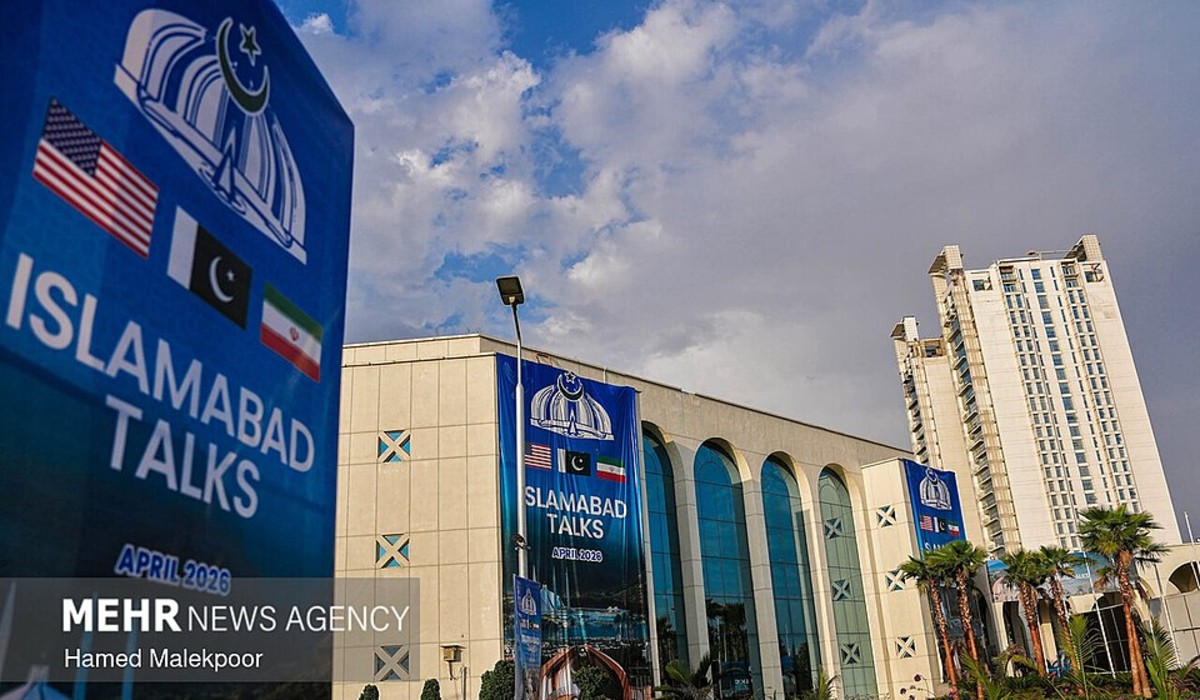
 Islamabad Talks 11 April 2026. Photo: Hamed Malekpour / CC BY 4.0
Chris Bambery argues that there are few options for Donald Trump in his war with Iran. Will he agree a peace deal or walk away from the conflict?
Despite the United States declaring a ceasefire with Iran armed clashes continue between the two states. Last Thursday 7 May a US warship attempted to enter the Strait of Hormuz. It withdrew after being hit by Iranian missiles.
The next day the Iranian military said that the US had targeted an Iranian oil tanker and another vessel approaching the Strait of Hormuz from the east and carried out ‘aerial attacks’ on several coastal areas.
All of this before possible talks in Islamabad between the two states. Iran’s Foreign Minister Abbas Araghchi has said ‘every time a diplomatic solution is on the table, the US opts for a reckless military adventure’ and questioned whether Washington was engaged in a ‘crude pressure tactic.’ Araghchi also dismissed reported US intelligence assessments of Iran’s missile capabilities. ‘The CIA is wrong. Our missile inventory and launcher capacity are not at 75% compared to Feb. 28,’ he wrote, referring to the day the US and Israel launched the war. ‘The correct figure is 120%.’ He added: ‘As for our readiness to defend our people: 1,000%.’
If the talks happen the gap between the two sides is a big one. Bur reports from the US say that the two sides were ‘getting close’ to an agreement whereby Iran would agree not to develop a nuclear weapon and halt enrichment of uranium for at least 12 years. In return the US would lift sanctions and release billions of dollars in frozen Iranian assets, and both sides would guarantee to re-open the Strait of Hormuz within 30 days of signing.
If this is true it would represent a success for Iran whose leaders have always said they would not build a nuclear bomb. It also means Washington has dropped demands that Iran hands over its stock of enriched uranium to another state, with Pakistan and Russia possible candidates.
But one sticking point remains. Tehran has said a peace deal must apply to Lebanon. America’s ally Israel is carrying on its war on Lebanon, not just on Hezbollah but on civilian targets. It’s hard to see Trump ordering Benjamin Netanyahu to cease and even if he did the question is whether the Israeli premier would agree.
Despite Trump’s bluster re-starting the war would be difficult. The price of a gallon of petrol in the US is over $4 a gallon and opposition to the war is rising at the same time as Trump’s ratings plummet.
It now appears that when Trump wanted to force the opening of the Strait of Hormuz, Saudi Arabia made it clear the US could not use its bases in the Kingdom. On 27 February, the day before the US and Israel attacked Iran, not only was the Strait of Hormuz open but Saudi Arabia and the Gulf States were solidly behind the US. Fast forward to today and not only does Iran now control the Strait but that unity has gone.
Qatar and Oman are co-operating with Iran. Saudi and the United Arab Emirates are having a massive spat, with UAE seemingly building on its recognition of Israel to enter into a military alliance with it. Israel has provided it with missile defence systems.
The US failed to protect these states from Iranian missile and drone attacks. Each of them will think seriously on the consequences of this. China, which is a major economic player in the region, will be watching with interest.
All of this is bad news for Washington.
Trita Parsi points out that:
‘The United States… is unlikely to reenter a full-scale war. Not because it lacks the capability — but because it lacks the strategic freedom to use it.’
As in Vietnam and the two Gulf Wars, the US relies on overwhelming firepower and its technological superiority but Iran has turned the tables around. Parsi’s conclusion is that:
‘The danger for Washington is not irrelevance. It is that we continue to pursue a strategy designed for a world that no longer exists. The same is true for countries that have chosen to rely on American primacy.’
Whether the peace talks get under way and a deal is reached is a major question. If they don’t I expect the US will walk away – creating a situation of no peace but no war.
Meanwhile, Israel is fighting wars in Lebanon, the West Bank and Gaza, with incursions into Syria. It’s a postage stamp sized nation with a military reliant on reservists who have to take leave of their civilian jobs to fight. It has failed to defeat Hezbollah who continue to hit Israel with drones and missiles and have inflicted heavy damage on the Israeli Defence Force.
On Friday the Financial Times stated:
‘Hizbollah has proven proficient at targeting IDF soldiers in the “security zone”, increasingly via explosive drones, including first-person-view drones inspired by those used in Ukraine, and has maintained sporadic rocket fire into Israel. Three Israeli civilians and 17 soldiers have been killed and dozens more troops wounded.
‘Israeli military officers even admitted that the Shia militant group’s lingering military capabilities defied their earlier perception that the group had suffered an abject defeat.’
Netanyahu promised Israel would destroy Hamas and Hezbollah and the Islamic Republic of Iran. He has achieved none of that and if the US walks away from Iran, which Netanyahu claims is an existential threat to Israel, Israel cannot fight a war against it on its own. An alliance with the UAE would be a major plus for it but cannot make up for the fact Iran has not just suffered but has emerged from the war as a far bigger regional player.
Before you go
The ongoing genocide in Gaza, Starmer’s austerity and the danger of a resurgent far right demonstrate the urgent need for socialist organisation and ideas. Counterfire has been central to the Palestine revolt and we are committed to building mass, united movements of resistance. Become a member today and join the fightback.

Chris Bambery
Chris Bambery is an author, political activist and commentator, and a supporter of Rise, the radical left wing coalition in Scotland. His books include A People's History of Scotland and The Second World War: A Marxist Analysis.