

Continuing our compendium of holiday reading, more Counterfire writers suggest a mixture of books to take away with you
Terina Hine
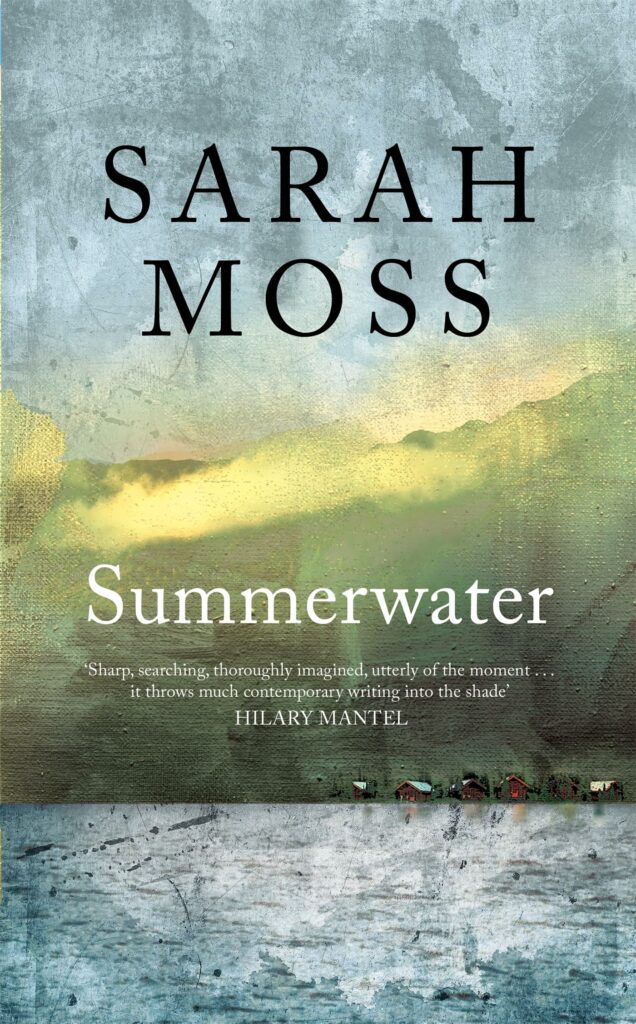
For my holiday, I like short books for travelling, a novel that can easily slip into my hand baggage and not weigh me down, physically or mentally, saving something longer for my arrival. Two short novels I’ve read recently are both by Sarah Moss, an English writer whose prose style is simple and immediately absorbing. Her Summerwater (Picador 2020) is perhaps an obvious choice, being set in a holiday cabin on the shores of a Scottish loch. It’s a dark tale of a pretty miserable summer holiday spent in the pouring rain. Set over the course of one day, events are told from the perspective of the different holiday makers, the same moments seen from differing points of view. I particularly loved the opening scene as the narrator goes running around the loch through the rain in the early morning. The sense of place and the runner’s inner dialogue are pitch-perfect. Moss’s ability to describe the conflicts of family life while simultaneously touching on the bigger, political issues of our time is her brilliance. Politics and landscape are threaded throughout her writing. There is no escaping either.

Moss’s earlier novel Ghost Wall (Granta 2018) is also set on a summer holiday of sorts, this time in Northumberland on an archaeological camping experience. The seventeen-year-old Silvie and her working-class parents join a group of archaeology students and their professor to live like ancient Britons. Culture and class come into direct conflict, as tensions within the group build. Silvie’s bus-driver father despises the students; they, in turn, laugh at him, Silvie is stuck in the middle. Once again, the countryside is described beautifully, and the land itself becomes part of the story, having a power of its own. This is a novel that grips you from the beginning and is perfect for reading in one sitting. Both of Moss’s books are slim, but don’t be fooled; they are jam-packed with ideas. They provide insight into modern life, raise political and sociological questions and the atmosphere she conjures lives on long after you finish reading.
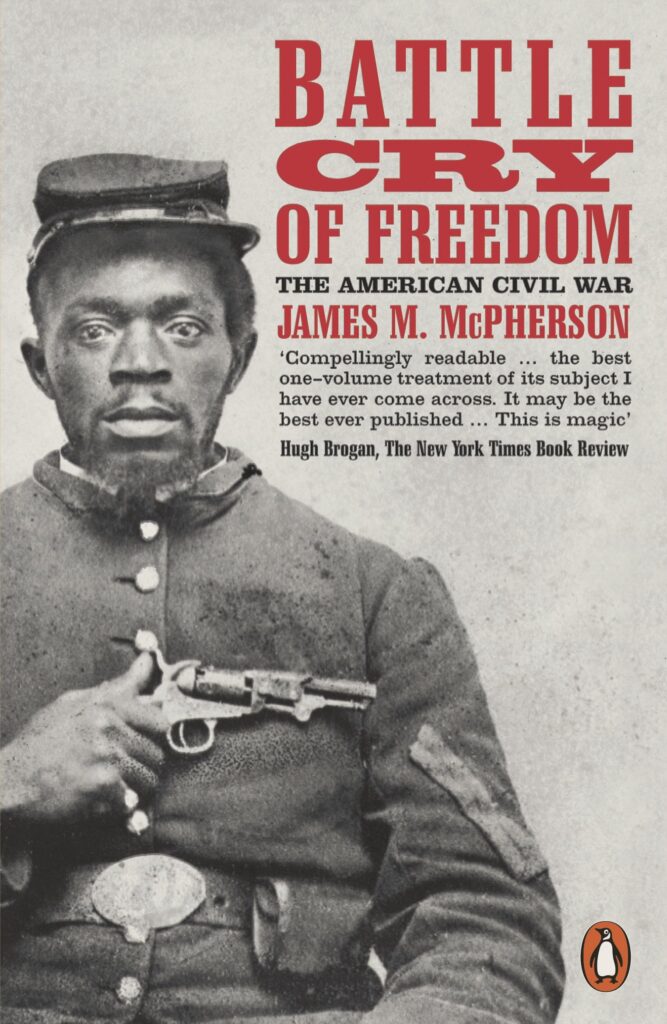
For my long read this summer, I intend to tackle James McPherson’s Battle Cry for Freedom (Penguin 1988). It’s been on the bookshelf for a while, and I hope the summer break will bring an opportunity to read what I understand to be one of the best accounts of the history of the American Civil War.
Kevin Crane
Having read Bevins’ excellent If We Burn over Christmas, I was keen to catch up with his earlier book on my summer getaway. The Jakarta Method: Washington’s Anticommunist Crusade and the Mass Murder Program that Shaped Our World (Public Affairs 2020) is not a light read, dealing with one of the major crimes of the twentieth century, but it is a gripping one. The author sees the Jakarta purge, a brutal CIA-sponsored coup in which half a million people were killed and around a million imprisoned for peaceful political beliefs, as a pivotal moment in the post-World War II world, whereby American imperialism prevented anticolonialism from developing into anticapitalism.
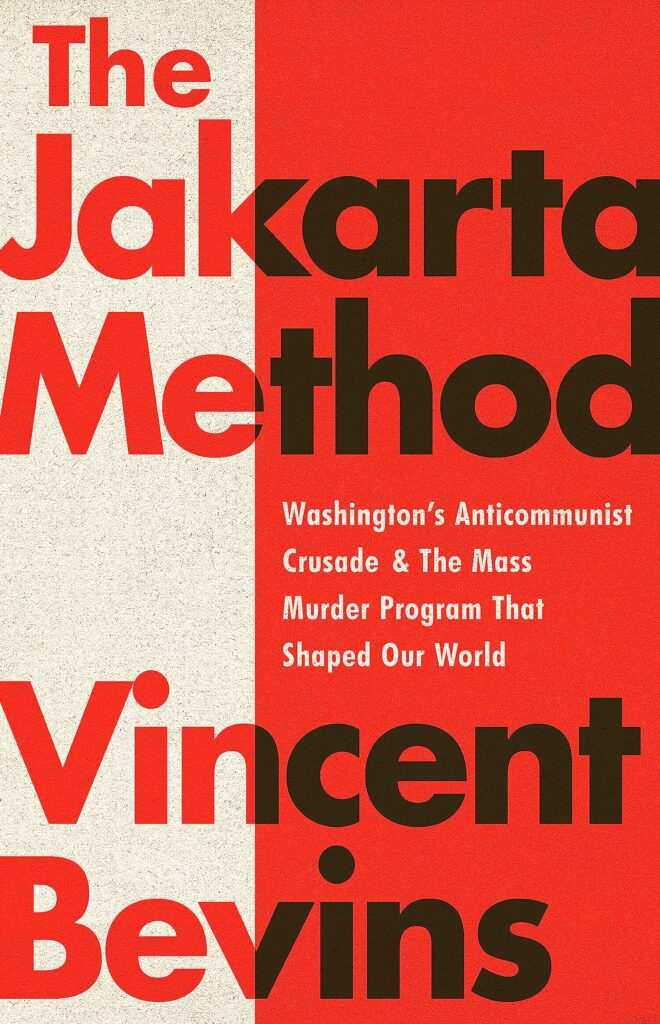
Bevins has a real enthusiasm for relaying the actual voices of working-class people in the Global South, and how their life stories are essential to understanding major political events. It’s one thing to know as a statistic that the Communist Party of Indonesia had been the largest non-governing communist party in the world; it’s another to hear about the day-to-day experience of its individual members, intellectuals, and activists. Indonesia is the world’s fourth-largest country, yet we seldom get the human details of its people’s lives in any context. For this alone, the book is refreshing.
The dark irony at the centre of this story is that neither the Indonesian Communists, nor the post-colonial government, nor even the ‘communist’ world powers, Russia and China, believed that a violent conflict was coming. The purge was forced by Cold War ideologues at the CIA, ironically demonstrating a mirror image of a Marxist analysis about class forces in the newly independent state.
In the Global North, we forget Indonesia – I’ve only ever read about these events before in Tariq Ali’s writings – but it has cast a long shadow over the rest of the world. This superb short history gives a compelling reason as to why that is, and why it matters.
Pete Webster
‘Here is a book which I should like to see published in millions of copies and translated into all languages. It gives a truthful and most vivid exposition of the events so significant to the comprehension of what really is the Proletarian Revolution and the Dictatorship of the Proletariat.’
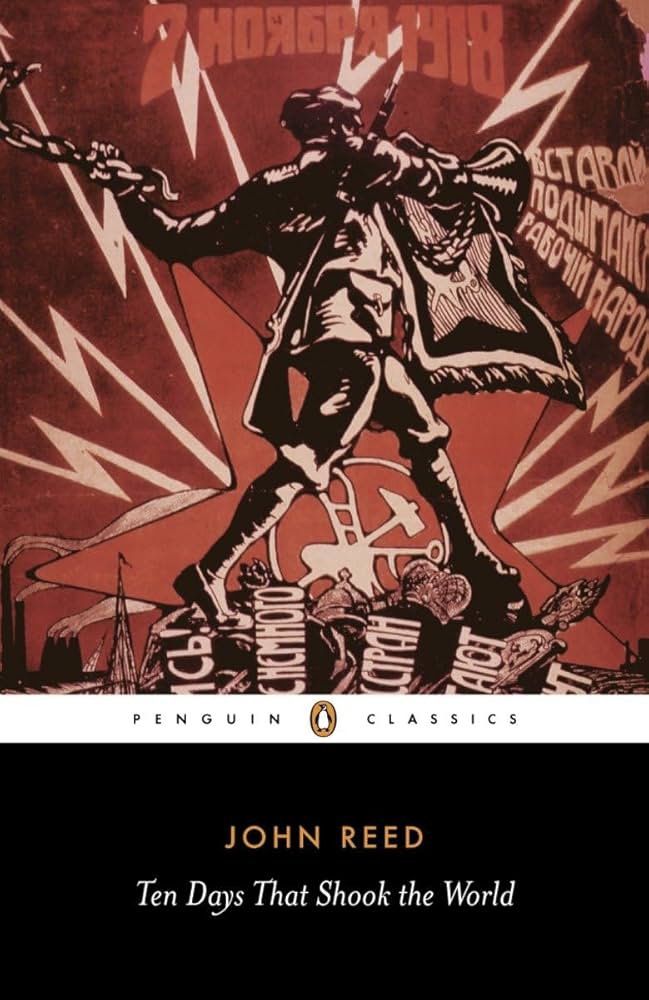
So wrote Lenin in his introduction to John Reed’s amazing Ten Days That Shook The World (1919, Penguin Classics 2007). Reed was an American journalist before and during World War I and was present in Russia, mainly in Petrograd, during the November Revolution of 1917. Previously, he had been an agitator and organiser in the Socialist Party of America, and had been involved in many industrial disputes led by the Industrial Workers of the World, the Wobblies. He also reported on the Mexican Revolution and World War I.
His eye-witness account of events leading up to the Bolshevik-led insurrection gives an intimate description of the twists and turns as various class forces, political parties and factions coalesced and collided with one another in a roller coaster of a historical ride.
As well as a blow-by-blow account of unfolding events, his style of writing grips the reader as he attends not only meetings where Lenin, Trotsky and other prominent leaders were speaking at, but he also captures the voices of those from the floor: of workers, of soldiers and sailors and of peasants.
His role as an international journalist also meant that he could have a more informed overview of the general situation as he encountered different social and political sectors, from the revolutionary to the downright reactionary. This allowed him to access meetings and key players who were determined to oppose any socialist movement that advocated for All Power to the Soviets to the extent of doing deals to invite the Kaiser’s German armies to occupy Petrograd and extinguishing both the soviets and their supporters, the mass of the city’s working class. In their view, a price worth paying.
Of course, it didn’t quite turn out like that, and if you read this book, you’ll find out why!
The book itself is almost 400 pages long, but don’t be put off. It has a great glossary outlining all the key organisations and key individuals, and in so doing gives an excellent introduction to those new to the history of the Russian Revolution, and a useful refresher for those who aren’t!
This is a powerful book and one that could not have been written by a passive observer hoping for some sort of objectivity, but by someone who was fully committed to an international workers’ revolution and understood how class relations interact at times of great struggle.
After briefly returning to America and becoming a founder member of the American Communist Party, Reed returned to Russia to write and fight alongside his comrades in the civil war. He succumbed to typhus in 1922 and was buried with honours next to the Kremlin in Moscow along with other fallen heroes. I lost my hard copy a few years back, but it is available as a free download.
Dominic Alexander
For Marx, capital is not simply a tangible thing; it is ‘value in motion’, something which, as it transforms from one state into another, actually hides itself beneath its material appearances. Capitalism is always presented as being about common-sense things, commodities, supply and demand, and so on. These are, however, only the surface appearances which mask the real ways in which the transformations of capital turn natural resources worked upon by human labour into commodities which, once sold, realise a profit for the capitalist.
Capitalist common sense presents this profit as the just return on investment, as if capital itself produces this profit. It does not, rather labour produces a surplus value which is appropriated by capital during production, and is transformed by capital’s motion through cycles of production and exchange, into that apparently more tangible thing ‘profit’.
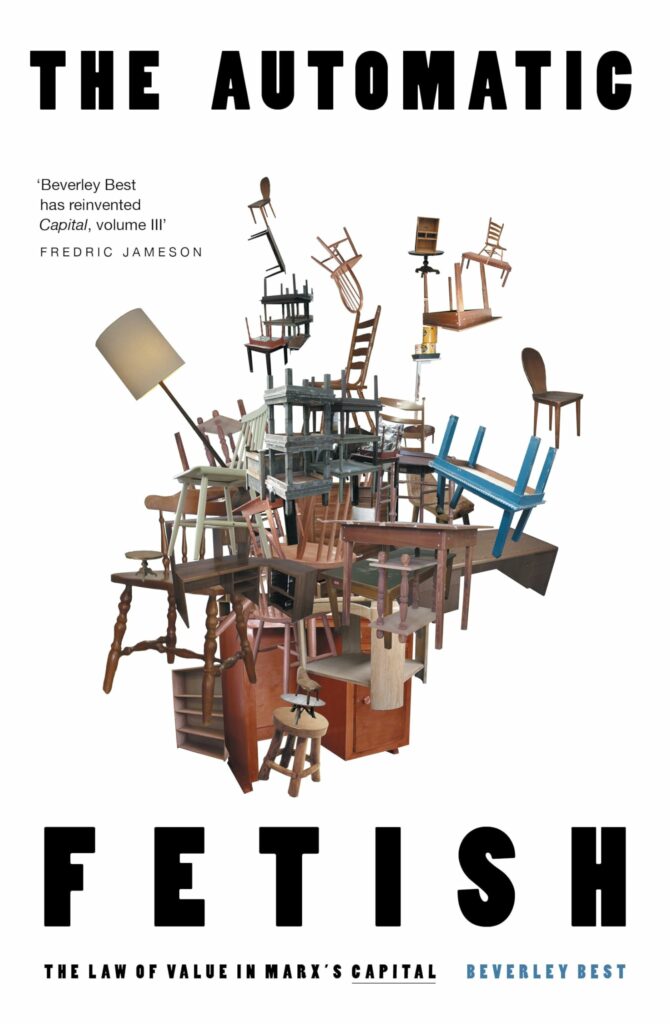
Beverley Best in The Automatic Fetish: The Law of Value in Marx’s Capital (Verso 2024) explains Marx’s analysis of value in Capital, particularly focusing on the notoriously difficult volume 3, which Engels had to construct out of an unfinished manuscript, unlike volume 2, which he had largely completed. Best emphasises the social character of capital and value; it only exists at the social level, through collective processes. The book is a thorough explanation of Marx’s value theory and its implications, which assumes no technical expertise on the part of the reader, so while it is not a breezy read, it is a deft unpacking of a sometimes daunting subject.
Capitalists and bourgeois economists fail to understand their own system because they start from the individual capitalist point of view and fail to look at the logic of the system at the social level. As a result, capital fosters illusions in its owners as to its miraculous power to create things and wealth. Nowhere in the modern world is this more evident than in various billionaires’ unhinged enthusiasms for the idea of human settlement beyond Earth.
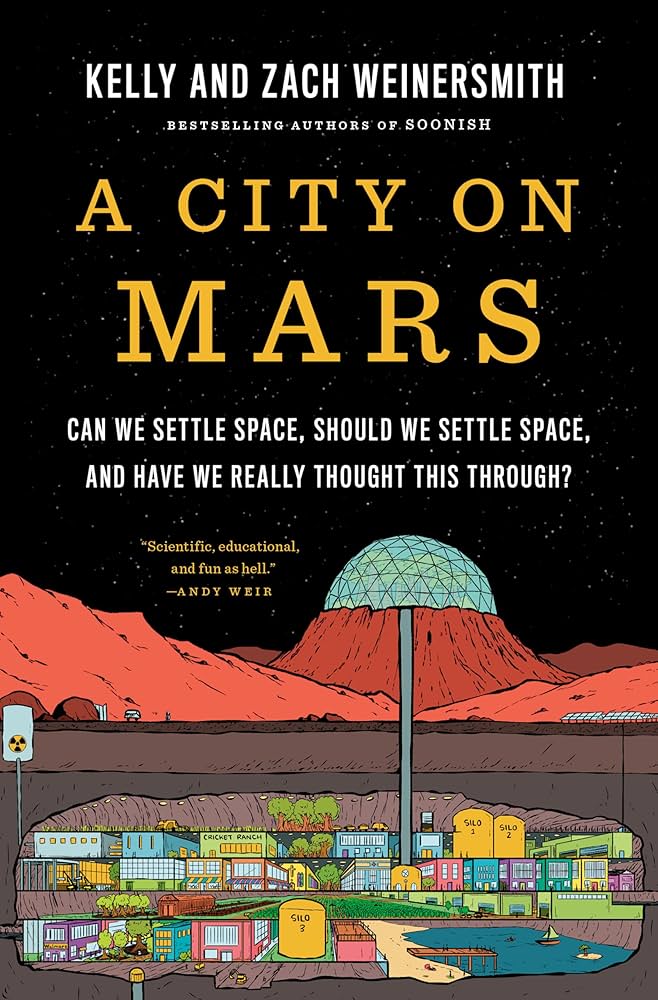
If you want an easier holiday read, then Kelly and Zach Weinersmith’s A City on Mars: Can We Settle Space, Should We Settle Space and Have We Really Thought This Through? (Penguin 2023) is a fascinating and witty demolition of fantasies that extraterrestrial human settlements are any kind of possibility for the foreseeable future. It’s not simply a matter of technical issues that could conceivably be overcome, but of huge obstacles to which the suggested solutions are beyond feasibility, including the really deleterious effects on human physiology of prolonged exposure to low gravity.
On the idea of using the moon as a springboard for further adventures, and actually manufacturing machinery in situ, where there are supposedly available resources, the Weinersmiths point out: ‘Noting that you could can make photovoltaics from metals and silicon [abundant on the Moon] is like noting that you can build an airplane because the dirt below your lawn contains aluminium, iron, and carbon’ (p.128). Then there’s the issue of the regolith on the Moon and Mars, toxic dust that would get everywhere because it would be very hard to filter out, endangering both machinery and human lungs. They also point out that even compared to an Earth habitat catastrophically affected by global heating, Mars would be a terrible, toxic and dangerous prospect. Among the many fantastical ideas that get shredded by the Weinersmiths is the notion that large bodies like asteroids could be brought closer to Earth for easier mining. One of the authors doubles as a cartoonist, and the book is peppered with amusing illustrations, including one about this notion. It features a bemused hadrosaur looking out at the reader, saying, ‘You’re interested in the dense metals, you say?’ This is a fascinating and entertaining book.
Katherine Connelly
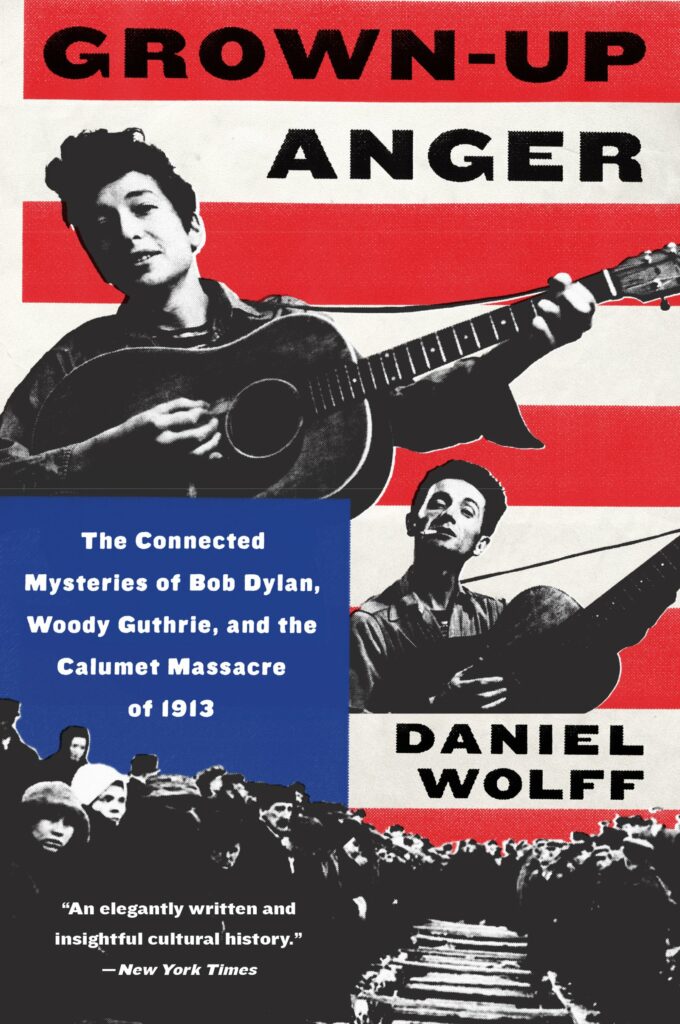
If you enjoyed the film A Complete Unknown, which came out earlier this year, I think Daniel Wolff’s Grown-Up Anger: The Connected Mysteries of Bob Dylan, Woody Guthrie, and the Calumet Massacre of 1913 (New York: HarperCollins, 2017) is a book you’ll want to take to the beach. Unlike the film, this isn’t the story of ‘Dylan going electric’. Instead, this book tells many stories of resistance and struggle in the United States, stories that have been suppressed and hidden, but shared and re-told in American folk music. It begins with the moment that changed the author’s life when, as a teenager, he first heard Bob Dylan’s ‘Like a Rolling Stone’.
Captivated by Dylan’s musical articulation of his own anger and, more widely, the insurgent mood of the 1960s, Wolff sets out on a musical journey across time to the source of this anger. He takes us to the moment movingly dramatised at the beginning of A Complete Unknown, when Dylan sings ‘A Song to Woody’ to his dying musical hero Woody Guthrie. This celebration of Guthrie and folk music uses the tune to Guthrie’s ‘1913 Massacre’ and so we journey with Wolff through Guthrie’s formative experiences in the Great Depression to the brutality meted out to striking workers in Calumet, Michigan in 1913, which culminated in the deaths of seventy-three working-class people at the strikers’ Christmas party. Wolff explores the cover-up and also a musical tradition of struggle and truth-telling from Joe Hill and the Industrial Workers of the World, which finds new expression in the young Bob Dylan.
It’s a powerful refutation of the cynical sneer that young musicians who speak out against establishment violence are immature: their anger has deep roots. And that feels especially relevant right now.
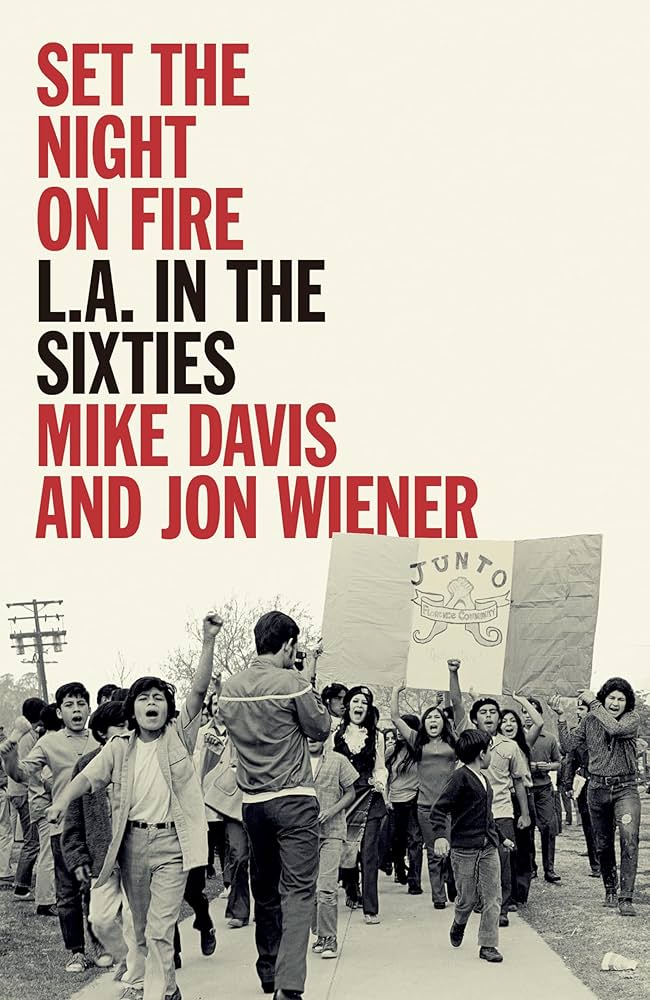
I read Set the Night on Fire: L.A. in the Sixties (New York; London: Verso, 2020) last year and it has been on my mind as I watched the news of the protests at the immigration raids in the city. This is a wonderful book by the late and deeply missed Mike Davis and Jon Wiener, both from the city of LA, who combine personal experience of the struggles of the city with an epic portrait of the multiple mass movements that terrified the political establishment in the 1960s. The political development of the civil-rights movement, the Black Panthers, the women’s liberation movement, the Chicano movement, the campaigns for nuclear disarmament, the anti-Vietnam movement, the Watts riots and many more are explored in fascinating detail, which takes readers to the heart of debates about how to confront oppression, violence and exploitation. They also show how new political ideas were conveyed in and reshaped the music, art, theatre and even film industry in the city.
This is no nostalgic portrait of a bygone age, nor is it the liberal establishment’s comfortable story about change having already been achieved. In part, it explains how the establishment fought back and curtailed and commodified the dreams of the 1960s. Yet, in excavating those dreams, Davis and Wiener provide a glimpse into a completely different world that we could win, and how exciting that struggle could be.

One for young people is Barbara Mitchelhill’s Secret Suffragette (London: Andersen Press, 2019). This fiction book for young people provides a wonderful and very realistic insight into the radical working-class suffragette movement in East London. Through the eyes of young East Londoner Daisy with seemingly impossible dreams of becoming a nurse, Mitchelhill shows readers how exciting it must have been to go on a suffragette demonstration in Victoria Park, to hear Sylvia Pankhurst speak just after being released from a prison hunger strike and to try to outwit the police after throwing suffragette leaflets from the top of the Monument (and all these are things that really happened). The book shows why this movement for women’s rights was so important in East London, but also why there were very different reactions to it, providing sensitive and nuanced descriptions of domestic violence, sweated labour and how people change their minds.
Before you go
The ongoing genocide in Gaza, Starmer’s austerity and the danger of a resurgent far right demonstrate the urgent need for socialist organisation and ideas. Counterfire has been central to the Palestine revolt and we are committed to building mass, united movements of resistance. Become a member today and join the fightback.
