
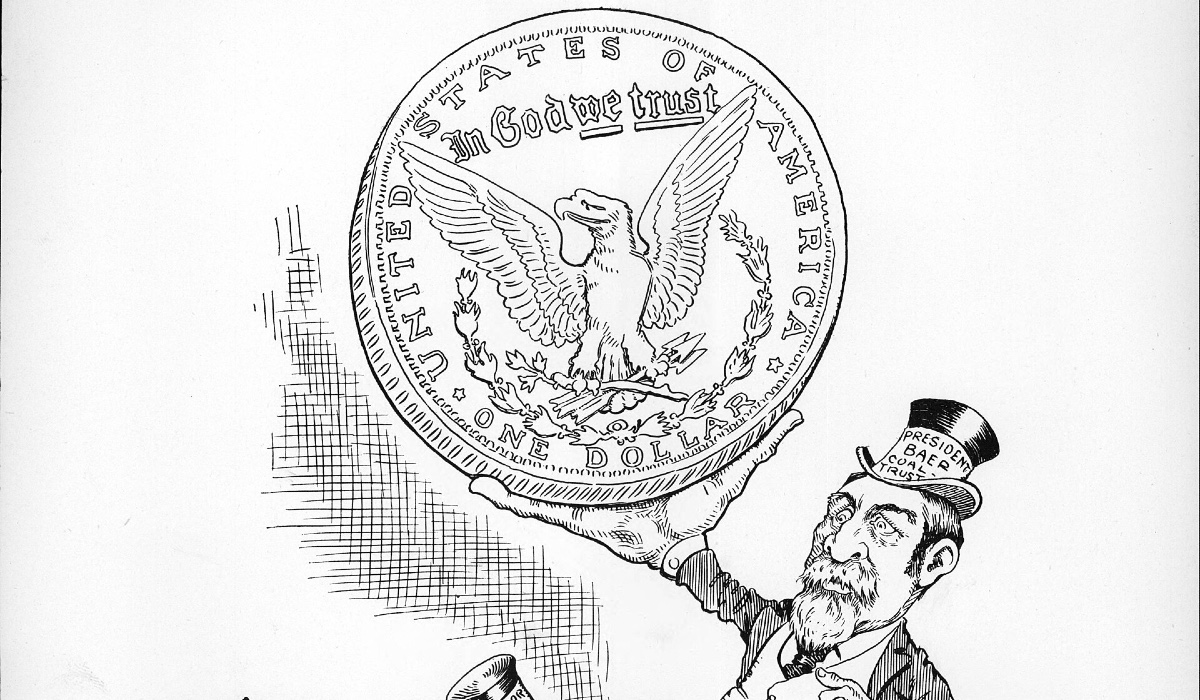
 Almighty Dollar Cartoon by Charles Bartholemew, 1902/ Wikimedia Commons
Hassan Elbiali, political analyst and commentator, argues that a US war financed by debt could accelerate the end of the petrodollar
While watching the ceasefire negotiations from Islamabad, what struck me wasn’t the diplomatic choreography. It was that while Trump’s generals were arguing about Hormuz tolls, the Treasury Department was quietly borrowing another $88 billion that month just to pay interest on what America already owes. The war on Iran isn’t just a geopolitical disaster. It’s a fiscal time bomb and the shrapnel is hitting the global reserve currency system.
The US is financing this war on borrowed money, at higher interest rates, on top of an already catastrophic debt base. That’s not sustainable and markets know it. What is happening now is the beginning of something larger – the structural erosion of American economic dominance.
The Arithmetic of Overreach
The first six days of Operation Epic Fury cost $11.3 billion, according to Pentagon figures. However, Harvard public finance expert Linda Bilmes argues the real cost is higher – around $16 billion for those same six days.
Why the gap? The Pentagon counts replacement costs at historical inventory values. Bilmes counts what it actually costs to replace assets today: aircraft losses, munitions expended at historic burn rates and carrier strike group maintenance. The difference between accounting and reality.
Bilmes believes the war will cost at least $1 trillion over the next decade, stating she is “certain” the US will reach that figure. However, that is the operating cost. The real bill arrives later. Long-term disability benefits for combat veterans (Bilmes notes the US already owes $7.3 trillion for previous wars), interest payments on borrowed money and economic damage from disrupted oil markets.
The Trump administration gambled, hoping this war would be short and contained. It wasn’t, and unlike previous administrations, this one isn’t asking Americans to pay for it through taxes.
The Bush Precedent
In 1950, fighting the Korean War, President Harry Truman gave more than 200 speeches advocating for a “pay-as-you-go” policy, using tax revenue, not borrowing, to fund the military.
By World War II, progressive income tax rates hit 77%. The government faced hard choices: fight or invest in civilian infrastructure. It chose explicitly.
George W. Bush changed that calculus in 2001 and 2003, cutting taxes at the exact moment he launched wars in Iraq and Afghanistan. He was the first US president to fund a war entirely through borrowing rather than taxes or budget adjustments.
Bilmes and economist Joseph Stiglitz published research showing the Iraq war ultimately cost $2 trillion – four times the Congressional Budget Office’s projection- and by 2013, this was revised to $4–6 trillion when long-term costs were included. Trump is repeating that script and he’s doing it in a worse fiscal position.
The Interest Rate Trap
The US is not just borrowing more; it is borrowing at interest rates that are historically elevated.
The Congressional Budget Office projects that interest payments will hit $1 trillion in 2026 alone, a 7% increase from 2025. Over the next decade, net interest payments are projected to total $16.2 trillion – higher than any 10-year period in American history. That’s not a metaphor. It’s the single fastest-growing line item in the federal budget.
The US government is currently spending more than $88 billion per month in interest payments- more than $22 billion a week. For context, that’s roughly equal to total defense and education spending combined. Every dollar that goes to interest is a dollar unavailable for infrastructure, healthcare, social programs, or critically- future military capacity.
Here’s the vicious cycle- more debt requires higher interest rates. Higher interest rates mean more money servicing debt. More debt servicing means less fiscal flexibility to respond to crises.
When the next emergency hits, a pandemic, a climate disaster, another war, the US won’t have ammunition in the budget to respond. That’s not a budget problem. That’s a national security problem.
The Dollar’s Slow Collapse
The Iran war is something more than just expensive. It’s accelerating the end of American financial hegemony. For 50 years, the petrodollar system has been the hidden foundation of US power. In 1974, Henry Kissinger struck a secret deal with Saudi Arabia. Oil exporters would price crude in dollars, and the US would guarantee their security.
In return, those oil revenues would flow into dollar denominated assets, treasury bonds mostly. It created a perpetual buyer for American debt, allowing the US to run deficits other countries couldn’t sustain. The dollar’s share of global foreign exchange reserves has fallen from over 70% in 1999 to just over 50% today. That’s not a crisis yet. But it is structural erosion.
The US dollar’s share of global foreign exchange reserves reached roughly 56.9% as of Q3 2025, its lowest level since 1995 and down from 72% in 2001 according to IMF data. Other currencies such as the euro and the yuan are taking larger slices and now the Iran war is testing the petrodollar system directly.
The Strait of Hormuz
When Iran blockaded the Strait of Hormuz, it didn’t just create a military problem for Trump. It created an economic signal. Countries suddenly realised: we don’t have to pay for oil in dollars, we can use alternatives. Deutsche Bank strategist Mallika Sachdeva predicted in March that the Iran war could be remembered as “a key catalyst for erosion in petrodollar dominance, and the beginnings of the petroyuan.”
That’s not hyperbole. There has been a proliferation of bilateral trade arrangements denominated in non-dollar currencies, particularly involving China. Countries subject to US sanctions, like Iran, have agreements to settle energy trades in yuan. The “weaponisation” of the US dollar to impose sanctions following Russia’s invasion of Ukraine accelerated this trend.
The yuan doesn’t yet challenge dollar dominance. Yuan-denominated trade accounts for less than 4% of global totals, and China’s Cross-Border Interbank Payment System (CIPS) remains tiny relative to dollar-based infrastructure centred on SWIFT. However, the infrastructure exists now – it works and it scales.
The Paradox
The harder Trump pushes militarily, the faster countries flee the dollar system. By weaponising sanctions, threatening allies and making the dollar itself into an instrument of coercion, the US is giving every country that can afford it a reason to diversify away.
Gold reserves have now eclipsed central bank holdings of valuation-adjusted dollar assets for the first time in several decades, according to analysis from Finance BigGo. That’s the market saying: we don’t trust the dollar like we used to.
The Iran war isn’t causing this shift, it’s accelerating it. The US Treasury is financing the acceleration by borrowing at the exact moment when international confidence in American fiscal discipline is collapsing.
What This Means
The Congressional Budget Office projects debt held by the public will rise from 101% of GDP in 2026 to 120% in 2036. Higher than at any point in American history. That is not sustainable.
Markets will force correction- either through inflation, currency devaluation, or forced fiscal austerity. Once it happens, the dollar’s role as the world’s reserve currency won’t snap back overnight. Reserve currencies don’t collapse; they erode. The British pound took 30 years to become secondary and the dollar’s decline could follow a similar timeline.
The real cost of the Iran war won’t appear in Pentagon budgets. It will appear in the interest rates the US pays in 2030, 2035 and 2040. It will appear in reduced military capacity, in infrastructure spending deferred and in a generation of Americans bearing the bill for a war their country couldn’t afford.
This is what military overreach looks like in the age of high debt. Not defeat in the field, defeat in the bond market. By the time everyone sees it clearly, it will already be too late to reverse.
Before you go
The ongoing genocide in Gaza, Starmer’s austerity and the danger of a resurgent far right demonstrate the urgent need for socialist organisation and ideas. Counterfire has been central to the Palestine revolt and we are committed to building mass, united movements of resistance. Become a member today and join the fightback.
