
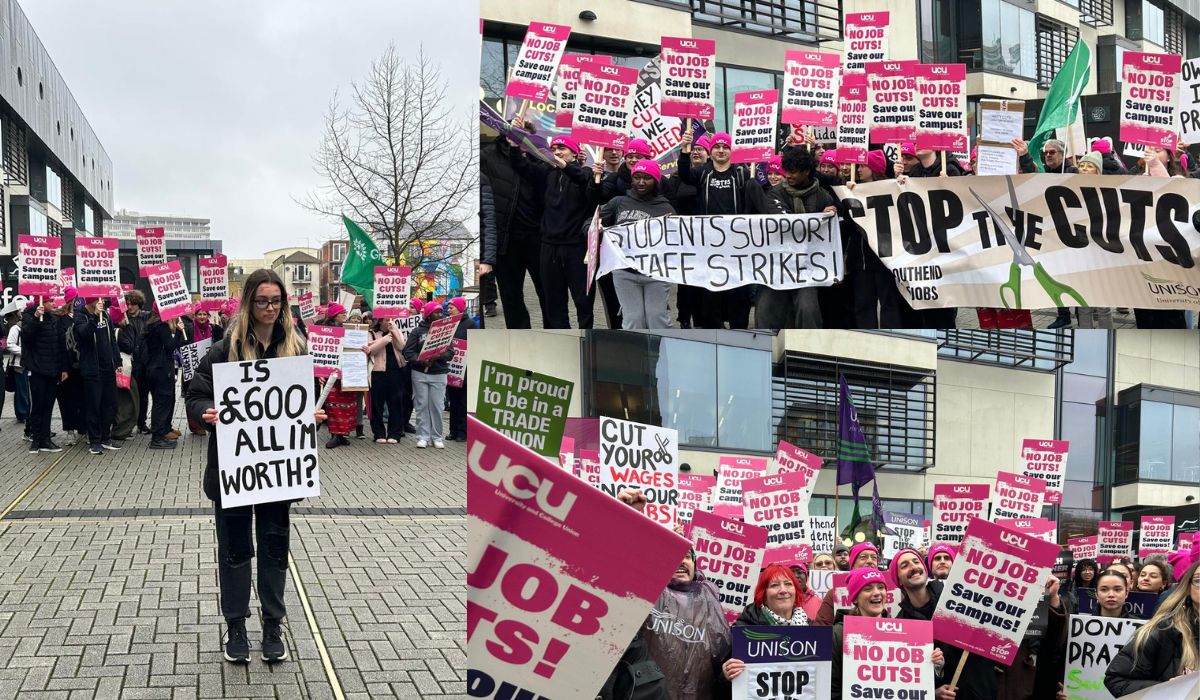
 Essex University staff and students held a noisy protest on Thursday against
management’s proposal to shut the Southend campus. Source: Des Freedman
Essex University staff and students held a noisy protest on Thursday against
management’s proposal to shut the Southend campus. Source: Des Freedman
Letting markets decide the funding of higher educationhas left many institutions in the doldrums, but the staff and students in Southend are fighting back, says Des Freedman
Hundreds of staff and students of Essex University held a noisy protest on Thursday against management’s proposal to shut the Southend campus as part of a cost-cutting programme that will devastate the local community.
Faced with a £23m deficit, the university has also announced 400 job cuts – divided between professional services and academic staff in both Colchester and Southend – around 20% of its workforce.
In response, UCU is set to take seven days of strike action from 12 February, with Unison shortly to ballot as well.
Nursing, social care and drama students joined with members of the local Unison and UCU branches to attack the decision, which will penalise, in particular, poorer students who will have no way to afford the journey to and from the main campus in Colchester.
The protestors heard from a range of speakers, including the secretary of the university’s Unison branch, Ryan McCready, who talked about the ‘appalling consultation’ conducted by management.
“The university doesn’t want staff to have a voice. We heard about losing our jobs on Zoom. There’s been no dignity in this.”
McCready highlighted the wider concerns about higher education funding and argued that staff and students needed to stand together to fight the cuts.
Jordan Osserman, co-president of Essex UCU, condemned the ‘unaccountable senior managers and business leaders with no links to the community who are trying to decide the “size and shape” of our university.’ Osserman called for resistance: ‘We’ve never seen a movement win by asking nicely. We’ve never won anything without a fight.’ Arguing that while managers just want to ‘save their skins’, the real issue is that “they can’t run this university without us and they can’t make it function if we refuse to make it function”.
Andrea Egan, the new general secretary of Unison, called on the university to scrap its plan. “This crisis is being dumped squarely on the back of workers,” she argued and attacked the refusal of the government to support higher education staff and students.
“The funding model for HE is broken, but where’s the government? Where’s [the education secretary] Bridget Phillipson? They’re standing back, and that is a political choice.”
The final speaker was Jo Grady, general secretary of UCU, who paid tribute to the local branch for leading a fight against the proposed closure. “We need to see decision-makers in universities held to account. Education isn’t just for the select few or select areas. It signifies opportunity and hope, and closing the campus signifies the opposite.” She raised a loud cheer when she said: “Less protecting Mandelson and your cronies and more protecting Southend and the campus. Are you going to continue to bow to big business or to government for communities like those in Southend?”
The campus was first opened in 2008, one of several funded by big grants from a Labour government and part of a strategy that promised to transform struggling towns and to provide more accessible university opportunities for local people. This was a £25 million project that aimed to regenerate an ailing seaside resort with an influx of business, medical and (later) drama students.
The problem was that the strategy to democratise access to HE was never followed up with sufficient public funding or coherent planning. In fact, within a couple of years, tuition fees had trebled, students were increasingly saddled with unsustainable debt, and market forces were embedded in the delivery of HE. Universities became major businesses run by vice-chancellors with astronomical salaries funded, in particular, by income from overseas students. Student number controls were scrapped in 2015 so that institutions competed even more vigorously with each other, leaving smaller and less prestigious universities ever more exposed to changing demographics and political priorities – especially around immigration.
Now, with a huge decline in the number of overseas students signing up for UK programmes – hardly a surprise given both Tory and Labour government rhetoric about the damaging impact of immigration on local communities – it’s local communities like in Southend that are going to be badly hit.
Using the cringeworthy language of the government and the regulator, the university is talking about how much it regrets its “exit” from Southend as if it’s somehow going to re-enter anytime soon. Moreover, the university is refusing to share the full business case for its decision because of “commercial sensitivities” that may affect selling off its “assets”.
It used to be the case that a university’s assets were human and not about buildings and infrastructure. Well, those human assets – its staff – are now set to take sustained strike action to fight against the closure, the cuts and the broken promises of regeneration and educational accessibility.
The market has failed Southend – and dozens of other places which were promised sustainable higher education – and it’s outrageous that this Labour government is just as content as its Tory predecessors to shrug its shoulders, blame foreign student ‘overstayers’ and do nothing as jobs, academic programmes and campuses crumble before our eyes.
All eyes are on Essex as staff and students fight not simply for jobs and programmes but also for a higher education system that is accessible to all.
Before you go
The ongoing genocide in Gaza, Starmer’s austerity and the danger of a resurgent far right demonstrate the urgent need for socialist organisation and ideas. Counterfire has been central to the Palestine revolt and we are committed to building mass, united movements of resistance. Become a member today and join the fightback.

Des Freedman
Des Freedman is Professor of Media and Communications in the Department of Media and Communications at Goldsmiths, University of London. He is the co-author of 'The Media Manifesto' (Polity 2020, author of 'The Contradictions of Media Power' (Bloomsbury 2014), co-editor of 'The Assault on Universities: A Manifesto for Resistance' (Pluto 2011), and former Chair of the Media Reform Coalition.