
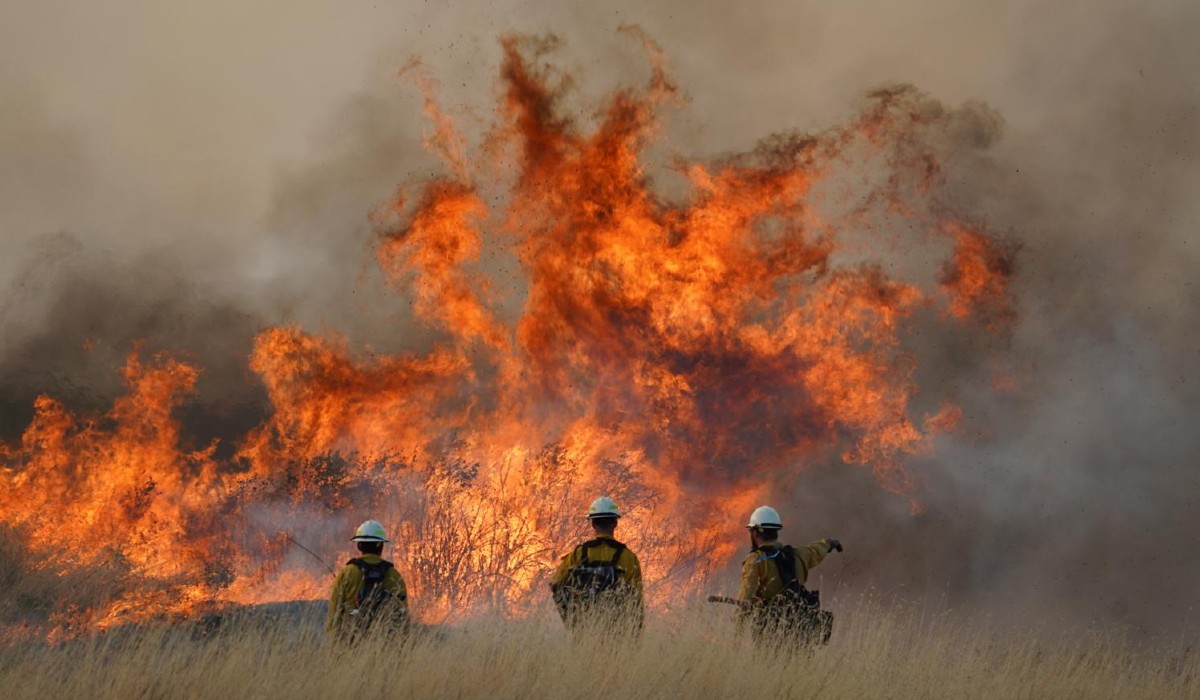
 Billowing flames in grasslands of the Modrite Fire / Public Domain
As extreme wildfires become a deadly seasonal threat, governments are accelerating the causes of the crisis, showing that the system of profit is an existential threat, argues John Clarke
Devasting wildfires are raging across Canada and they are clearly a manifestation of the rapidly intensifying global climate disaster we are now living through. As communities are being evacuated, overstretched and under-resourced firefighting systems are being tested to the limit. Yet, even in the face of this, no plan to curtail carbon emissions is being developed. On the contrary, Canada’s political establishment has united around a plan to develop massive fossil-fuel projects that can only worsen this already desperate situation.
CTV News reports that more than 950 ‘wildfires are scorching Canada from coast to coast, the national wildland fire summary says. Roughly 241 blazes are out of control.’ In the province of Ontario, nearly 200 ‘wildfires are blazing across the province, already scorching more land than all of last year’s fires.’
Among the fires raging in Ontario, 73 are considered to be burning out of control and, according to Global News, the provincial natural resources minister, Mike Harris, told reporters that: ‘Since the beginning of this year we’ve been obviously prepping for another season of wildfires here in the province but this year has been unprecedented.’
The scale on which the forests are burning has ensured massive air-pollution problems for densely populated urban areas across a large part of North America. The Guardian informs us that air-quality ‘alerts were issued across more than 20 US states [and] about 109 million Americans across the midwest, mid-Atlantic and north-east experienced unhealthy air this week.’
A resident of Waterloo, in south-western Ontario, told The Guardian that those ‘without air conditioning have the battle of choosing between dealing with heat or smoke. For many of us, this is the second or third or fourth summer facing these conditions that were nowhere near normal even just a decade ago.’
In nearby Hamilton, a self-employed carpenter complained that toxic air had led to loss of pay, as outdoor work became impossible. He stated that with ‘wildfires getting worse and worse, year after year, why is our government not stepping up to the plate? Freebies don’t help when I can’t breathe, can’t work, or can’t feed my family or keep a roof over my head.’
On 18 July, Toronto registered the worst air quality of any major city on earth for the second time in a few days. According to Toronto Today, the ‘city has also opened “cleaner air spaces” … for residents who need relief from the smoky conditions.’ Such short-term respite falls far short of keeping vulnerable low-income tenants and unhoused people safe. Social abandonment is emerging as a feature of the climate crisis that must be exposed and challenged.
Global heating
The Canadian Climate Institute makes the link between more severe wildfires and the onset of global heating very clear. It notes that Canada is warming at double the global average and that it is home to more than a quarter of the world’s boreal forests, so that the conditions have been created for a catastrophic intensification of wildfires.
The Institute informs us that the ‘last three fire seasons have been among the 10 worst on record. Canada experienced its most destructive wildfire season ever in 2023, with fires consuming 16.5 million hectares—more than double the previous record and nearly seven times more than the historical average.’ Since carbon emissions are not being curtailed and the warming of the climate is continuing, there is no reason to expect anything other than ever larger and more destructive fires in the years ahead.
Given the scale of the problem and the bitter experiences of the last few years, no one in authority can credibly suggest that the wildfires that are now raging have taken anyone by surprise. Yet, we see here in Ontario a shocking lack of preparedness for what is unfolding.
On 17 July, The Grist reported that thirteen Indigenous communities across Canada face evacuation orders, with the worst impacts being experienced in Ontario. ‘The Namaygoosisagagun (Collins) First Nation watched one blaze largely destroy its entire community in less than an hour, forcing residents to flee by boat. Residents reported having only minutes to gather their belongings before homes were overtaken by the flames …’
Having been forced to organise their own desperate evacuation, with some having to leave hastily in boats, the members of this community are left wondering what support they will receive in order to rebuild and return. A letter from a lawyer representing the community, sent to the Ontario Indigenous Services Minister, states that ‘… the question is not merely whether recovery will be delayed. It is whether Namaygoosisagagun will have a future in the place it has called home since time immemorial.’
Ontario’s Conservative premier, Doug Ford, has responded to allegations that his government undermined the capacity to respond effectively to the kind of emergency situation that is now happening with his characteristic bluster. However, CBC News makes clear that this ‘year’s budget shows the province spent $271 million on emergency firefighting in 2025-26, but plans to spend $150 million in 2026-27. The province had initially planned last year to spend $135 million, but went well over budget due to a difficult fire season.’
More oil production
Even as Ford seeks to excuse his failure to keep communities safe in the face of the threat of fire, he is working flat out to ensure that this danger is made even more serious. Another CBC News report published earlier this month informs us that the ‘premiers of Alberta and Ontario unveiled a proposed 3,300 km pipeline to transport oil from Western Canada to refineries in southern Ontario. The pipeline would transport an estimated 500,000 barrels per day of oil with possible expansion to 800,000 barrels per day.’
For its part, the federal government of Mark Carney is pursuing an even more reckless course, with massive plans for expanded fossil-fuel production. Indeed, Carney is doing all he can to support the Alberta government’s plans to ‘double Alberta oil production to eight million barrels a day in as little as a decade.’ He intends to support another Alberta pipeline initiative to transport oil to the Pacific coast. For good measure, Carney has also declared that earlier plans to reduce carbon emissions have now been revoked.
As these dreadful fires rage, Donald Trump has added a note of absurdity, declaring, as reported by CBC News, that: ‘We are holding Canada responsible for the fact that they are not properly maintaining their Forests, and Brush therein, and the United States is being unnecessarily invaded by filthy, polluted, and unhealthy air.’ He went on to threaten ‘to top up the import tariffs he’s already levied on Canadian goods in response to the smoke that has drifted south of the border.’
Trump may well know even less about forestry than he does about climate change. Though forest management is not an irrelevant consideration, the key factor at work is that global heating continues to render the vast wooded areas of Canada ever more combustible. In this regard, fossil-fuel capitalism on both sides of the border is fully responsible, as are its political agents like Trump and Carney. They are quite literally pouring oil on a fire that is starting to burn out of control.
Like heatwaves, droughts, floods and rising sea levels, the enormous increase in the scale and severity of wildfires is a manifestation of a climate disaster that is already producing terrible results but that is still in its relatively early stages.
We are approaching a sustained 1.5C increase in global temperatures and the impacts are already massively destructive and lethal. As long ago as 2012, a report issued by the World Bank was warning that a course towards a 4oC increase by the end of the century had been set.
As Canada’s forests burn, releasing vast quantities of CO2 into the atmosphere in the process, we see yet more horrible evidence that defeating the profit-driven drive to climate destruction is a defining struggle of our times.
Before you go
The ongoing genocide in Gaza, Starmer’s austerity and the danger of a resurgent far right demonstrate the urgent need for socialist organisation and ideas. Counterfire has been central to the Palestine revolt and we are committed to building mass, united movements of resistance. Become a member today and join the fightback.

John Clarke
John Clarke became an organiser with the Ontario Coalition Against Poverty when it was formed in 1990 and has been involved in mobilising poor communities under attack ever since.