
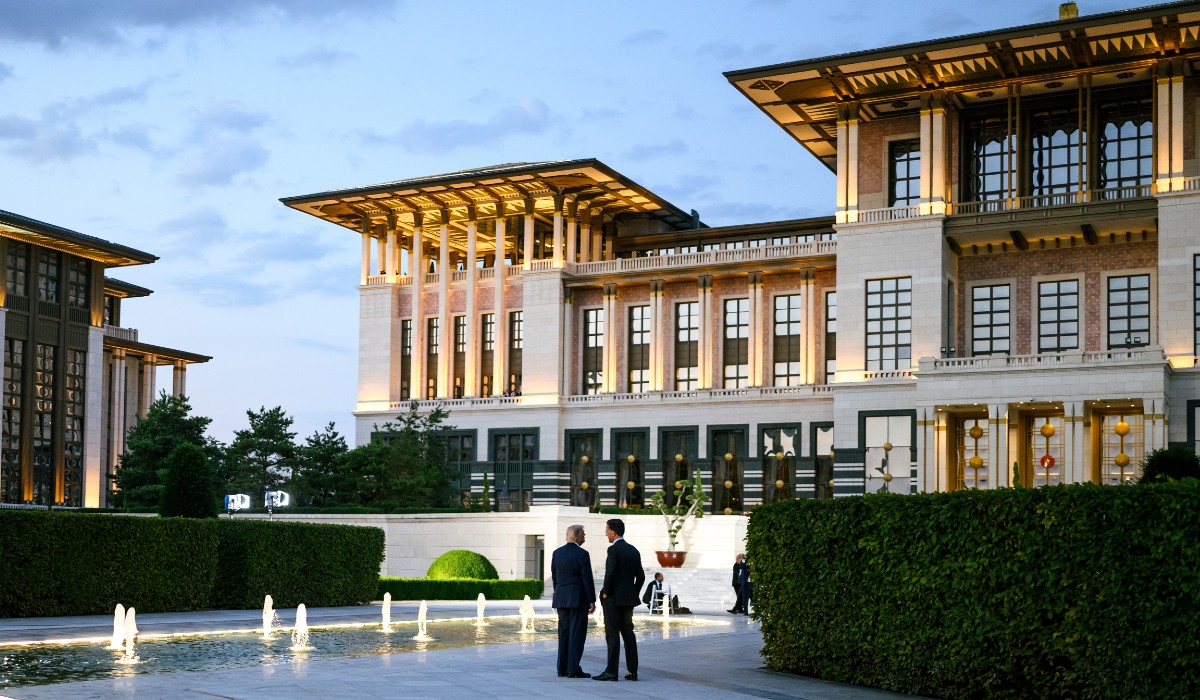
 Donald Trump speaks with NATO Secretary General Mark Rutte speaking at the Bestepe Presidential Compound in Ankara, Turkey / Public Domain
The staggering increase in military spending by ‘middle powers’ comes at a huge social cost. Anti-war and workers’ movements must unite to resist this, argues John Clarke
Wars involve death and destruction on a massive scale but, before a single bomb has been dropped, huge resources that might meet the needs of populations have been diverted into costly military buildups. An arms race, by definition, means one level or another of social abandonment.
At this stage in the development of global capitalism, an unprecedented effort to increase the capacity to unleash state violence is underway. The incredible scale on which the drive towards war is unfolding is utterly staggering.
An article in Al Jazeera that was published this April noted that the ‘world’s militaries spent $2.88 trillion in 2025 [representing] $350 of military spending for each person on the planet.’ Moreover, the global military budget is shooting up, with 2025 producing ‘the highest levels of military spending in history, increasing to $2.88 trillion from $1.69 trillion in 2016 – a rise of 41 percent.’
Predictably, the ‘US is by far the biggest spender, as it has been every year since World War II. The $954bn spent by the US is more than the next six countries combined.’ However, country after country is now acting to build and maintain a vastly increased capacity to inflict death and destruction.
Middle powers
The new priority given to a military buildup is particularly striking in the case of the lesser imperialist powers that have functioned as junior partners of the US since World War Two. These ‘middle powers,’ as Canadian prime minister Mark Carney characterised them in a speech he delivered at the World Economic Forum in January, are trying to grapple with the Trump administration’s America First turn and its rejection of the previous US role of cornerstone of a ‘rules-based’ global order. A major effort to increase independent military power is very much part of this.
Certainly, Carney’s government is working to increase drastically Canadian military capacities. For years, the US and other Nato powers have sharply criticised Canada as a supposed laggard in arms spending but Carney is determined to change all that and the zeal with which he is approaching this is remarkable.
A self-congratulatory Government of Canada news release that was issued in April proudly announced that it had ‘delivered on a core objective of its plan – achieving the NATO 2% defence spending target this year, half a decade ahead of schedule … generating significant economic benefits — driving innovation, growing the defence industrial base, and creating long-term prosperity for Canadians.’
The release makes it abundantly clear, however, that this ‘historic defence investment’ is but a prelude. We are told that over the next decade, ‘Canada will deliver half a trillion dollars in defence investment, putting the country on a clear path toward meeting the new NATO Defence Investment Pledge of 5% of GDP by 2035.’
To put this level of military expenditure into some perspective, it is worth noting that Israel, a garrison state undertaking a brutal occupation and engaged in ongoing wars of regional aggression, devotes 8.8% of its GDP to its military. The Canadian state isn’t remotely comparable to Israel in matters of military deployment, yet a huge diversion of resources to raise the level of preparedness for war is underway.
A glance at other ‘middle powers’ confirms this appalling pattern. According to the Stockholm International Peace Research Institute, ‘Japan’s military expenditure rose by 9.7 per cent to reach $62.2 billion in 2025, equivalent to 1.4 per cent of GDP—the highest share since 1958.’ Tellingly, ‘US allies in Asia and Oceania such as Australia, Japan and the Philippines are spending more on their militaries, not only due to long-standing regional tensions but also due to growing uncertainty over US support.’
In the UK, Keir Starmer has taken care to augment his objectionable political legacy with a final effort to boost military spending. The BBC reported on 30 June that Starmer would seek ‘a £15bn increase in military spending [that] will be funded by cutting investment budgets in other areas.’ He even suggested that this move was necessary to reverse the ‘corrosive hollowing out’ of the armed forces that supposedly took place under Conservative governments.
Those imperialist countries that have functioned for decades within a US-led world order are still trying to come to terms with a major US strategic turn that has seriously disrupted trading relations, diplomatic cooperation and military alliances. Their rush to increase military capacities is often presented as simply an attempt to appease Trump but there is more to it than that.
No doubt, the ‘middle-power’ political leaders are anxious to preserve as much as they can of their former cooperative relationship with Washington but they are acutely aware that the US now measures things to a much greater extent in terms of immediate self-interest. As part of this, Washington’s readiness to defend allies in order to preserve global and regional alliances is greatly diminished.
As reported by CTV News, Mark Carney used the recent Nato Summit in Ankara to proclaim that, when it came to Trump’s demands for increased military spending by other Nato members, it’s ‘not just that he’s winning the argument — he’s won the argument. Countries realize they need to take more responsibility. They see the direct threats.’
PBS News informs us that Nato general-secretary Mark Rutte was ready as always to put on a display of abject submission. He went to the White House before the summit to display a ‘chart labeled the “The Trump Trillion” in gold letters — showing $1.2 trillion in spending by European allies and Canada since 2017.’ For his part, however, Trump simply denounced Nato allies for not joining his attack on Iran and declared that: ‘We don’t need their money — we don’t need anything. I just want loyalty.’
It can’t be lost, even on the obsequious Rutte, that Trump’s imperious demands reflect an extreme indifference to the Nato alliance and US commitments to it. Article 5 of the Nato treaty and the principle of mutual defence it set out is now resting on sand. Trump ‘has cast doubt over whether he would defend another member not spending enough on their military …’ He has also announced that he is ‘scaling back the number of troops, warships, aircraft and drones it would provide if one of them came under attack.’
The changed strategy driving this development, though it takes a particularly sharp form with Trump in White House, reflects declining US global power and a demise of the post-war global order that won’t be reversed by a change of president.
The awareness that the lesser imperialist powers would need to increase their military strength has been growing for some time. As far back as 2017, CBC News reported that ‘Canada’s foreign affairs minister Chrystia Freeland had warned that the world’s democracies [!], including her own, need to be prepared to flex their military muscle going forward.’
Freeland, who would later play a particularly hawkish role in the Ukraine conflict, declared that ‘it is precisely the countries that stand for values and human rights that also need to be ready to say we are prepared to use hard power where necessary.’ Clearly, Mark Carney and other Western defenders of ‘democracy’ have taken her thinking to heart and are working to ensure that, independently of US military might, they will be able to deploy ‘hard power’ in pursuit of their predatory objectives.
There is no doubt that the Carney government’s effort to boost military spending massively is entirely in line with the aspirations of Canada’s major capitalists. The Maple reported in 2024 that ‘Canada’s leading business lobby group [the Business Council of Canada (BCC)] is recommending deep government spending cuts to help pay for a massive boost in Canada’s military budget.’
At the time, the BCC ‘called on the federal government to invest “in a strong and sovereign defence industrial base,” and to increase military spending toward three per cent of Canada’s GDP after 2034/2035.’ As we have seen, Carney has far exceeded this proposal and is on track to spend 5% of GDP, in line with his Nato counterparts.
In the present volatile global context, with major conflicts underway and economic rivalries playing out ever more sharply, this drive to increase the capacity to wage war is a disastrously dangerous development.
Not only will this arms buildup involve massive measures of austerity, but it will increasingly generate the militarisation of society and economic life. Increasingly, anti-war movements will have to forge alliances with those fighting to defend workers’ rights and resisting social cutbacks. We all have a stake in challenging and defeating the military feeding frenzy that is now underway.
Before you go
The ongoing genocide in Gaza, Starmer’s austerity and the danger of a resurgent far right demonstrate the urgent need for socialist organisation and ideas. Counterfire has been central to the Palestine revolt and we are committed to building mass, united movements of resistance. Become a member today and join the fightback.

John Clarke
John Clarke became an organiser with the Ontario Coalition Against Poverty when it was formed in 1990 and has been involved in mobilising poor communities under attack ever since.