
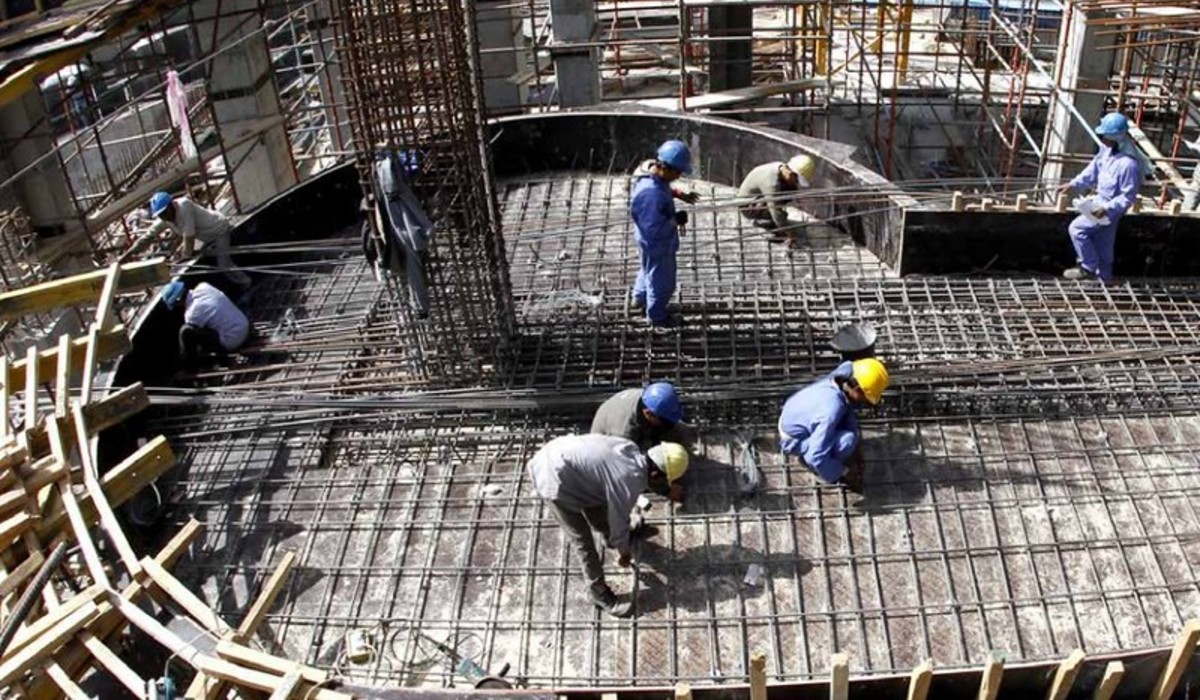
 Migrant construction workers in the Gulf Cooperation Council. Photo: ILO / CC BY-NC-ND 3.0 IGO
We’re told that national borders are there to protect us and ‘our’ nation but, as Tayfun Er explains, they play a key role in controlling and disciplining both the home and international workforces
Nobody crosses a border because a wage table tells them to. People migrate because staying has become impossible: work disappears, wages collapse, debts tighten, crops fail, towns are destroyed, families need money, and states offer no future.
War, repression and the absence of basic democratic rights all matter. However this article is about a narrower economic paradox. Why can a worker from a poor country earn more in a rich capitalist country and still remain useful to capital as an exploitable worker?
The answer is not that migrants choose exploitation. They choose survival. Capitalism is the system that makes survival available through the labour market.
Two Different Measures
The first distinction is simple but decisive: the rate of exploitation and the mass of surplus value are not the same thing. The rate of exploitation is the ratio between surplus value and wages, or s/v. It tells us how much unpaid labour capital extracts in relation to the wage paid for labour-power.
The mass of surplus value is different. It refers to the total amount of surplus value produced or realised. That depends not only on wages, but also on productivity, technology, scale, turnover time, infrastructure, market access and the position of a firm or country in the world economy.
This matters because a worker in the Global South can face an extremely high rate of exploitation. Long hours, low wages, unsafe workplaces, weak unions and informal contracts can make exploitation brutal. The point is not to soften that reality.
A very high rate of exploitation in a small workshop, plantation, mine or informal service job does not automatically produce a large mass of surplus value. Old machinery, weak infrastructure, narrow markets and subordinate insertion into global trade can limit what capital can extract and realise. Low wages alone do not make capital strong. Capital also needs command over the conditions that make labour profitable.
What Migration Moves
Migration moves labour-power across an uneven world economy. Sometimes capital goes to labour, by relocating production to cheaper regions. Sometimes labour goes to capital, by moving toward countries where wages are higher and remittances can support families left behind. These are not opposite processes. They are two movements within the same world system.
The Global South is not outside capitalism. It is inside capitalism in a subordinate position. Its workers produce food, minerals, garments, components, energy and services for the world market. Its economies are shaped by debt, imperial pressure, local ruling classes and multinational firms.
Capitalism develops unevenly. Some countries command finance, technology, patents, logistics, currencies and high-value production. Others are held in low-wage work, raw-material extraction, export agriculture, debt and dependent manufacturing.
Migration is one way this unevenness becomes a lived experience. The worker does not leave because capitalism is absent at home. The worker leaves because capitalism is present there in a blocked and often brutal form.
Higher Wages, Stronger Circuits
A migrant may earn more in Britain, Germany, France, Canada or the United States than at home. That higher wage is real. It may pay rent, keep children in school, cover medical bills or sustain a family through remittances.
The scale is large enough to belong to the structure of the world economy, not merely to border politics. According to the ILO’s Global Estimates on International Migrant Workers, 68.4 percent of international migrant workers in 2022 – 114.7 million people – were concentrated in high-income countries. The World Bank’s Migration and Development Brief estimated that officially recorded remittances to low and middle-income countries would reach $685 billion in 2024, more than foreign direct investment and official development assistance combined.
These figures do not prove that each migrant worker produces more surplus value after migrating. They show something narrower: migrant labour is concentrated in the high-income centres of capitalism, and part of the wage earned there returns to dependent economies on a massive scale. Migration is therefore not a side issue at the border. It is one of the ways labour-power, wages and household survival are organised across the world market.
The question of surplus value requires another step. Here the relevant bridge is productivity, not the nominal wage. The World Bank’s GDP per person employed indicator – GDP divided by total employment – is not a measure of Marxist surplus value. But it does point to the material basis of the paradox: labour in the capitalist centre is usually attached to a much larger productive and institutional apparatus.
That is why a higher wage can coexist with stronger exploitation. Capital in the centre can often pay more because labour is connected to larger firms, denser infrastructure, faster turnover, deeper markets, more developed logistics, stronger property relations and greater capacity to realise value.
The migrant’s labour is not automatically more productive as an isolated individual. Many migrant jobs remain low paid, exhausting and labour-intensive. Yet their location inside the capitalist centre matters. Hotel cleaning helps sustain tourism and property income; warehouse work serves logistics systems organised around speed and inventory control; construction labour may be manual, but the site can be tied to land values, public contracts and speculative urban development.
Put more carefully, migration does not mechanically raise the worker’s s/v ratio, and it does not make every job individually more productive. What it often does is relocate labour-power from blocked, low-wage economies into capitalist centres where higher wages can be combined with larger firms, richer circuits, faster circulation, tighter discipline and a greater capacity to realise value.
Liberal economics sees the wage rise and calls it progress. Marxist political economy asks what kind of capital stands behind the wage, and what kind of social relation makes that wage possible.
Direct Profit and Reproductive Work
Not all migrant labour occupies the same place in the production of surplus value. Some migrant workers directly produce surplus value. They work in sectors where capital buys labour-power to produce goods or services for profit: construction, logistics, agriculture, food processing, private cleaning firms, delivery platforms, hospitality and manufacturing.
Other migrant workers do work that is better understood as social reproduction. Carers, domestic workers, nurses, cleaners in public services and many care workers may not all produce surplus value directly in the narrow sense. But they reproduce the labour-power, households and urban life without which accumulation cannot continue. Capitalist centres need both kinds of labour. They need workers who produce profit directly, and they need workers who cook, clean, care, transport, repair and maintain the daily conditions of work.
This distinction is important. The argument should not pretend that every migrant job produces surplus value in the same way. It does not.
The broader point is that migrant labour is drawn into the production and reproduction of the capitalist centre. Whether directly productive or reproductive, it helps maintain the machinery through which capital accumulates.
The Border Organises Labour
Capital does not simply want labour. It wants labour that can be disciplined. This is where the border becomes part of the labour market.
A migrant worker may depend on an employer for legal status. Another may work without papers. Others face language barriers, racism, debt to recruiters, insecure housing or the threat of deportation. These conditions weaken bargaining power.
The border does not only exclude. It also includes people under unequal conditions. It sorts workers into different levels of fear, legal security and political voice.
For capital, this is useful. A worker who fears deportation is easier to threaten. A worker whose visa depends on a job is less likely to strike. A worker separated from family may accept work others reject because the need for remittances is immediate.
The border is therefore not the opposite of the labour market. It is one of the devices through which the labour market is organised.
Racism Does the Bosses Work
Racist politics hides this economic relation.
It tells native-born workers that migrants caused low wages, when employers are the ones who use migrant vulnerability to impose them. Housing shortages get blamed on migrants too, though landlords, developers and speculation are what actually drive housing crises, and the same goes for pressure on public services, which governments cut, privatise and underfund.
The purpose is division. The migrant worker is told to accept less because he or she is foreign. The native-born worker is told to accept less because someone foreign will replace them. Capital gains from both fears.
Migration is therefore a class question because migrant insecurity is used against the whole working class.
What Stronger Exploitation Means
The phrase ‘stronger exploitation’ should be understood carefully.
It does not mean migrants want exploitation, and it is not a claim that every migrant faces a higher s/v ratio than before. Nor should it be read as putting a cleaner, a carer, a warehouse worker and a farm worker in the same place in the production of surplus value; their relation to capital differs from case to case.
It means that migration often moves labour from dependent, low-wage economies into richer capitalist formations where labour can be made more usable for capital.
The worker may earn more. Life may improve in immediate and important ways. A family may survive because of that movement. But the receiving system does not welcome the migrant as a free human being. It receives labour-power.
Migration can raise the wage and deepen dependence on the wage relation at the same time. It can rescue a family from destitution while giving employers a more vulnerable workforce. It can move a worker away from one brutal form of exploitation and into another, richer and more organised one.
The scandal is not that people move. The scandal is that capitalism makes movement necessary and then turns that movement into another source of profit.
What Socialists Should Say
The right wants to police migrants. Liberals want to manage them. Capital wants to use them. Socialists must organise with them. The answer is not border policing. It is equal rights for all workers.
That means secure status, the right to organise, the right to strike, equal wages, public housing, public services and an end to deportation threats. No worker should have fewer rights because of where he or she was born.
If bosses can divide workers by passport, they will. If the state can make one section of the class more frightened than another, it will. If racism can make native-born workers blame migrants instead of capital, it will be used again and again.
Migrants move because capitalism has made their old lives impossible and their new lives profitable for someone else. They move toward higher wages, but also toward a stronger machinery of exploitation.
The question is not why migrants come, as if the mystery were their movement. The question is why capital has built a world in which millions can survive only by moving into another layer of the wage relation.
The scandal is the world that makes movement into a condition of survival and exploitation into the price of hope.
Sources: ILO, Global Estimates on International Migrant Workers, 2024; World Bank, Migration and Development Brief, December 2024; World Bank, GDP per person employed (constant 2021 PPP $), World Development Indicators.
Tayfun Er is a writer and civil engineer based in Turkey. He is the author of two widely discussed books on oligarchy in Turkey, as well as numerous articles and research essays. His work focuses on Marxist political economy, class power, migration and the contradictions of capitalist development. Website: www.tayfuner.com
Before you go
The ongoing genocide in Gaza, Starmer’s austerity and the danger of a resurgent far right demonstrate the urgent need for socialist organisation and ideas. Counterfire has been central to the Palestine revolt and we are committed to building mass, united movements of resistance. Become a member today and join the fightback.
