
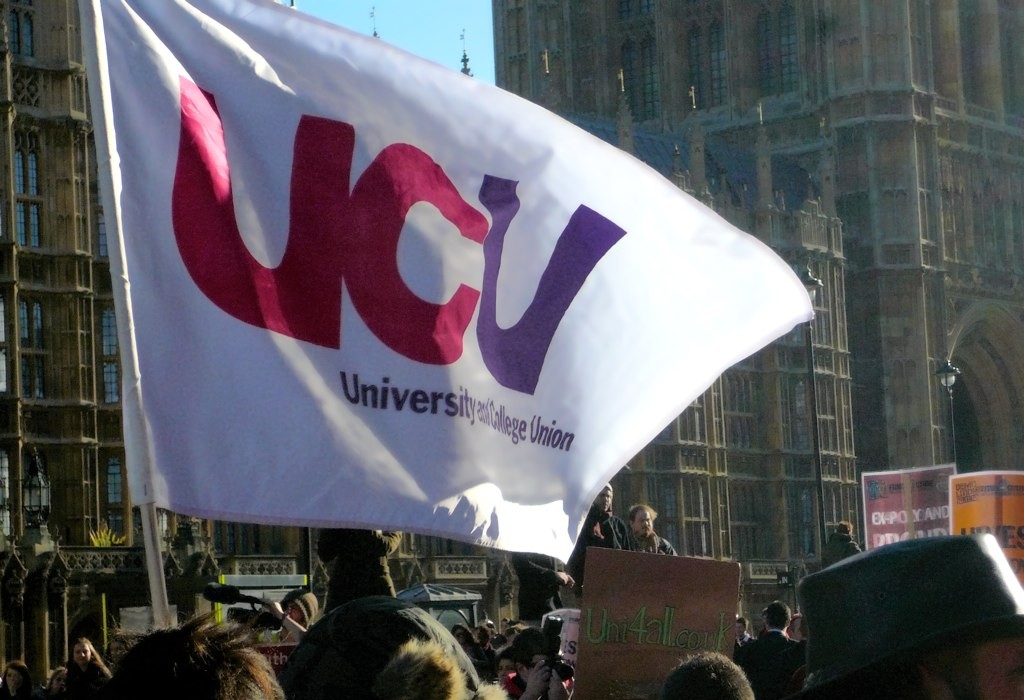
 The University & Colleges Union flag flies in front of Parliament. Photo: Simarchy / CC BY-ND 2.0
The crisis in higher education demands a national response, say UCU members in Counterfire
Universities are in crisis. According to the Office for Students, the sector’s regulator, 119 institutions (around 43% of the sector) are forecasting deficits for this academic year. The OfS predicts that this figure could rise to 163 providers (representing nearly 60% of the sector) within three years. Some 24 institutions are now reckoned to be in danger of bankruptcy and what the regulator nauseatingly calls “market exit” in the next 12 months.
This has led to a devastating programme of job cuts across Higher Education. The University and College Union (UCU) lists approximately 30 universities currently facing redundancies across the UK – from Aberdeen to Ulster. This includes 2,700 staff put ‘at risk’ by Nottingham University, 1000 at Sheffield and 600 at Sussex.
Bosses at Essex want to cut 400 jobs and close its campus in Southend while Goldsmiths wants to make £20m of savings from job cuts despite already having generated £16m of savings in two previous rounds of redundancies. At Edinburgh, where 1800 jobs are threatened, management has said that ‘nothing is off the table’
Even the head of the sector’s umbrella organisation, Universities UK, has estimated that some 30,000 jobs have been slashed in the past three years. One recent poll of university bosses found that more than two-thirds of institutions were prepared to issue further compulsory redundancies in the next few years while 90% were considering job freezes and voluntary severance schemes.
Collapsing market
There are several reasons for the crisis, all rooted in the marketisation of universities and their transformation into businesses competing to recruit national and international students to stay afloat. Most recently, many have been hit hard by falling numbers of overseas students discouraged or even prevented from coming to study in the UK as the government panders to Reform’s anti-immigration policies. Public funding has been withdrawn from whole swathes of subjects with universities told to depend instead on tuition fees which are now over £9,500 a year.
Meanwhile, universities have invested the billions of pounds of student fees not into providing fair pay for staff and lower staff/student ratios but into inflated salaries for senior management and vanity projects of new overseas campuses and shiny buildings. These are often built in partnership with private developers, on the backs of huge loans or underwritten by bonds secured with the support of major banks. Universities have hitched themselves to the financial sector – servicing debt rather than their own students.
Graduates are now entering a job market that’s also in crisis and are doing so with huge levels of personal debt. The government has frozen the repayment threshold so that significant numbers of graduates are seeing pay deductions subject to interest of 3% over and above inflation, causing more people than ever to question whether a university education is ‘worth the time and money’.
The UK needs a publicly funded university sector to deliver high-quality and accessible education. Instead, successive governments have delivered a failed market in which rival institutions compete, prioritising standardised curricula and popular courses and closing more specialist programmes that don’t have the same commercial appeal or – to use the industry jargon – employability. This is precisely what we’ve seen with the suspension of humanities courses at Hertfordshire and the closure of black studies programmes at Birmingham City University.
Local resistance is not enough
There is impressive local resistance to the job cuts and programme closures and an increasing number of strike ballots and student occupations. Some of these actions are likely to secure at least partial protection for courses and jobs under immediate threat. However, the scale of the crisis demands more than local resistance: a national assault requires a national response. The challenge facing UCU is to develop a strategy capable of matching the scale of the attack.
This year’s UCU Congress in Harrogate demonstrated genuine determination to fight back not just locally but nationally. One motion specifically proposing that the union move by default to holding disaggregated national ballots – an approach that would have institutionalised localism and blocked the national strategy we need – was rejected by delegates.
At the same time, Congress passed two motions each proposing a way forward: one to pursue a ‘trade dispute’ directly with the Secretary of State for Education over higher education funding; the other to take national action against employers on job losses, combined with a national campaign to defend pay, jobs and pensions. These two resolutions need now to be drawn into an integrated strategy capable of mobilising the whole union, and this means treating them as complementary not as alternatives.
A ‘trade dispute’ with the Secretary of State is important for correctly identifying the roots of the crisis. Government defunding of universities has driven marketisation, competition for students, dependence on tuition fees and international student recruitment, producing the crisis we now face. Such a dispute has the potential to provide a national focal point for uniting staff and students around demands for a properly funded university system, and for balloting for national strike action over it.
The industrial dimension
At the same time, there are real risks with relying on a trade dispute alone. The government is likely to challenge it in the courts on the grounds that it would be a political dispute which is not allowed by the legislation. When in 2016 the then National Union of Teachers pursued a dispute over funding with the Tory Secretary of State and balloted, the High Court refused to declare the dispute unlawful and the NUT’s strike action went ahead. Nevertheless, there can be no guarantee the courts will take the same approach today.
This is why the directly industrial dimension of the strategy is very important. The motion supporting national strike action against job losses and a national campaign to defend pay, jobs and pensions provides a complementary basis for a wider fightback.
The issue of pay should not be neglected or sidelined in this strategy. University employers have offered just 2% this year. This comes after more than fifteen years of declining real wages. Since the financial crisis of 2008, higher education workers have suffered a real-terms pay cut of around 25%. This erosion of pay is not separate from the wider crisis. Employers have sought and increasingly failed to balance the books by holding down wages as well as increasing workloads and reducing staffing levels. The result has been a steady transfer of the burden of the crisis to staff, compounded by rising cost-of-living pressures, most recently because of the Iran war.
Holding leadership to account
This also matters strategically. Though many are, not every branch is currently facing mass job losses. But every member has experienced pay erosion. A campaign focused solely on redundancies risks appearing relevant only to those institutions facing the sharpest immediate attacks. Conversely, a campaign centred on pay would fail to express solidarity with branches fighting for survival. Bringing the two together, with branches highlighting one or other to suit their local circumstances, offers the best possibility of mobilising the whole union.
Therefore, running a national ballot over pay and job losses combined with a dispute with the Secretary of State has several advantages. It would offer a legally stronger basis for industrial action by rooting the campaign in the employers’ attacks on pay and jobs. It would connect every local struggle to a broader political explanation of why these attacks are taking place. And as a result, it would speak directly to the great majority of members, increasing our prospects of building participation to reach the 50% ballot threshold.
None of this will happen automatically. Congress has set the direction, but the task is to hold the leadership accountable to it. Elected officers must be pressed to implement what delegates voted for and not to delay or shelve resolutions. One opportunity for exerting pressure will be the higher education workers’ conference proposed in the trade dispute motion. If convened with genuine breadth, it could be a mobilising event for shaping an integrated national strategy that can win.
Before you go
The ongoing genocide in Gaza, Starmer’s austerity and the danger of a resurgent far right demonstrate the urgent need for socialist organisation and ideas. Counterfire has been central to the Palestine revolt and we are committed to building mass, united movements of resistance. Become a member today and join the fightback.
