
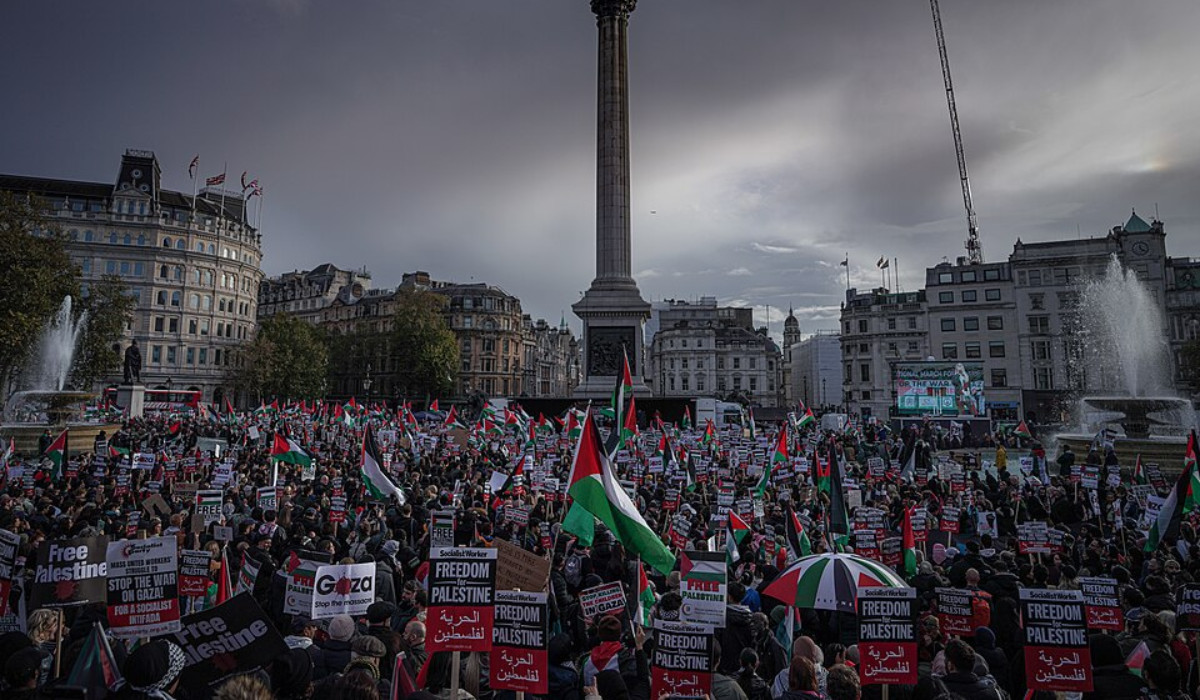
 Gaza - Stop the Massacre - Protest in London's Trafalgar Square 04 November 2023. Photo: Alisdare Hickson / CC-BY-SA-2.0
The decision of the leadership of Your Party to exclude members of left groups who have been committed to building the organisation is a mistake which will weaken the left, but has been predictable given events of the past year, argues Michael Lavalette
Supporters of ‘The Many’ inside Your Party CEC have pushed through a motion that will effectively ban the far-left and far-left parties, networks and groupings from YP membership. This means that organisations like Counterfire can no longer remain members of a party that proscribes socialists.
The motion that was discussed states that YP stands for a ‘broad, pluralistic membership movement’ but then immediately lists a series of organisations deemed ‘not aligned’ to YP values – so not that broad, and certainly not pluralist!
The proscribed list is not exclusive. The motion adds that the ban applies to any organisation that:
- Operates as a democratic centralist party or organisation.
- Maintains its own national political membership structure.
- Requires political discipline and accountability to an external leadership or programme.
The motion makes clear that ‘such organisations would automatically fall within the scope of the ineligibility rule’.
The new ‘policy’ marks the end of the road for YP as a broad, left, insurgent party and confirms it will, at best, be a small, and weak, version of Labour Mark 2.
The origins of Your Party
The heady days of last summer, when close to 800,000 people signed up to register an interest in Your Party, and when hope and enthusiasm for a viable left alternative to Labour excited and energised people across Britain, feel like light years away from the mess that YP is today.
Your Party had its origins in five separate, but linked phenomena.
First, and most importantly, was the mass movement in support of Palestinian liberation that had grown up after October 2023. The Palestine movement is one of the most remarkable social movements to develop in British history. Week after week people took to the streets in towns and cities across the country to protest the slaughter of Palestinians in Gaza. There was workplace days of action, school student strikes, direct action outside banks and factories, sit-down protests in streets and railway stations and repeated, mass marches in the centre of London.
The movement shifted public opinion significantly on the question of Palestinian rights and opposition to Israeli apartheid; it challenged and took on the governments (both Tory and Labour) over the right to protest and march, and, crucially, it opened a vast chasm between the Palestine movement and the traditional parties of politics (Tory, Labour and Lib Dem) who were all clearly recognised as appeasers of Israel and US imperial interests in the Middle East.
In the General Election of June 2024 the electoral performance of ‘pro-Gaza’ Independents produced the best ever electoral results for a left of Labour network. Five MPs were returned but many more in London, Birmingham, Yorkshire and Lancashire not only saved their deposits but got votes of 20 and 30 percent. The election results emphasised that it was possible to challenge the political establishment and win
The second element was the network of Independent groups in local councils across the country who had left Labour over Gaza, or being expelled from Labour for their pro-Palestine views (for example the Blackburn, Oldham, Enfield networks). Some groupings, for example in Newham, had a longer history of opposition to Labour rooted in the campaigns against war in Iraq and years of state directed Islamophobia. In addition there were smaller groups of Independents who had left Labour over decisions around cuts and austerity (for example in Liverpool and Derbyshire). Cumulatively, these groups had years of experience of working in local government. They were clearly ‘pro-Palestinian’ but their direct involvement in the Palestinian movement was varied. Nevertheless they immediately offered numbers of elected councillors which could have helped solidify any voter base – and gained YP recognition from, for example, the Local Government Association which would have allowed for one paid full-time national local government lead (paid for by the state!).
The third element is best categorised as ‘Jeremy Corbyn’. Corbyn was sidelined by Labour in the run up to the 2024 election, he only left the party when it became clear they would not select him to stand in the General Election. He stood as an Independent, drew supporters in from across the country and achieved a massive victory. Corbyn was the figurehead of the electoralist left. He was a man with a fantastic history of campaigning against war, imperialism, inequality and injustice. A permanent thorn in the side of Labour’s leaders he was widely respected inside, and outside, of Labour’s ranks. Around him he brought the (better) remnants of Momentum, and former Labour members, many of whom, had joined when Jeremy became Labour leader and left when he was deposed.
The fourth element was Zarah Sultana. Re-elected as a Labour MP in 2024, Sultana was almost immediately suspended by Starmer for voting against the continuation of the two-child benefit cap. She was not the only one, but unlike some others (such as Rebecca Long-Bailey) she refused to bow to Starmer to get the whip back. She used her position in Westminster to attack Labour over benefit cuts, the winter fuel allowance and their complicity in the Gaza genocide. She was young, brave and not afraid to speak out and, as a result, attracted a layer of young people (in particular) to her.
Finally, there was the broader social-political context. For 16 years in Britain we have been subjected to austerity, cuts in services and wage stagnation. The consequences of years of privatisation have become apparent in, for example, sewage filled rivers and waterways, extortionate and inefficient public transport networks, and gas and electricity prices amongst the most expensive in the world. What’s left of the welfare state is in crisis and drastic decline: our NHS is holding on by its finger tips, we have a massive housing crisis, if our young people go to university they face a life time of debt to pay ‘loans’ off, the pension age is disappearing over the hill and our children are put in overcrowded classrooms and are tested within an inch of their lives.
And as if this wasn’t all bad enough, we have become one of the most unequal societies in the world. The fabulously wealthy enrich themselves as we struggle to pay the rent and feed the kids.
These, in the context of a ‘warfare state’ (with increased government spending going to the military and to wars in Ukraine and the Middle East) were the ‘objectives circumstances’ that created the space that YP could fill. These are the factors behind the initial 800,000 sign ups and the massive wave of hope that accompanied the announcement of the new party.
But if the ‘objective circumstances’ were ripe for the development of YP, the ‘subjective element’ (the actions and decisions of those ‘at the top’ of YP) would lead the project into repeated conflicts and crises.
A year of factionalism
The decision to set up a new party was announced by Zarah Sultana in a social media post on 3 July 2025. She stated she was resigning from the Labour Party and would be the joint leader of a new left party alongside Jeremy Corbyn. In many ways the combination seemed perfect. The older ‘statesman’ of the left with a profile, record and appeal that could enthuse crowds, and the younger, Muslim, socialist woman whose star was on the rise.
But it was immediately clear that those around Corbyn were not happy. He had not been consulted on the announcement (though was at the meeting where the decision was taken) and those around him started briefing that he had been ‘bumped into the decision’.
Interestingly, Liverpool councillor Alan Gibbons has recently written that the issue was that ‘Collective had been working on this [the project to set up a new party] for two years’ and they felt marginalised – an interesting comment as most people don’t know who the self-selecting ‘Collective’ were (or are) and the two year time-line suggests a significant disconnect from developments in the fast-moving Palestine movement (and is also indicative of a ‘top down’ approach to party building).
Outward appearances seemed to stabilise over the summer, but there were repeated claims from Sultana that she was being marginalised within Parliament. Nevertheless, groups (now referred to as ‘proto-branches’) started to form as people started to pull together to form YP networks. With almost 800,000 email sign-ups there was still significant excitement at the prospects of a viable left of Labour alternative. By the last week of August there were a series of formal YP launch events. On the first launch day in Lancashire close to 2000 people came to two events in Blackburn and Preston. But ominously whilst all the Independent MPs were present, Zarah Sultana was excluded.
Over the next few months there were repeated spats between the Independent MPs group and Zarah Sultana’s supporters. These included arguments over ‘social conservatism’, trans rights, landlordism, Zionism and anti-Zionism, misogyny and sexism (towards Zarah) and various other issues which increasingly became embedded as ‘wedge’ issues between the two groupings.
Things came to a head when Sultana opened up the ‘membership portal’ and announced formal membership was open. Within a day close to 20,000 people signed up and paid. But almost immediately Corbyn and his supporters said this was a false launch and threatened legal action. Utter confusion reigned.
By the time membership re-opened, there were two membership schemes, two ways of paying, two groups in control of two sets of membership data and constant threats and accusations between both groups. What a mess!
In essence two groups were forming into more permanent factions. One around Zarah, drawing in elements of the far-left, whose vision was for an alliance of socialists with a narrower ‘programme’ of hard left demands. The other around Corbyn whose vision was of a mass (though passive) electoralist party. For the Sultana faction key themes were the need to build branches and enforce party democracy. For the Corbyn faction key themes were radical policies controlled from above by a leadership loyal to Corbyn. In short-hand, two visions: a narrower (and purer) ‘socialist alliance’ or a broader and more passive Labour #2.
The immediate consequences of the infighting and factionalism was that from 800,000 sign ups, the party was reduced to 56,000 members. 56,000 meant that YP had a larger membership than the Independent Labour Party at its height (about 30,000 in the 1930s) and was similar in size to the Communist Party at its largest (60,000 at the end of the Second World War). But the drop from 800,000 to 56,000 was dramatic.
The November Conference
Now all eyes turned towards the Conference at the end of November. Conference delegates were selected by sortition. In essence this meant delegates were randomly selected and accountable to no-one. They had no branches to report back to, because ‘the centre’ were refusing to pass out membership data or to set up formal branches.
Sortition had a veneer of participatory democracy about it, but in reality it was miles away from the democratic, delegate-based traditions of the working-class movement. And ironically, despite its claims, it left control firmly in the hands of an unelected, unaccountable ‘Officers’ group’.
On the eve of conference Corbyn’s team expelled members of the SWP and barred two Counterfire members from conference, the Counterfire members (Michael Lavalette and John Rees) being initially barred for daring to suggest the internal factionalisation needed to stop and that a collective leadership, focused on unity should be established.
Despite these shenanigans the conference voted to set up branches, for collective leadership, (probably because members were fed up of the leadership clashes) and for greater democracy within YP.
The conference offered a point in which both sides could have pulled together. Instead both dug in for the CEC elections that would take place in January and February. Two factions became formalised over late December and early January: the Grassroots Left (or the Zarah faction) and The Many (or the Jeremy faction).
The election campaign was tortuous. Mudslinging was common. Factionalism and in-fighting became normalised. National hustings were held after the election started. Email lists were used by both factions – something not available to ‘non slaters’. It wasn’t until 10 days into the election that candidates were informed of the election system being used (and it was the most conservative version of the STV that was decided upon, one that would clearly favour The Many).
Counterfire’s position in the elections was that effectively we were in the last chance saloon! Our vision was for a united, radical, insurgent party of the whole left and a party that was rooted in our social movements, our communities and our trade unions. In the CEC ‘public office holders’ section our candidate (Michael Lavalette) got 10 % of the vote indicating that there was an appetite for unity and a different approach. But in a faction fight there is always a distinct possibility that those not on the factions get marginalised!
In the CEC elections around 25,000 people voted, less than half the claimed membership.
The outcome of the CEC elections saw The Many win the most seats. But Grassroots Left got a significant minority. Would they try to work together to heal the divisions, or would the dominant faction steamroller over the defeated faction?
In the first few meetings of the CEC the notes released by delegates suggest the CEC has little space for debate and that voting, so far, is on strict factional lines. The establishment of an officers’ group (all of whom are from The Many faction) and the appointment of (unnamed) national paid officers, suggests that decision making will be tightly controlled and centralised.
The conference decisions on ‘collective leadership’, setting up branches, and dual membership have effectively been honoured in the breach.
So where are we now?
YP is dominated by factionalism. The decision to witch-hunt and ban the far-left is symptomatic of the ‘control freakery’ within the dominant faction. The membership is passive (and those at the centre seem reluctant to establish branches and release membership data). It would seem, from reports, that attendance at YP events has declined sharply since last summer.
YP has a purely functional relationship with the wider movement. The odd email telling us to attend a march is not suggestive of a party fully engaged in social movement activity. Rather than seeing a symbiotic relationship between party and movements (each developing and feeding each other) the movements are related to (if at all) as recruiting grounds.
The Many’s vision of YP as a mass electoral organisation (whatever that means) doesn’t fit with an organisation that failed to stand any candidates in the 2025 local elections, failed to stand in recent Parliamentary by-elections, was, with the exception of a handful of candidates, too late to challenge in the May 2026 local elections (and so resorted to ‘endorsing various Independent networks) and has failed to organise to stand in the Welsh and Scottish elections. It’s a strange electoral vehicle which fails to stand in elections.
Making matters worse for YP has been the rise of the Greens. Under Zack Polanski the Greens have managed to speak to ordinary people about inequality, cuts and the cost-of-living increase. They have spoken out about Gaza and have managed to avoid the internal navel-gazing of YP. On the back of their victory at Gorton and Denton their membership has risen to 200,000 – one can only wonder how many of these were initial email sign-ups to YP.
The proposal to exclude far-left activists from YP opens up a very real question: who is left to organise constituency level branches, if they ever get around to doing this? The expulsions seem like YP is determined to hammer the final nails into its own coffin.
Counterfire: the struggles continue
The hope and enthusiasm of last summer has been undermined by those at the top of YP, but many of the ‘objective circumstances’ remain the same (the wars of the Middle East, the shift from a welfare to a warfare state, the rise of racism and Islamophobia, the years of austerity and cuts, the cost of living crisis and the horrendous levels of inequality). The ‘need’ and ‘demand’ for a left alternative has not disappeared, it is just that YP does not seem to be the answer.
Counterfire is an organisation that looks to work with others across the left in a full range of community, trade union and social movement activities. We work with people from a range of left political parties and none. We throw ourselves into building movements like Stop the War, the Palestine solidarity movement and the anti-racist movement. We are committed to the campaign to build a broad, radical, insurgent electoral alternative to Labour. It was for this reason we threw ourselves into the campaign to build YP.
But the factionalism and endless debates on internal structures has driven people away from YP. We do not believe that there is the will, among some at the centre of YP, to rebuild the party in a non-sectarian, non-factional, outward facing manner and to establish YP as an activist party rooted in the experiences of working class communities.
The decision to exclude the far-left from YP will automatically mean that Counterfire, our members and elected councillors, will now leave YP. We will continue to work with groups and networks (including comrades who remain in YP, of course) who are actively building electoral challenges to the establishment parties and to Reform.
As an organisation our main energies will be focused on the campaigns against war, imperialism, racism and austerity. And as part of these campaigns we will explore how we can take the challenge on the electoral front forward with others, in our communities and movements, who share a vision for a radical insurgent opposition at the ballot box.
Before you go
The ongoing genocide in Gaza, Starmer’s austerity and the danger of a resurgent far right demonstrate the urgent need for socialist organisation and ideas. Counterfire has been central to the Palestine revolt and we are committed to building mass, united movements of resistance. Become a member today and join the fightback.
