
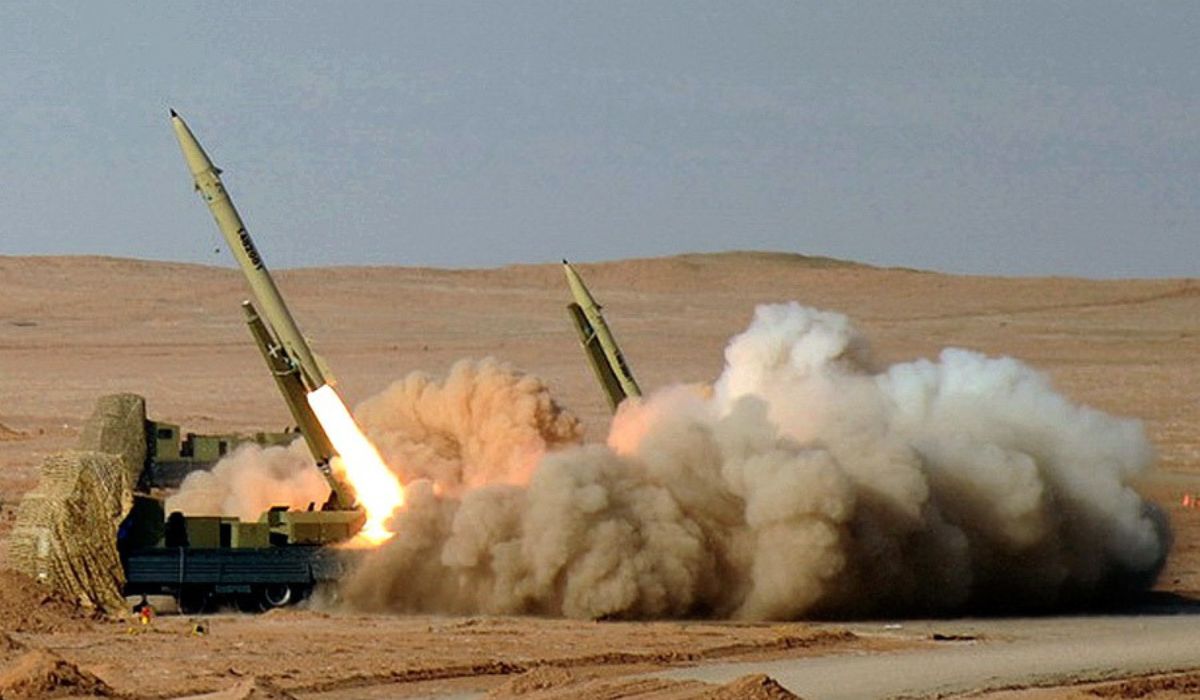
 Fateh-110 is an Iranian Ballistic single-stage solid-propellant, surface-to-surface missile. Source: Hossein Velayati - www.ypa.ir - wikicommon / cropped from original / CC BY 4.0
Chris Bambery explores censorship, military strategies and domestic opposition to the war
Since the start of the war with Iran, the Israeli military has imposed strict censorship regulations on local and international media outlets operating inside the country.
Reporters and networks are prohibited from publishing the precise location of Iranian missile impacts or even filming or photographing the extent of the damage in a way that could give away the location. These restrictions are designed, in the words of the army’s chief censor Colonel Netanel Kula, ‘to prevent assistance to the enemy during wartime.’
As former IDF spokesperson Lieutenant Colonel (reserve) Peter Lerner explained:
‘Indeed, in Israel there’s a military censorship that gives guidelines to the media on what can or cannot be broadcast. Mostly around force protection and specific impacts of missile locations so that the Islamic Republic cannot confirm targeting.’
It is, of course, almost impossible to stop Israeli citizens from filming rocket strikes and so on and sharing on social media. So, the Israeli Air Force says Iran has fired 400 missiles at Israel since the US-Israeli attack on Iran on 28 February. Of these, 92% were intercepted, it adds.
Iran’s successes
The Israeli paper Haaretz has confirmed that eight out of ten Iranian missiles launched against Israeli targets are reaching them, following mounting reports and growing quantities of footage pointing to the failures of Israeli and US ballistic-missile defences. The report notes that success rates have continued to improve as air defences have increasingly been strained by the destruction of US forward radar systems in allied Arab states such as Qatar and the United Arab Emirates, which have limited the quantities of cueing data that can be provided.
On 25 March, the same paper reported:
‘In addition, in the last 25 days, 35 cluster missiles have penetrated Israel’s air-defense systems dropping dozens of bomblets that have hit over 190 urban locations, mostly in central Israel.’
It added:
‘Since the beginning of the war, some 5,000 Israelis have been evacuated to hospitals for wounds due to fire from Iran and Lebanon. Thousands of buildings have been damaged and some 5,000 evacuated from their homes, 1,600 of them in Tel Aviv, about 1,000 in Dimona, some 650 in Beit Shemesh, 600 in Arad and 500 in Be’er Sheva.’
On the opening day of the war, Iran fired hundreds of ballistic missiles. Most were intercepted. Most were older weapons and they seem to have been used to deplete Israel’s missile defences.
Since then, Tehran has launched fewer short and long-range missiles: several dozen per day on average. Yet its hit rate has increased, according to military analysts.
Iran has, of course, targeted the Gulf States, unlike in the twelve-day war last June, when it concentrated fire on Israel. But it also seems that Iran is conserving its remaining arsenal of missiles and drones and becoming more selective in what it targets.
Kelly Grieco, senior fellow at the Stimson Center, a Washington-based think tank, says:
‘US and Israeli strikes have clearly caused significant damage to Iran’s launcher infrastructure. That physical attrition likely accounts for a significant share of the launch rate decline. But Iran also seems to have also made a deliberate choice to change strategies,’ she added. ‘Over time, Iran has shifted toward smaller, more precisely targeted salvos aimed at specific high-value targets.’
However Dr. Farzan Sabet, an expert on Iran at the Geneva Graduate Institute, said Iran has:
‘Invested in a massive missile and drone capacity which is relatively well-dispersed, hardened, and concealed across the country’s large expanse and difficult terrain.’ ‘It’s likely that the Trump administration and Israel have overstated how much they have degraded Iran’s ballistic missile and drone capabilities. The US and Israel may have also underestimated Iran’s missile stockpile and launcher capacity.’
Estimates of Iran’s short-range ballistic missiles alone range from 2,000 to 8,000. The size of Iran’s arsenal and the fact it seems to be still building missiles has caused alarm in Israel.
The Washington Post reports: ‘The pace alarmed Israeli security officials. Israeli defences “cannot absorb 3,000 to 5,000 missiles,” a former senior Israeli security official said, describing concerns that Iran could have exceeded such numbers in a year.’
The ability of the US to track Iranian missiles has also been curtailed. At the onset of the war, Iran attacked and destroyed $2.7 billion worth of high-value radar systems, including the AN/FPS-132 radar in Qatar, and two AN/TPY-2 radars in Jordan and the United Arab Emirates. This has left US and Israeli defences heavily reliant on ship and aeroplane-based radars and on the AN/TPY-2 radar station in Turkey.
In addition to Iranian missile and drone attacks are those from Hezbollah. Haaretz reported on Saturday:
‘Northern Israel – especially communities along the Lebanese border – has come under sustained missile and rocket attacks in recent weeks from Iran and Hezbollah, resulting in multiple fatalities, numerous injuries, and significant damage to homes and infrastructure.’
Anti-war protests in Israel
Last Saturday saw protests against the war and against Prime Minister Benjamin Netanyahu, inside Israel, with Haaretz reporting:
‘Anti-war demonstrations are taking place … in dozens of locations across the country, some of which have been violently dispersed by police, with 22 arrested.
‘For the first time since the outbreak of the war with Iran and Lebanon, anti-judicial overhaul demonstrations gathered alongside anti-war protesters with the support of the “Peace Partnership” coalition of dozens of anti-occupation and civil society groups’
In Tel Aviv, a thousand people gathered in Habima Square with police forcefully dispersing them, claiming that they were violating Home Front Command guidelines.
The protesters chanted, ‘In Tehran and Kiryat Shmona, girls want to live. In Gaza, in Eshkol, children want to grow up,’ as well as ‘We don’t want more wars, the peoples want to live,’ and ‘No to a Kahanist government. No to a government of fascists.’
The last references the ultra-right Rabbi, Meir Kahane, who encouraged attacks on Palestinians and is an inspiration to the likes of Finance Minister, Bezalel Smotrich, and National Security Minister, Itamar Ben-Gvir.
In Haifa, protesters chanted, ‘People are returning in coffins while he builds himself a palace’ and ‘Netanyahu is a terrorist.’ Banners read, ‘Enough: Put an end to the eternal war,’ ‘Military successes are not a cover for political incompetence,’ and ‘Hope will prevail.’
The same Haaretz article adds:
‘In northern Israel, residents gathered at Guma Junction to protest the war and harm to communities near Israel’s border with Lebanon.
‘“We are being bombed with zero warning, and the coalition is busy taking more power for itself,” the organizers said.
‘Bar Yanov, a resident of She’ar Yashuv, said: “The north is once again being abandoned.”’
Compared to the ‘No Kings’ protests in the US and those against the far right and in support of Palestine, these seem small beer. But the Netanyahu government will note that numbers are growing.
A note of caution
Here, it is necessary to add a note of caution. The overwhelming majority of Jewish Israelis approved the genocide in Gaza. There will not be pro-Palestinian demonstrations because the overwhelming number of Israeli citizens are Zionists.
But war weariness is another matter.
Last June, I detailed the damage Iran inflicted on Israel, especially its economy. Israel is having to finance multiple wars with hundreds of thousands of reservists called up and absent from work. Every missile or drone attack brings people down into air-raid shelters, again impacting the economy.
Polls inside Israel show that today 68% of Israelis say that they support the continuation of the Iran war, down from 81% at the outset of the conflict.
Again, it sounds like a small change, but in the context of a militarised state in which the message is rally around the flag to prevent its destruction, it is a possible indication of where things are going.
Meanwhile, there is no let-up in Iran’s and Hezbollah’s attacks on Israel. Even the censors can’t stop news of attacks on high-profile targets such as Ben Gurion Airport from getting out.
Before you go
The ongoing genocide in Gaza, Starmer’s austerity and the danger of a resurgent far right demonstrate the urgent need for socialist organisation and ideas. Counterfire has been central to the Palestine revolt and we are committed to building mass, united movements of resistance. Become a member today and join the fightback.

Chris Bambery
Chris Bambery is an author, political activist and commentator, and a supporter of Rise, the radical left wing coalition in Scotland. His books include A People's History of Scotland and The Second World War: A Marxist Analysis.