
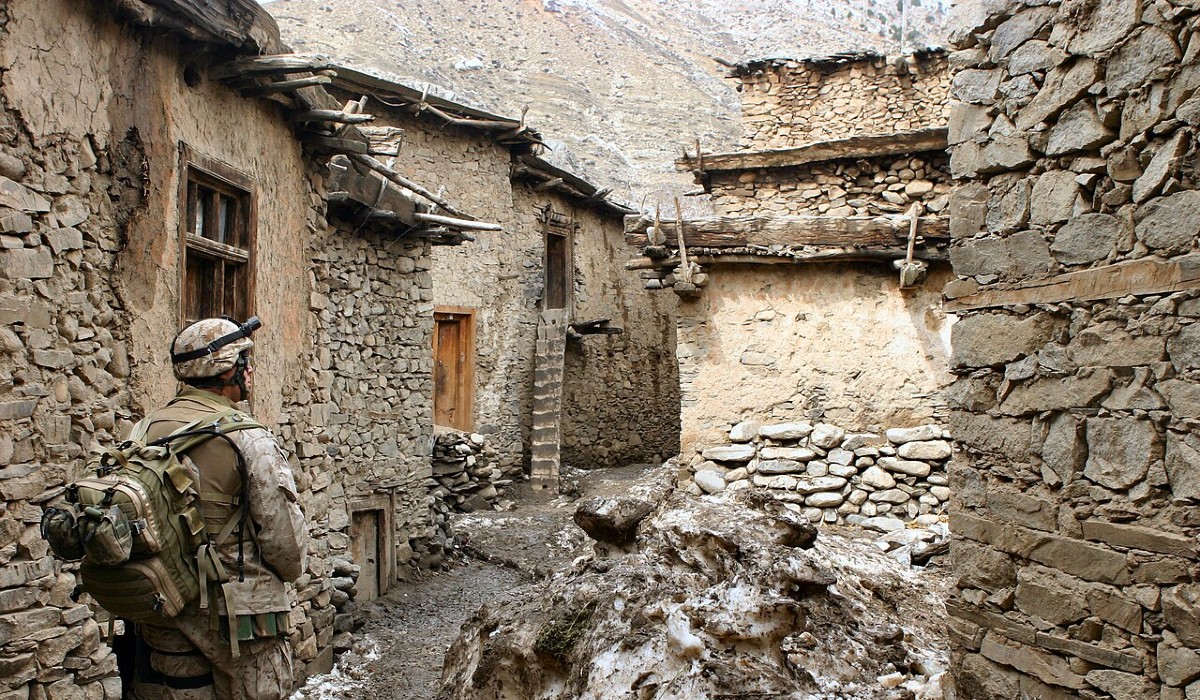
 US Navy Corpsman searches for Taliban fighters in Mihtarlam, 2005. Photo: Cpl. James L. Yarboro, U.S. Marine Corps / Public Domain
Chris Bambery uses his latest briefing to examine the calls for ‘boots on the ground’ and the difficulties of implementing a ground invasion
The contrast between where public opinion over the war in Iran stands in the United States and where it stands in Israel is stark.
A poll released on Thursday in the USA shows 56 per cent of voters think that the war benefits Israel more than it does the USA, compared to 29 per cent who believe it benefits the USA.
Overall, 53 per cent of respondents disapprove of US strikes on Iran, while 43 per cent approve.
It also found a generational divide among Republicans, with 68 per cent of those younger than forty-five preferring a Presidential candidate who would reduce support for Israel, while 56 per cent of those older than forty-five favour a candidate who prioritizes support for Israel.
Another poll released on Friday 20 March found that 65 per cent of adult Americans believe Trump will order a massive ground-scale invasion in Iran, with 55 per cent of the Americans polled saying they don’t support troops going to Iran against just 7 per cent that do.
The Pentagon has already deployed the 31st Marine Expeditionary Unit, a rapid-response force of about 2,200 marines, to the Middle East, and this is putting strains on the already bloated military budget. As petrol (gas) prices rise and the Pentagon is requesting $200 billion from Congress to support operations in the Middle East.
Secretary of State for War, Pete Hegseth, told a Pentagon press conference last week, ‘Obviously, it takes money to kill bad guys. So we’re going back to Congress and our folks there to ensure that we’re properly funded for what’s been done, for what we may have to do in the future, ensure that our ammunition is—everything’s refilled’.
In contrast to the mood in the US, according to an Israel Democracy Institute poll, 93 per cent of Jewish Israelis support the war in Iran, with most thinking it should continue until the regime is overthrown.
The Christian Science Monitor reported on Tuesday of last week that more than 57,000 alarms had sounded in Israel since the start of the war. According to the Institute for National Security Studies (INSS), 206 salvos have been fired from Iran, which included 265 missiles and more than 500 UAVs. In addition, Hezbollah has fired more than 325 salvos from Lebanon.
Israelis are becoming exhausted. ‘When Hezbollah fires rockets, there is zero time to reach shelter’, says Yaakov Selavan, deputy mayor of the Golan Regional Council.
But Selavan also noted, ‘We’re strong, we’re resilient, and we’re giving the government and the [Israel Defense Forces] what it needs to finish the Hezbollah threat once and forever. If it means I’ll need to be one more month in the bomb shelter, I’ll do it, but let’s get the job done’.
Domestically, criticism of Benjamin Netanyahu has melted away. The various challenges to his coalition, including a demand from ultra-Orthodox parties for a law exempting their young men from military conscription, controversy over domestic legislation and the prime minister’s corruption trial are not in the news. Instead, the Israeli opposition parties have rallied around the flag and support for the war. This reflects public opinion.
The vast majority of Israelis believe Iran poses a fundamental threat to the very existence of the Zionist state. This is a state with a permanent war economy, and that is permanently at war – whether against Iran, Lebanon, Gaza, the West Bank or even Syria, which it bombed last week. Israel is a state that needs a menacing “other” to justify its existence.
This explains the different war aims of Washington and Tel Aviv. The US wants to destroy Iran’s nuclear programme and its missile arsenal, and end Iranian support for Hezbollah, the Houthis, Hamas and their supporters in Iraq. Trump would like to force sections of the Iranian regime to come to his heels, as has happened in Venezuela.
Netanyahu is more interested in projecting Israeli power, but that would give Israel even more leverage over US policy in the Middle East. What Netanyahu wants is chaos. He wants a weakened and dismembered Iran, plagued by civil war as befell Libya, Sudan and Syria.
The war aims of Netanyahu and Trump are therefore different. Will it be US hegemony and order, or a greater Israel and chaos? Whatever the outcome, the USA and Israel will remain joined at the hip, even if they are pulling in different directions.
For the Gulf States, the uncertainty over their futures is giving them nightmares.
While they dislike and fear Iran, they also fear Israeli inspired chaos because it will disrupt the flow of oil and gas. They also fear the extension of Israeli power over the Gulf and increasingly free to make decisions without US approval. They can live with the Israel contained by the Abraham Accords, but fear it as a highly disruptive, dangerous presence, out of Washington’s control.
The Gulf States are caught on the horns of a dilemma and this will surely become more alarming the longer the war lasts.
They are right to be worried. Netanyahu is urging further military escalation. On Thursday 19 March Netanyahu told a press conference that the war will not be won with air power alone, ‘there has to be a ground component as well’. But, that ‘ground component’ will not be made up of Israelis. Netanyahu wants US boots on the ground.
The online newspaper Politico, cites two sources “familiar with the discussions” saying that the Pentagon is thinking about increasing the number of troops in the region by 50,000.
White House Principal Deputy Press Secretary Anna Kelly said in a statement, ‘The United States military can take out Kharg Island at any time if the president gives the order’. And right on cue the ultra-Zionist and neocon Senator Lindsay Graham said, ‘Mr President: Take Kharg Island and this war is over!’
It might not be as easy as Senator Graham thinks.
Kharg island, 30km (12 miles) off Iran’s mainland, is a hub for roughly 90 per cent of the country’s crude oil exports. Its civilian population is 20,000. The US targeted it just over a week ago.
A seaborn attack would involve sailing through the Straits of Hormuz, currently considered too dangerous for the U.S. Navy. The Iranians would have time to mine the approaches to Kharg and to deploy shore-based antiship missiles, aerial drones, and drone boats. US Marines would then be in range of Iranian missiles and drones. Despite Trump’s boasting, Iran is still armed and dangerous.
Getting troops onto Kharg be air is not without difficulties too. A helicopter assault to drop Marines on the island would be very risky. It could not be done in one operation and stationary helicopters would be highly vulnerable. Paratroopers would also be vulnerable. Landing on an island is difficult enough, but if it is defended by drones and land forces that would be possibly suicidal.
Trump’s claims that the US attack on Kharg had destroyed Iranian troops and their defensive positions is unlikely. Taking Kharg Island would not in any case be the end of the matter. Iran has threatened to turn any oil firms working with the USA into ‘a pile of ashes’.
A US invasion of Kharg Island has many possible outcomes. US troops could be bogged down and suffer casualties; oil prices could spiral if oil installations are destroyed; and the fate of the 20,000 civilians on the island have not been discussed.
Iran has promised a massive escalation if Kharg Island is invaded and the Gulf States would be the most likely casualties. But make no mistake, further escalation in this war is going to bring more suffering to everybody, and the calls from the anti-war movement for an immediate end to the war is the only call making sense at the moment.
Chris Bambery is the author of The Second World War: A Marxist History, (Pluto Press, 2014)
Before you go
The ongoing genocide in Gaza, Starmer’s austerity and the danger of a resurgent far right demonstrate the urgent need for socialist organisation and ideas. Counterfire has been central to the Palestine revolt and we are committed to building mass, united movements of resistance. Become a member today and join the fightback.

Chris Bambery
Chris Bambery is an author, political activist and commentator, and a supporter of Rise, the radical left wing coalition in Scotland. His books include A People's History of Scotland and The Second World War: A Marxist Analysis.