
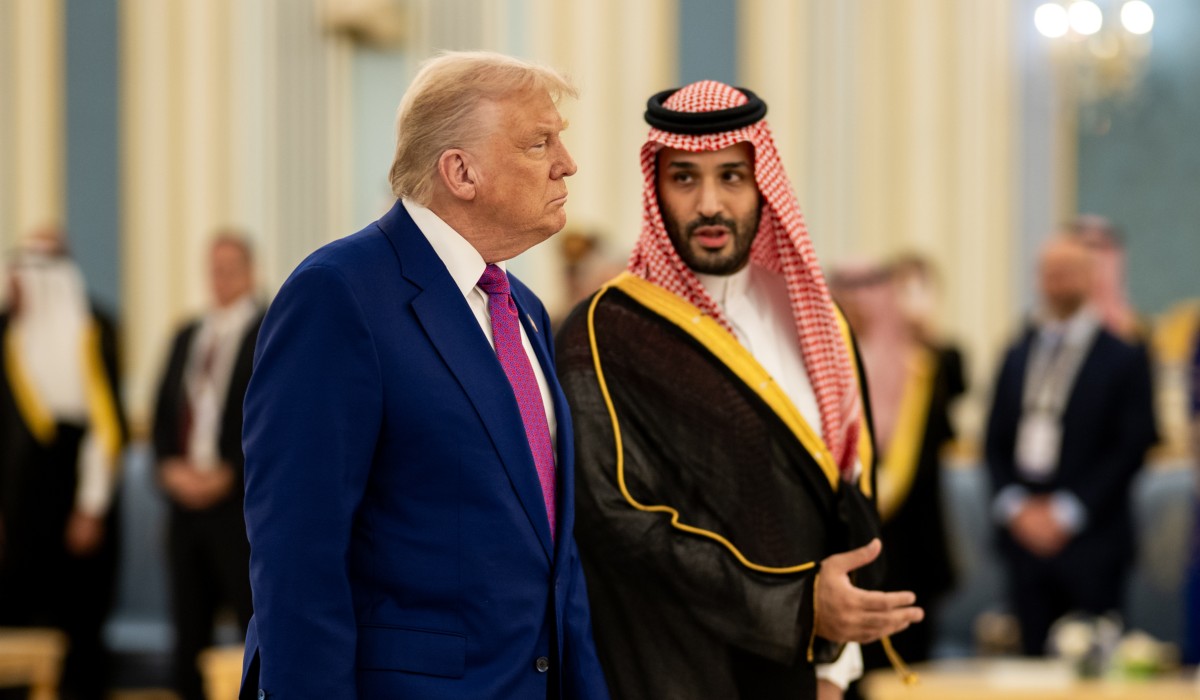
 Mohammed Bin Salman and Donald Trump, May 2025. Photo: White House / Public Domain
Chris Bambery argues that Saudi Arabia’s future is in jeopardy the longer the war continues
Media attention to the role being played by Saudi Arabia in Trump’s and Netanyahu’s war on Iran is growing.
On Monday the New York Times published a report that said that Saudi Arabia’s Crown Prince Mohammed bin Salman had advised US President Donald Trump to “keep hitting the Iranians hard.”
Earlier this month the Washington Post, reported that the Crown Prince had privately lobbied Trump to launch strikes against Iran. Since then further reports said he was in regular private conversations with Donald Trump, urging the US president once again “to continue hitting the Iranians hard.”
Yet, in public Saudi Arabia has said it would not participate in any potential war with Iran, and not surprisingly, Iranian Foreign Minister, Abbas Araghchi, has demanded clarification on bin Salman’s reported remarks to Trump.
A report in the Financial Times has added to the controversy. The FT quotes a person ‘familiar with Riyadh’s thinking’ saying that Saudi Arabia did not want regime change in Iran, so much as a weakened republic that would serve the kingdom’s interests.
He added that some in Saudi Arabia want Trump to ‘finish the job’ no matter where that ends. Fears are being expressed about the prospect of ‘chaos’ but all the Gulf states would benefit from the degradation of Iran’s ability to fire missiles.
An Atlantic Council article says of all this:
‘Saudi Crown Prince Mohammed bin Salman appears prepared to seize upon the current opportunity to cement Riyadh’s role as the dominant power in the Middle East, even as Saudi Arabia remains wary about US and Israeli operations. This nuance helps explain the mixed messaging regarding whether Saudi officials were advocating US strikes against Iran.’
Iran has been targeting the giant US Prince Sultan Air Base in al-Kharj and has also struck the crucial Ras Tanura oil refinery, which sits on the Gulf Coast within easy range of Iran.
However, Saudi Arabia has not suffered as many attacks as the United Arab Emirates, Qatar and Bahrain, and it also has an oil pipeline to the Red Sea that can help maintain oil exports.
Nevertheless, the worsening overall economic situation is having an effect. Mohammed bin Salman has been encouraging foreign investment to diversify the economy away from oil and gas. The same Financial Times article reports:
‘Firas Maksad, managing director for the Middle East and north Africa at Eurasia Group, said the conflict [with Iran] was a setback to the Saudi Vision 2030 plan to transform the kingdom’s economy and to lure foreign direct investment. They were already missing their targets’, he said, and ‘now they’re going to have to focus on other things. They’re going to have to reorientate spending to defence. It’s going to be a much longer timeline.’
Khaled Almezaini, an associate professor of politics and international relations at Zayed University in Dubai in the United Arab Emirates, notes:
‘Disruptions to aviation, tourism, shipping routes and energy exports combined with higher insurance premiums and freight costs mean the region is likely losing hundreds of millions of dollars per day in economic activity.’
For example, Saudi hopes of becoming a major tourist and sporting venue received a huge blow from the cancellation of the Saudi and Bahraini Grands Prix in April.
In 2023 Riyadh restored diplomatic relations with Iran in a Chinese-brokered deal. Relations between the countries had been antagonistic stretching back to the 1979 revolution in Iran and the overthrow of the Shah, who was a key ally of the Saudis. Since then, Saudi Arabia and other Gulf states with allegiance to the USA have viewed Iran as a malign force across the Middle East.
The Saudis had backed Iraq during their war with Iran and cut their diplomatic ties with Tehran. The two states were, once again, on opposite sides in the civil wars in Syria and Yemen. In the background to this is Saudi fear of Iran controlling the Persian Gulf and the economic and strategic power that would give their Shi’a rivals.
The Emirati diplomatic adviser Dr Anwar Gargash has stated that the Arab Gulf states can ‘no longer sit idle and absorb [Iranian] attacks against their facilities’, while Qatar’s Ministry of Foreign Affairs spokesperson Dr Majed al-Ansari has said that Iran’s attacks ‘cannot go unanswered’ and a ‘price must be paid.’
From Israel Haaretz reports that the Gulf States, while not wishing to participate in the US-Israel war are urging the US not to halt its strikes on Iran because they ‘fear an emboldened Iran in control of oil routes.’
But none of these states seem ready to join the war themselves because if they did the Iranian response would be to sharply increase its attacks on them.
There is also the issue of Israel. Joining the war means joining with Benjamin Netanyahu. Dr Hasan Alhasan, Senior Fellow for Middle East Policy at the International Institute for Strategic Studies (IISS) notes:
‘Public opinion in the Gulf is largely opposed to involvement in the war. Perceptions of the US and Israel have worsened dramatically across the region due to Israel’s conduct in Gaza.’
In the medium to long term the failure of the US to protect them from Iranian attacks will lead all states in the region to question their reliance on Washington. An Atlantic Council article notes:
‘Recent events will force the Gulf States to reassess their national security and economic strategies in ways that could have lasting consequences, long after US operations in Iran have concluded.’
Qataris will recall that in September 2025, Israel attempted to assassinate the Hamas negotiating team, housed in a Qatari government residential complex in Doha. The Atlantic Council article points out that the Israeli strike suggested to the Qataris that despite hosting one of the largest US bases in the region it was still vulnerable to attacks.
Donald Trump stokes the concerns of the Saudis and the rulers of the Gulf States every time he opens his mouth. At the start of the war Donald Trump told CNN that the Iranian attacks on the Gulf were ‘the biggest surprise’ of the conflict so far.
And on Monday, when asked by Fox News White House senior correspondent Peter Doocy about Iran’s strikes on Gulf states, Trump said experts had not anticipated that Tehran would target neighboring countries, ‘Nobody. Nobody. The greatest experts — nobody thought they were going to hit.’
Iran had clearly decided before this war began that any attack on it by the US and Israel would be met by attacks on US assets in the Gulf. The fact that Trump’s team found this to be “the biggest surprise” is an incredible admission.
Before you go
The ongoing genocide in Gaza, Starmer’s austerity and the danger of a resurgent far right demonstrate the urgent need for socialist organisation and ideas. Counterfire has been central to the Palestine revolt and we are committed to building mass, united movements of resistance. Become a member today and join the fightback.

Chris Bambery
Chris Bambery is an author, political activist and commentator, and a supporter of Rise, the radical left wing coalition in Scotland. His books include A People's History of Scotland and The Second World War: A Marxist Analysis.