
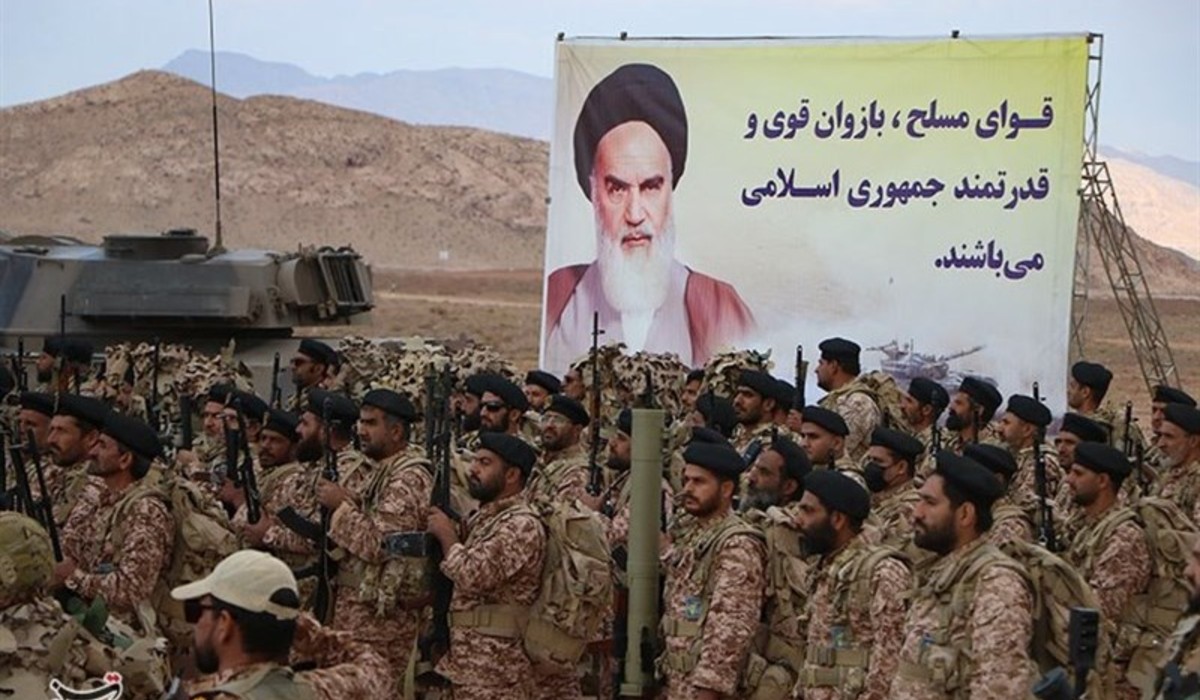
 Islamic Revolutionary Guard Corps Ground Force in Kerman tactical exercise. Photo: Sarallah Ankouti / CC BY 4.0
Chris Bambery, in the first of a series, gives his latest analysis of the US-Israel war on Iran
The assassination of Iran’s supreme leader, Ali Khamenei, marks yet another departure in international relations. It is a political assassination in line with Israel’s 2024 killing of Hezbollah’s secretary-general, Hassan Nasrallah.
It is clear that Donald Trump and Benjamin Netanyahu hope that by killing Khamenei it will trigger a popular uprising in Iran. But the assassination is also a dangerous gamble.
Firstly, it is something warring states have generally avoided because it has obvious knock-on effects, not least in countries that are also in Trump’s crosshairs. In Beijing and Moscow Presidents Xi and Putin will note that they would be an immediate target in any conflict with the US. This will no doubt be factored into their war preparations.
Secondly, how effective is targeting rival heads of state? For example, if Iran had taken out Benjamin Netanyahu, I doubt that it would buckle Israel’s military resolve one iota. Indeed, despite Netanyahu being unpopular among swathes of the Israeli public, the effect would have been to unite Israel behind their war effort.
Better the devil you know
The Second World War provides a useful context for thinking about how the premature deaths of leaders could have changed the course of the war.
For example, President Roosevelt died in office, but it had next to no effect on the course of the war, as US military leadership passed seamlessly to his Vice President, Harry S. Truman.
The impact of the deaths of war leaders depends on timing. If Winston Churchill had been assassinated in May or June 1940 Britain might have exited the war because the government was split between those determined to fight Hitler and those who wanted to negotiate peace. Once Churchill won the argument about fighting on after Dunkirk, his government was solid enough to have survived, even if he had fallen.
Similarly, in Russia in the summer and autumn of 1941, Stalin’s removal might have led to the end of the war (if, and it’s a big if, Hitler had agreed) because the Soviet leadership was in deep disarray. But, after victory at Stalingrad the Communist Party and the industrial and military leadership were cohesive enough to have fought on regardless of losing Stalin.
In Germany in 1945, Hitler’s assassination would have meant German surrender because the Third Reich was facing unavoidable defeat, but it is unlikely that German resolve would have crumbled before then.
For most of history world leaders have generally operated on the principle: better the devil you know to the devil you don’t. German propaganda treated Hitler like a God, but he was not the ablest military leader Germany had to offer. If he had died before 1945 the end of the war might have looked very different.
Khamenei’s martyrdom
In Iran there is another very obvious calculation. Israel is fighting this war to ensure Iran does not emerge as a single nation state that might be a threat in the future. Israel wants to divide Iran into competing authorities, as happened in Iraq, Libya and Syria, so they consume themselves in civil war.
Iranian nationalism runs deep and the leadership clearly understands Israeli intentions. The prospect of Iran’s Balkanisation is not an appealing one.
There is another factor that the US and Israel do not seem to have grasped in relation to Khamenei’s murder. Iran is a Shi’a state. Martyrdom is central to Shi’ism and Khamenei died a martyr.
This is bound to have an impact beyond Iran among the Shi’a populations of the region – including Lebanon and Yemen.
It is very doubtful that Trump would send troops into Iran to achieve regime change, but without them it’s difficult to see how it can be achieved, short of a popular uprising. Sending in Israeli troops is simply never going to happen. The big question is whether the Iranian regime can maintain itself. Trump and Netanyahu hope that it can’t.
Obviously, the regime is deeply unpopular, as we saw with the protests at the beginning of this year. And there are some, so deeply alienated from the regime, that they support the return of the despotic Pahlavi dynasty, ousted by mass revolution in 1979. But Iran’s population is well educated and well informed. How seriously can they take Trump and Netanyahu’s claims they will bring democracy, women’s liberation and other liberal reforms?
As said Iranian nationalism is a powerful force and people recall how British and American imperialism has humiliated the country in the past. Furthermore, US victory would be bound to include demands over Iranian oil and the Straits of Hormuz.
History shows too that bombing a country is not the best way to bring revolution, indeed the Second World War shows the opposite. Carpet bombing German cities did not prevent Germans fighting to the bitter end. There was no red carpet for ‘liberating’ invading armies.
The likelihood is that the US and Israel face a long war and that Iran will maintain its ability to strike back, as it has already shown.
Within the Israeli press there is deep concern over how the war aims of Israel and the US could diverge. Israel is in this to achieve final victory. That would be the degradation and division of Iran so that it can never challenge Israel again.
But Trump is not in it for the long haul. He was elected on the promise of an end to ‘forever wars.’ His MAGA base is already hostile to his unconditional support for Israel in Gaza, and his poll ratings are dreadful.
What Trump wants above all is to be able to appear on screen to declare total victory, even if that’s far from the case. Israelis are worried that faced with that opportunity he will grab it with both hands and exit the fight.
Added to that is the simple fact that Israel is the US’s only ally in this war. That’s a weakness not a strength. Across the globe Israel is a pariah state responsible for genocide in Gaza.
As I write, much of the Israeli population is sitting in shelters as Iranian ballistic missiles strike. Most have been shot down but there are a limited number of Patriot missiles available to maintain Israeli defences. And Iran is actually concentrating on striking US targets in the Gulf, of which there are plenty.
Last June Israel buckled because Iranian missiles were getting through and the economy is tanking. In the medium term more young professionals, along with Western companies, will exit at the first chance they get. For the Israeli population this is now a ‘forever war’ and that does not spell out a happy future.
The Iranians know all this. They are playing a long game. The question is can the Islamic Republic survive in the short term?
Chris Bambery is author of The Second World War: A Marxist History (Pluto Press 2014)
Before you go
The ongoing genocide in Gaza, Starmer’s austerity and the danger of a resurgent far right demonstrate the urgent need for socialist organisation and ideas. Counterfire has been central to the Palestine revolt and we are committed to building mass, united movements of resistance. Become a member today and join the fightback.

Chris Bambery
Chris Bambery is an author, political activist and commentator, and a supporter of Rise, the radical left wing coalition in Scotland. His books include A People's History of Scotland and The Second World War: A Marxist Analysis.