
The Supreme Court’s ruling against Trump’s trade policy reflects the contradictions of the crisis-ridden regime of US imperialism, argues John Clarke
On 20 February, the US Supreme Court ruled against most of the tariff measures that Donald Trump has implemented and the means he has employed to put them into effect. In doing so, this notoriously conservative body created major problems for the administration on two fronts. It undermined the ongoing effort to expand the use of presidential power at the expense of the legislative institutions. At the same time, it very substantially interfered with the turn to protectionism that is at the heart of Trump’s America First strategic shift.
The country’s top court was split 6-3 on the tariff issue but, as NBC News reports, the majority ‘held that Trump’s aggressive approach to tariffs on products entering the United States from across the world was not permitted under a 1977 law called the International Emergency Economic Powers Act (IEEPA).’ This ruling ‘invalidates many, but not all, of Trump’s tariffs.’
Writing for the majority, Chief Justice John Roberts argued that the ‘president asserts the extraordinary power to unilaterally impose tariffs of unlimited amount, duration and scope [but] points to no statute in which Congress has previously said that the language in IEEPA could apply to tariffs.’ On this basis, ‘we hold that IEEPA does not authorize the president to impose tariffs.’
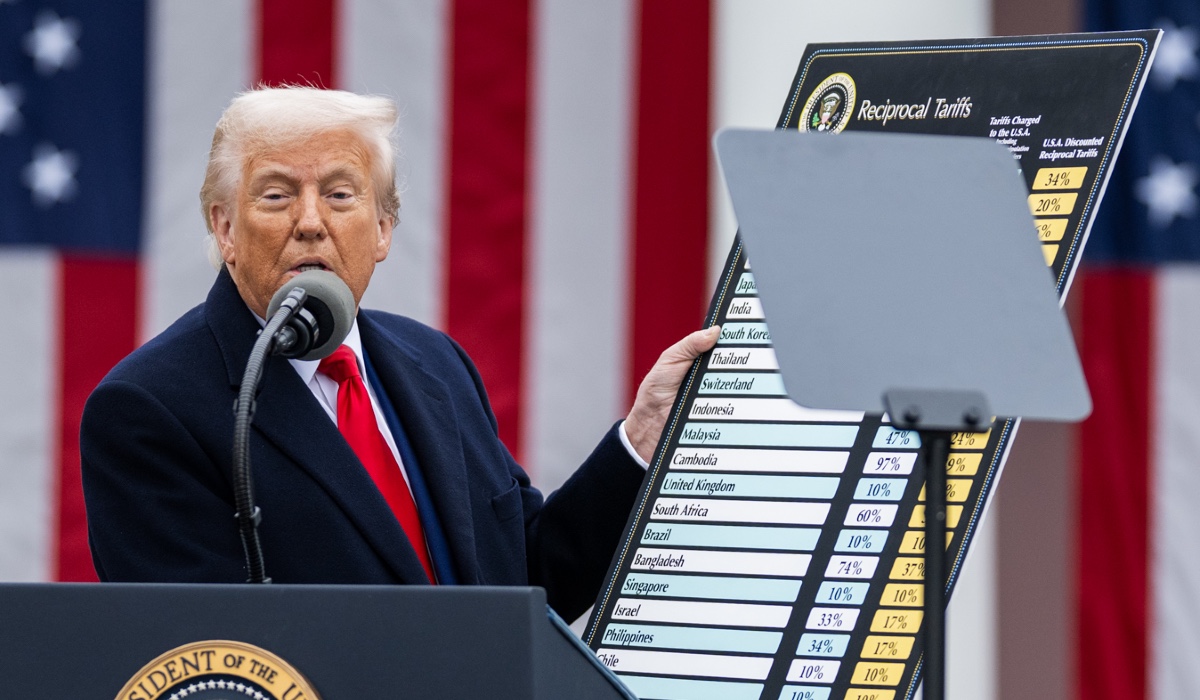
The ruling doesn’t negate all of Trump’s trade measures, ‘leaving in place ones he imposed on steel and aluminum using different laws, for example.’ However, he faces a huge setback, with the overturning of ‘his country-by-country or “reciprocal” tariffs [and] his 25% tariff Trump imposed on some goods from Canada, China and Mexico.’
Trump defiant
Within bourgeois democracies, political leaders frequently express regret at unfavourable electoral results or court rulings. However, it is normal practice perfunctorily to accept these results as consistent with the necessary checks and balances that exist within a supposedly democratic society. As we are by now fully aware, the Trump administration has dispensed with such niceties. It is unsurprising, then, that Trump was less than gracious in his enraged and defiant response to the ruling.
The president denounced the judges who ruled against him in the starkest terms possible. Consigning them to the ranks of his ‘enemy within,’ he declared, as reported by Global News, that the ‘Supreme Court’s ruling on tariffs is deeply disappointing, and I’m ashamed of certain members of the court, absolutely ashamed, for not having the courage to do what’s right for our country.’ He further declared them to be ‘very unpatriotic and disloyal to our Constitution.’
Returning to his standard theme on tariffs, Trump declared that: ‘Foreign countries that have been ripping us off for years are … dancing in the streets, but they won’t be dancing for long, I can assure you.’ He then boldly asserted that the ‘good news is that there are methods, practices, statutes and authorities … that are even stronger than the IEEPA tariffs available to me as president of the United States.’
True to his word, Trump has pressed ahead with some refashioned tariff initiatives. The CBC reports that in ‘response, the U.S. president turned to Section 122 of the U.S. Trade Act to impose the new global tariff. Trump said on social media Saturday morning that he’s raising that tariff to 15 per cent [from an initial 10 per cent] after a “thorough, detailed, and complete review” of the court decision.’
In announcing this step, Trump confidently asserted that he and his administration ‘will continue our extraordinarily successful process of Making America Great Again.’ However, the powers he has now utilised are not limitless and he is only deferring a reckoning since ‘Section 122 allows temporary tariffs of up to 15 per cent — but these tariffs can only be imposed for 150 days unless Congress approves an extension.’
It must also be noted that the administration must now deal with major legal repercussions. As Al Jazeera points out, ‘more than $130bn in tariffs have already been collected under the emergency declarations [and] the ruling is likely to trigger a prolonged legal battle over whether that money must be refunded.’ Some very powerful business interests will be conducting such litigation efforts and they will be a very major force for Trump to reckon with.
It is striking, in fact, that Trump’s whole approach on tariffs is very far from enjoying a consensus among US capitalists. The US Chamber of Commerce most certainly didn’t share the president’s outrage at the Supreme Court decision. It issued a statement that was something of a sigh of relief over the ‘welcome news for businesses and consumers.’ It called for ‘swift refunds of the impermissible tariffs’ and pointedly took credit for intervening in court in a way that had contributed to the Supreme Court’s decision.
On top of these problems, the Trump administration must also reckon with the stark fact that its turn to trade-war measures simply hasn’t produced the glowing results that were predicted. Michael Roberts points out that ‘… over the whole 2025, the US economy expanded 2.2%, or below the 2.4% rate in 2024. The boasting of Trump and his advisers of a US boom doesn’t look quite so convincing after these data.’
At the same time, the ‘Congressional Budget Office (CBO) estimates that US companies and consumers are now bearing 95% of the increased tariffs, particularly on imported foodstuffs. The tariffs on food imports have risen 44%, in effect, a 12% tax on consumers.’ Roberts notes that the Federal Reserve has found that ‘US import prices for goods subject to the average tariff increased by 11 percent … more than those for goods not subject to tariff.’ Trump’s capacity for bluster is limitless but it comes up against some undeniable realities that affect millions of lives.
Rough road ahead
The way ahead for Trump’s protectionist course of action looks very rough indeed. Up until now, he has proceeded with his tariff measures and broader agenda with both of the federal legislative bodies in Republican hands and hugely reluctant to interfere with his actions. The November midterm elections now pose the prospect of this changing to the great alarm of the Trump administration.
While it is true that the ‘progressive’ credentials of the Democrats have been hugely discredited and their opposition to Trump is, at best, weak and vacillating, his growing unpopularity and a widespread desire to stay his hand to the greatest degree possible are working against the Republican camp. The likelihood of Democratic control of Congress is considerable, even if the Senate is more an open question.
Though Democratic-controlled legislative bodies would hardly be shining examples of principled and effective opposition, there is no doubt that such a development would place very major restrictions on Trump’s freedom of movement. Indeed, so authoritarian and lawless is his conduct that impeachment proceedings are possible under a changed political alignment.
There is no doubt that Trump’s whole America First turn and the heavy-handed trade policies that are its centrepiece are in severe trouble. Not only do they face a rough ride politically but they are simply not delivering the promised results. Trump expresses the relative decline of US hegemony and is engaged in an effort to address this by abandoning the ‘world leadership’ role that the US has engaged in since the World War II in favour of a more pragmatic pursuit of immediate self-interest.
Trump and his key strategists hoped that a massive turn to tariffs would generate enough revenue to allow for massive tax cuts and that it would compel rivals, especially China, to capitulate and assist in the restoration of the US manufacturing base. This strategy is clearly failing on its own terms, putting Trump on a collision course with workers, consumers and even major portions of the capitalist class in the process.
The authoritarian and deeply reactionary Trump administration remains enormously dangerous but it reflects the deep contradictions within US imperialism and it is an increasingly crisis-ridden regime. That is expressed with particular emphasis in its erratic and floundering protectionist course and great uncertainty that hangs over the tariff measures on which it has staked so much.
Before you go
The ongoing genocide in Gaza, Starmer’s austerity and the danger of a resurgent far right demonstrate the urgent need for socialist organisation and ideas. Counterfire has been central to the Palestine revolt and we are committed to building mass, united movements of resistance. Become a member today and join the fightback.

John Clarke
John Clarke became an organiser with the Ontario Coalition Against Poverty when it was formed in 1990 and has been involved in mobilising poor communities under attack ever since.