
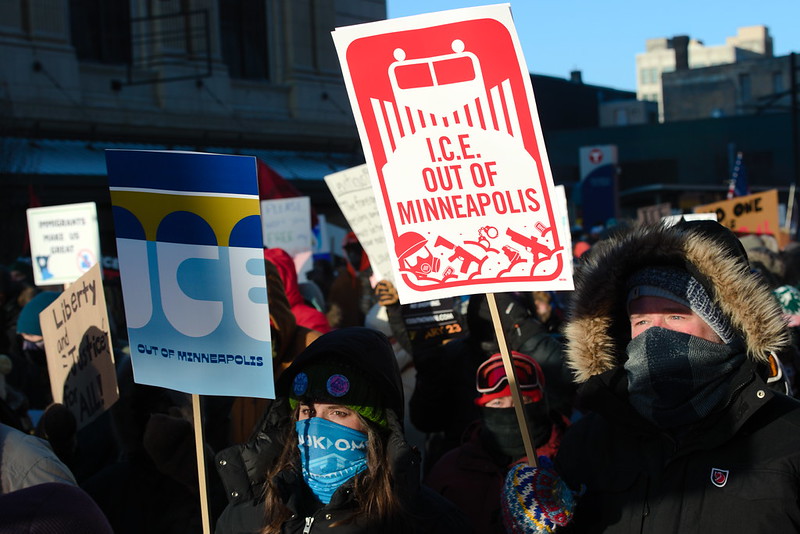
 Protest against ICE in Minneapolis, 23.01.2026. Photo: Fibonacci Blue / Flickr / CC BY 4.0
Working-class communities in Minneapolis have shown that Trump can be pushed back, but the movement cannot depend on the Democrats to follow through, argues John Clarke
As Trump’s immigration enforcers continue their rampage in cities across the US, his inner-circle and key supporters are turning their attention to the November midterm elections with considerable unease. Given Trump’s rising unpopularity, the loss of the Republican majorities in the House and Senate is very likely. This would impose some very unwelcome restrictions on the administration’s authoritarian drive to redefine and extend the powers of the presidency.
The Trump administration poses an enormous danger to basic democratic rights, as it forges ahead with its destructive political agenda. Yet, the recent period has seen levels of mobilisation and resistance that have shaken the administration and even forced limited tactical retreats from it.
There have been protests against the raids conducted by Immigration and Customs Enforcement (ICE) agents all across the country but the fight back taken up in Minneapolis has been exceptionally large and determined.
On 23 January, the CBC reported that on ‘a day that started with temperatures as low as –29 C, organizers said as many as 50,000 people took to the streets’ of the city to challenge the ICE enforcers, as ‘part of a wider show of defiance that organizers billed as a general strike.’ The report went on to note that ‘scores of businesses across Minnesota closed for the day and workers headed to street protests and marches, which followed weeks of sometimes violent confrontations between U.S. Immigration and Customs Enforcement (ICE) agents and protesters opposed to Trump’s surge.’
At the end of January, Inequality.org took stock of ICE’s brutal ‘Operation Metro Surge’ in Minneapolis that has ‘taken the lives of Renee Good and Alex Pretti while terrorizing Minnesota’s immigrant communities.’ It makes clear that the huge protests and strike actions that have been taken up in the face of this attack have been made possible by a very high level of community-based resistance and deeply rooted locally-based organising.
Kieran Knutson, the president of Communications Workers of America Local 7250 in Minneapolis, is quoted as saying that on ‘the positive side, in the neighborhood that my wife and I live in, for example, there are 700 people in the rapid response network. And my understanding is that there are eighty or so similar neighborhood networks across the Twin Cities — that means there’s thousands of people participating in this movement. Tons of people here are outraged, the whole society hates ICE here and that’s heartening.’
Dithering Democrats
The scale, the effectiveness and resilience of the challenge that Trump has faced in Minneapolis has certainly had an effect. Following clumsy efforts to justify the killing of the two protesters, some conciliatory measures had to be taken in the face of growing anger. Le Monde reported on 4 February that following ‘outcry over the shootings, Trump withdrew combative Customs and Border Protection commander Gregory Bovino and replaced him with the more policy-focused Homan, who pledged to draw down the operation with conditions.’ Moreover, some 700 immigration enforcers were moved out of Minnesota.
This is not to suggest that the operation has been brought to an end or to deny that the retreat is limited and tactical in nature. However, the image of intransigent ruthlessness that surrounded Trump’s immigration crackdown has been exposed as false and it was the determined mobilisation of working-class communities that achieved this.
If the fight against Trump’s ICE operations in Minneapolis and other cities has been inspiring and hopeful, the dithering and the retreats of his Democratic opponents, as the liberal wing of the US ruling establishment, offer a very different and dismal story.
An 18 January article in the Intercept drew attention to the gap between popular hostility to ICE and the failure of the Democrats to challenge the agency effectively. It noted that it ‘has been entirely predictable, then, as more Americans have witnessed the ways in which ICE has operated as a violent, lawless force, that there would be renewed calls from people across the country to “Abolish ICE”.’
However, it ‘has also been entirely predictable that establishment Democrats have tried to distance themselves from the idea … After Good was killed, Minneapolis Mayor Jacob Frey made waves by telling ICE, “Get the fuck out of Minneapolis” — but softened his tone in an appearance on Fox News: “I do not support abolishing ICE”.’
In line with this, ‘top Democrats in D.C. have been “feverishly working to fund the agency — with strings attached”… the kind of incrementalism that has failed time and again with the far right.’ This course has been followed, moreover, despite huge support for disbanding ICE, including a survey of US public opinion that found that support for abolishing the agency stood at 46% against 43% opposed.
It now appears, however, that the Democrats are unable to hold firm, even in pursuit of their timid ‘strings attached’ approach. On 5 February, the New Republic reported that the ‘Democrats are folding on their demand that federal agents stop covering their faces with masks while making arrests.’ House Minority Leader Hakeem Jeffries and Senate Minority Leader Chuck Schumer are now asking only that masks should not be worn in an ‘arbitrary and capricious fashion.’
As the article correctly argues ‘this is yet another confusing concession from a party whose base is desperately starving for its leaders to do something, anything, to stop the Trump administration from continuing to enact terror in their communities.’
Midterms threatened
The increasingly unpopular Donald Trump and his inner-circle are only too aware that the midterm elections in November are likely to cost the Republicans their majorities in both the House and Senate. Although the Democrats would still vacillate and compromise, even if they controlled these legislative bodies, the forward march of Trump’s authoritarian agenda would be seriously impeded by such a development and his more lawless antics might even force the hand of the Democrats and lead to impeachment proceedings.
To say the least, Trump’s commitment to respecting electoral outcomes is highly questionable. It is hardly surprising, then, that he and some of his leading co-thinkers are making very threatening noises with regard to the midterms.
The president doesn’t have the power to cancel elections and they are actually conducted under the supervision of the state level of government. Trump and those close to him are, however, clearly looking for a way to undermine the electoral process. National Public Radio has quoted Trump as insisting that: ‘We should take over the voting in at least many – 15 places – the Republicans ought to nationalize the voting.’
Continuing along these lines, ‘in a later interview with NBC, Trump doubled down on his comments and listed Atlanta, Philadelphia and Detroit – all Democratic cities – as targets for federal involvement.’ Trump bases his claim to intervene in this way on his longstanding and disproven assertions of voting irregularities.
Even more dangerously, the infamous Steve Bannon, still very influential in Trump circles, recently suggested on his ‘War Room’ podcast that: ‘We’re going to have ICE surround the polls come November.’ Such a move would obviously be calculated to intimidate and impede voter turnout, especially from Latino communities. However, it would also be a highly provocative move that could generate an explosive situation that would threaten the voting process itself, as Bannon is fully aware.
Yet, directly questioned on this proposal, the administration refused to distance itself from Bannon’s threat. Democracy Docket reports that ‘White House Press Secretary Karoline Leavitt ‘could not promise such a thing would not happen.’ Obviously well-prepared for the question, she told reporters that Trump hadn’t discussed the matter with her but ‘I can’t guarantee that an ICE agent won’t be around a polling location in November.’
As he works to extend presidential powers and undermine democratic rights, Trump has consistently promoted the notion that an ‘enemy within’ is pursuing a terroristic and treasonous set of objectives. Whether he spins tales of ‘narco-terrorists,’ sinister Antifa networks or the destructive role of supposedly radical Democrats, he presents a picture of a threatening crisis that must be responded to with exceptional measures.
As the midterms draw closer, a sense clearly exists within Trump’s circle that this is a ‘now or never’ moment and that the time for an assault on the electoral process itself may have arrived. The track record and present conduct of the Democrats offer scant reason to hope that they will effectively protect the elections, much less the democratic rights of assembly and expression that workers and oppressed communities must utilise in the struggles they take up.
Even with the level of resistance to the ICE operations that has been set in motion across the US and the significant impact this has already had, the Democrats are only capable of wretched shadow boxing and they can’t be relied on to stop Trump. That will require working-class mobilisation and popular struggle and the fight that has been taken up in Minneapolis points the way forward.
Before you go
The ongoing genocide in Gaza, Starmer’s austerity and the danger of a resurgent far right demonstrate the urgent need for socialist organisation and ideas. Counterfire has been central to the Palestine revolt and we are committed to building mass, united movements of resistance. Become a member today and join the fightback.

John Clarke
John Clarke became an organiser with the Ontario Coalition Against Poverty when it was formed in 1990 and has been involved in mobilising poor communities under attack ever since.