
The neocolonial board for Gaza is part of the aggressive new unilateral turn by the US, for which neither the UN, nor Europe or any other leaders have an answer, argues John Clarke
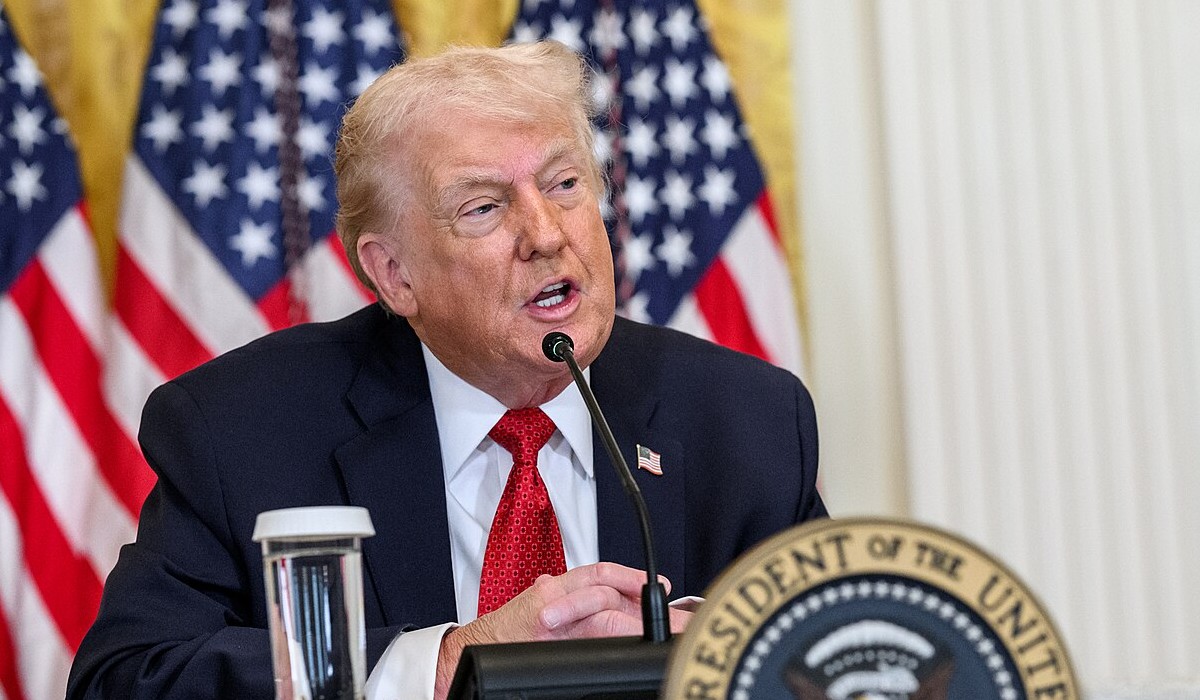
As Donald Trump selects those who will sit on the hideously misnamed ‘board of peace’ that will be charged with charting Gaza’s future, it becomes clear that this venture may be a pilot project for an approach that could be applied across the globe. In line with Trump’s clearly stated objectives, such a wider initiative would further diminish the authority of international law and weaken the United Nations.
At present, however, Trump is focused on establishing his Gaza board and setting it in motion. The task at hand, as the BBC notes, is to proceed with phase two of the ceasefire agreement, which US envoy Steve Witkoff presents as ‘the reconstruction and full demilitarisation of Gaza, including the disarmament of Hamas and other Palestinian groups.’
Given that phase one of the ceasefire has seen Israel consolidating its grip on Gaza and that almost ‘450 Palestinians have been killed in Israeli strikes since it came into force,’ the prospects for generating even an illusion of progress towards these stated aims are uncertain at best. Nonetheless, the board of peace is being taken forward with great flourish.
Oligarchic formation
The composition of the board is, to say the least, enormously telling. A 16 January White House statement informs us that to ‘operationalize the Board of Peace’s vision—under the chairmanship of President Donald J. Trump—a founding Executive Board has been formed, composed of leaders with experience across diplomacy, development, infrastructure, and economic strategy.’
This core group consists of Secretary of State Marco Rubio, Steve Witkoff, the notorious war criminal Tony Blair, Trump’s son-in-law Jared Kushner, Marc Rowan from Apollo Global Management, Ajay Banga of the World Bank and Robert Gabriel, who is Trump’s deputy national security advisor.
Each of these executive members ‘will oversee a defined portfolio critical to Gaza’s stabilization and long-term success, including, but not limited to, governance capacity-building, regional relations, reconstruction, investment attraction, large-scale funding, and capital mobilization.’
Other appointees to the full board will doubtless ensure that appropriate ‘world leaders’ and collaborators from within the Middle East are included but it is enough to consider the core members to immediately appreciate what is at play. It is an oligarchic formation consisting entirely of representatives of US imperialism and its closest allies, with a significant inclusion of business interests.
For good measure, CNBC reports that, with Trump as the inaugural chair, states that are invited to participate ‘would serve a three-year term on the board, but could secure a permanent seat by paying $1 billion cash within the first year of the charter’s start.’
The composition, structure and mandate of this board could hardly be more brazen and obvious. There are no Palestinians and the cast of characters who will gather round the table are uniformly those who will focus on assisting Israel in the pursuit of its colonial objectives, while charting a course of ‘reconstruction’ that is entirely to the liking of international investors.
In assessing this initiative, Middle East Monitor suggests that the Trump initiative ‘mirrors the League of Nations Mandate system, particularly the Class A Mandates established after World War I. These mandates were predicated on the idea that certain territories were inhabited by people “not yet able to stand by themselves under the strenuous conditions of the modern world”.’
The article goes on to argue that this ‘is a profound regression; it replaces the legal right to self-determination with a conditional “supervised” existence, where “peace” is defined solely as the absence of resistance to the dominant order.’ It draws from this the conclusion that to ‘accept the recolonisation of Gaza is to accept a world where the strong do what they can and the weak suffer what they must, all while a “Board of Peace” takes minutes of the proceedings. The struggle for Gaza is the frontline of the global struggle for decoloniality.’
Unlike the League of Nations model, however, the present effort will be directly controlled from Washington. Moreover, Trump administration’s attempt to revive an ugly colonialist tactic may have wider aims than crushing Palestinian resistance and furthering Israel’s objectives. An 18 January article in Al Jazeera reports that, in a letter sent to Argentinian president Javier Milei, Trump suggests that his ‘board would seek to “solidify Peace in the Middle East”, adding that it would “embark on a bold new approach to resolving Global Conflict” at the same time.’
A draft charter for the board that was sent to some sixty countries by the US explains that ‘the Board of Peace is an international organisation that seeks to promote stability, restore dependable and lawful governance, and secure enduring peace in areas affected or threatened by conflict.’
With no attempt at subtlety, the document reveals an intention to replace at least some of the key functions of the United Nations. It states that: ‘Durable peace requires pragmatic judgment, common sense solutions, and the courage to depart from approaches and institutions that have too often failed.’ This led one diplomat to comment anonymously that: ‘It’s a “Trump United Nations” that ignores the fundamentals of the UN charter.’
Massive uncertainty
Yet, as the Trump administration ushers in the demise of the post-war world order and pushes aside the international bodies and alliances that emerged and developed during this period, no clear alternative is posed that could restore a level of cohesion and stability. A rudderless period of massive uncertainty is unfolding that is to be dominated by the pursuit of immediate US self-interest.
The Guardian reports on an ‘historic speech’ given by UN secretary-general Antonio Guterres ‘to mark the 80th anniversary of the UN’s first major meeting.’ This was delivered only a week after ‘Trump announced the US withdrawal from multiple UN agencies as well as its key climate treaty’ and the state department warned that the UN must ‘adapt, shrink or die.’
In the face of this massive attack and, with Trump’s board-of-peace initiative arrogantly elbowing the UN out of its role in responding to international conflicts and crises, the best that Guterres could do was to weakly bemoan unnamed ‘powerful forces lining up to undermine global cooperation.’ No strategy was advanced to counter the America First turn and to preserve the UN in the face of a US wrecking operation because no such plan is being developed.
Much has been made of the speech delivered to the World Economic Forum in Davos by Canadian prime minister Mark Carney and it must be admitted that he was considerably more candid than Guterres managed to be. Carney acknowledged that ‘we knew the story of the international rules-based order was partially false, that the strongest would exempt themselves when convenient…’
However, ‘this fiction was useful, and American hegemony in particular helped provide public goods: open sea lanes, a stable financial system, collective security and support for frameworks for resolving disputes … This bargain no longer works. Let me be direct. We are in the midst of a rupture, not a transition.’
Despite this frank and largely accurate assessment of the present juncture, the failure to propose a real alternative is striking. Carney went into considerable detail to show how Canada is working to diversify trade and forge new international alliances outside of its relations with the US. He argued that ‘the middle powers must act together because if we’re not at the table, we’re on the menu.’
Yet, in practice, the Canadian government is scrambling to negotiate a compromise trade deal with the US that can only be highly unfavourable and Carney has even indicated a readiness to accept a place on Trump’s Gaza board of peace.
Like the other discarded junior partners of the US, especially those in Europe, the Canadian political establishment is engaged in an improvised and self-interested exercise in damage control with no strategy to counter the America First posture or to oppose it in any serious way. Mark Carney may not be as servile as Keir Starmer but he has no more idea of a viable way forward than his British counterpart.
Trump’s board-of-peace approach to international relations is but the latest expression of the stark new brand of US unilateralism that now dominates the world stage. The strategic shift that has been undertaken under the Trump administration poses a global threat of enormous proportions. If it is to be confronted and defeated, the challenge will have to take the form of working-class struggle and movements of resistance on an international scale.
Before you go
The ongoing genocide in Gaza, Starmer’s austerity and the danger of a resurgent far right demonstrate the urgent need for socialist organisation and ideas. Counterfire has been central to the Palestine revolt and we are committed to building mass, united movements of resistance. Become a member today and join the fightback.

John Clarke
John Clarke became an organiser with the Ontario Coalition Against Poverty when it was formed in 1990 and has been involved in mobilising poor communities under attack ever since.