
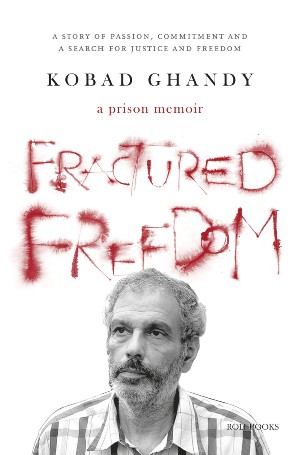
 Kobad Ghandy, Fractured Freedom: A Prison Memoir (New Delhi: Roli Books 2021), 316pp.
A memoir of a CPI (Maoist) activist lays bare the injustices and brutalities of India’s prison regime for political offenders, finds Wahid Shaikh
December closes the Gregorian year, but within the history of the Maoist movement, the month carries another resonance. It marks the founding of the People’s Liberation Guerrilla Army (PLGA), the armed backbone of CPI (Maoist); it seems this December signals the same for 2025 and the party: end of their existence. This symbolism becomes striking today, when public discourse is saturated with reports of Maoist surrenders, even as countless individuals allegedly associated with the movement continue to spend their lives in prison.
It was in this context that my own curiosity about the Maoist movement deepened: its history, its leaders, and the people who shaped it. Through the life and work of Anuradha Ghandy, I arrived at her husband, Kobad Ghandy, and eventually at his prison memoir. I read the book closely, met him in Pune, and interviewed him. This piece is a reflection on some aspects relating to his thoughts and observations on prison.
The book is dedicated to Anuradha Ghandy – Anu – as he and others lovingly called her, a Central Committee member and a leading ideologue of the banned CPI (Maoist), and one of the most iconic figures associated with the PLGA. She was not only Ghandy’s life partner but also a political companion who shaped his ideological, social and political journey. He credits her with guiding him toward social activism and regards her as an ideal social worker. In times of persecution, exile, and imprisonment, it is often the ‘better half’ who sustains those inside prison. Anuradha could have done precisely that, if death hadn’t intervened.
The central tragedy of Ghandy’s imprisonment is that it began after Anuradha’s death. When he finally enters prison, there is no partner left to visit him, console him, or hold life together outside. The loss is absolute. Yet paradoxically, Anuradha had already prepared him for incarceration. Arrested multiple times herself, she lived with the certainty that prison, and even the gallows, were occupational hazards of resistance. Through her life, she taught him how to endure confinement long before he experienced it.
For many prisoners, survival depends on the imagination of return: the belief that a spouse waits outside, sustaining hope across years or decades. Ghandy is denied even this. He cannot imagine a shared future. This absence lends the memoir a persistent, quiet sadness. When I met him, he told me that even three years into imprisonment, he had not come to terms with Anuradha’s death. Apart from close friends, there is no enduring presence in his prison narrative.
One is inevitably left wondering how different the story might have been had Kobad gone to jail while Anuradha was still alive: what role she would have played, how she would have responded to his incarceration, and how her presence might have reshaped the emotional and political texture of the memoir and his life.
Ghandy records that on 17 September 2009, he was abducted by the police in Delhi and charged under the UAPA [Unlawful Activities (Prevention) Act 1967] amongst other laws. Like many others, he was first declared absconding, then ‘arrested’ on the basis of alleged intelligence inputs, while the actual place of detention was never disclosed. He remained an undertrial for ten years, confined in seven prisons across five states. Arrested at 62 and released at 72, his age and experience allowed him to observe the prison system with unusual clarity. The police have still failed after ten years of imprisoning him in dozens of cases to prove their central allegation, that he was a senior Maoist leader and part of the party’s political bureau, in any court.
Structural injustice
His movement across prisons exposed him to the structural brutality of incarceration. Prison journeys to courts and hospitals, constant transfers, hunger strikes, and the sheer length of confinement broke his health. Old age magnified every indignity: carrying water, lifting loads, being denied Indian-style toilets, and enduring repeated full-body scans with metal detectors and hand-held scanners.
Medical care was negligent. Pre-existing illnesses went untreated; new ones emerged. Cataracts developed, worsened by an incorrect spectacle prescription given by a jail doctor. Only intervention at AIIMS [All India Institute Of Medical Sciences] restored his vision. Others were less fortunate. He recalls undertrials losing eyesight because of delayed treatment, reinforcing a grim truth: in prison, neglect can maim as effectively as violence.
He writes that during his ten years in prison, he was repeatedly taken to court or to hospitals for treatment. Each time he returned, he was subjected to full-body checks at the prison gate; first through metal detectors and then through hand-held metal scanners that searched his body and clothing. He notes that the high levels of radiation emitted by these devices enter a prisoner’s body, and no one can truly measure the long-term harm this causes.
Ghandy describes constant illumination, bulbs and tube lights burning day and night, as routine practice. Sleep becomes nearly impossible; attempts to cover lights are stopped. The experience in Arthur Road Jail was no different. In the anda cell, all prisoners improvised black eye covers by procuring black cloth and tying it as a band to cover their eyes at night. Those who could not obtain cloth wrapped their handkerchiefs instead. For a short while, the illusion of darkness helped induce sleep. But as soon as one turned in bed, the cloth would slip off, and the struggle between artificial prison light and natural sleep would begin again. Prisoners would half-sleep and half-wake through the night, until the call for the dawn prayer finally forced everyone out of bed. He notes that according to the United Nations, depriving someone of sleep through constant lighting amounts to a form of torture. At night, darkness allows the body to produce melatonin, which induces sleep. Light suppresses this process and instead triggers the release of cortisol, which prevents sleep.
Under CCTV surveillance at all hours, prisoners feel like animals on display. The state, he suggests, views people as animals: some roaming freely under illusion of freedom, others locked in cages.
He writes that in law, bail is the rule and jail the exception, but in practice, this principle does not operate in Indian courts. He refers to the states of Uttar Pradesh and West Bengal, where bail is rarely granted, whereas in the southern states, bail is more often allowed. In cases labelled as terrorism, on the one hand, the government is making the laws increasingly stringent, and on the other hand, the attitude of the courts is becoming ever more lethargic. Through these laws, governments are effectively encroaching upon and undermining the powers of the judiciary, often without the courts even realising it. The judiciary ends up displaying excessive reluctance in granting bail. Ideally, if the government is bent on tying the courts’ hands, the courts should respond by granting bail on a large scale and thereby teaching the government a lesson in constitutional conduct. He also writes that all kinds of bizarre restrictions are imposed on prisoners, for instance, if you wish to donate your body or organs after death, the jail authorities will not permit it.
Obstruction and corruption
Education, which could redeem prison time, is systematically obstructed. Despite well-organised Indira Gandhi National Open University (IGNOU) facilities in Tihar, he was denied enrolment in a human-rights course solely because he was accused of being a Naxalite. Terror-related undertrials face extraordinary hurdles in studying, accessing libraries, or even keeping books sent by family. Time, the one resource prisoners possess in abundance, is rendered useless. In one instance, a 7/11-blast accused was denied permission by jail authorities to appear for a law examination. When the matter reached the High Court, such an exorbitant cost of escort guards was imposed on him that even after paying nearly sixty lakh [6 million] rupees, completing a three-year degree became virtually impossible.
Similarly, he was not allowed to go and study in the jail’s best library. In prison, the cheapest and most readily available commodity a prisoner possesses is time: something people outside rarely have. The best use of this time would be for prisoners to read as many books as possible and enrich their knowledge and experience. Yet in most jails, library systems are either absent or grossly inadequate. Even where a library exists, books are often missing; and where books are available, there is no proper system for reading. Those arrested in terrorism cases are not only barred from visiting the library to read books of their choice, but even books sent by their families are frequently not allowed by jail authorities. In the Bhima Koregaon case, prisoners had to seek court permission merely to be allowed to carry a few books from court to jail on each hearing date in order to read them.
Ghandy writes that he obtained permission from the magistrate to keep and use a chair and a table, as he could not sit on the floor for long due to back pain. Having a chair and table made reading and writing much easier for him.
I recall that in the famous 1993 bomb-blast case, when the well-known prisoner Mustafa Dossa was lodged in Arthur Road Jail [Mumbai] and was arrested in old age, it was difficult for him to sit down and get up from the floor. He therefore obtained a chair and a cardboard table from the TADA [Terrorist and Disruptive Activities (Prevention) Act] court to use inside the jail. The chair was sent to him by his family. He would sit on that chair and say that a chair is a blessing; not the kind of chair of power to which people cling, on which they sit to commit wrongs and misuse authority, but a chair meant for human comfort: a place where one sits to rest, relax a little, think quietly, sip tea or coffee, and weave dreams of the future.
Corruption, Ghandy notes, is the organising principle of prison life. No concession is free. Transfers, bedding placement, hospital visits, extra blankets, water, court production: everything has a price. The harsher the regime, the greater the scope for profiteering by staff.
Transferred from Tihar to Chanchalguda Jail in Hyderabad, Ghandy describes the shock of greenery, trees, flowers, gardens, after years of concrete. For a moment, prison felt like paradise. When a prisoner sees greenery and flowers, even briefly, it creates the illusion of freedom. Perhaps it was such a garden that inspired Faiz Ahmad Faiz in Montgomery Jail in 1954 to write: ‘Let colours fill the flowers, let the spring breeze blow / Come, for the garden must flourish again.’
He explains that the idea of writing a prison diary emerged during his confinement in Surat Jail, Gujarat, supported by reading English prison literature. Prison diaries, he argues, are the most accessible form of prison writing. If a political prisoner commits to writing a few lines daily, a year yields substantial material; with incarcerations often lasting five to ten years, the output can be immense.
Denying support
On Tihar, he recalls that families were once allowed to bring clothes and home-cooked food during visits. Gradually, items were banned – first rice, lentils, vegetables, paneer; then fruits; finally, all home food – on the pretext of preventing the smuggling of tobacco, drugs, cash, phones, and blades. In reality, such contraband enters via prison staff and is sold on the black market. Home food, he writes, nourishes not just the body but family bonds. Its ban demoralised prisoners, though visits remained vital. Books were later banned too. Despite claims that Tihar is an ‘ashram’ for reform, it has never been reformative: minor offenders become hardened criminals, learning crimes and building networks.
Yet even such spaces are rare, as authorities fear gardens enable prisoners to hide contraband. Later, in Jharkhand Jail, he encountered a cash-based system that fuelled corruption, though a humane superintendent allowed him computer access, lRelease did not bring closure. After ten years inside, he emerged to a life stripped bare: no wife, no children, no home, no income. He depended on others even for basics like a phone, Aadhaar, and a bank account. His sole resolve was to write, drawing on four decades of social activism.
Medical care is abysmal. Pre-existing ailments went untreated; new ones developed. Gruelling journeys between jail, court, and hospitals break even healthy bodies. Hunger strikes worsened his condition. Transfers across jails for multiple cases damaged his health further.
A fellow inmate wrote about Kobad, calling him the ‘Gandhi’ of Tihar Ashram: serene despite illness, observing squirrels, tending tulsi, rose, and guava plants, and spending seven to eight hours daily reading and writing. Such a person, he felt, did not belong in prison. This modern-day Gandhi lives anonymously, without home, family, or income, moving between relatives and friends, dependent on sporadic help.
Kobad observes that while prisons elsewhere house convicts serving sentences, India uniquely[1] incarcerates large numbers for long periods before conviction, where the injustice in the legal system begins. Investigative agencies build terror cases, block bail, and coerce guilty pleas to boost conviction rates, offering a ‘sentenced exit’. A recent five-part series by The Wire report documents this.
He recounts an attempted air transfer from Hyderabad Jail thwarted because airport authorities demanded a minister’s written order. He was detained in a vehicle all day and returned to jail; the transfer occurred only the next day after the order arrived. The author recalls his own narcotics-related air transfer: seated at the last row, boarded and deboarded from the rear to avoid public view, yet stared at like a spectacle. An air hostess even asked if he had carried out a blast.
After release, questions overwhelmed him: where to live, with whom? His wife had died; he had no children, home, job, or business. He depended on others for basics: phone, Aadhaar, bank account, legal address, eventually arranging them with relatives’ help. His sole aim thereafter was to write for society, drawing on more than four decades of activism.
He notes that a prison doctor prescribed the wrong spectacle power, worsening his vision and causing headaches. Correct diagnosis at AIIMS resolved both. Discrimination in hospitals is common: unnecessary teeth are extracted, wrong medicines given, spectacle powers altered, X-ray reports falsified. Such abuses suggest state doctors presume guilt and add their own punishment before trial.
Finally, he recounts his 2010 arrest by Andhra Pradesh Police and presentation before Karimnagar Court with a Telugu-language ‘confession’, though he does not know Telugu, exposing the routine fabrication of confessions. Yet such statements retain legal validity, laying bare the bankruptcy of the justice system.
This memoir ultimately exposes a deeper injustice: India’s prison system and its systemic problems, and draws us to work for possible solutions.
Abdul Wahid Shaikh is a Mumbai based prison rights activist and national general secretary of Innocence Network, India. It advocates for judicial and police reforms. Shaikh was acquitted in 2015 after nine years in Arthur Road Prison, Mumbai in the 7/11 Mumbai train bombings. He is the author of Innocent Prisoners (New Delhi: Pharos Media & Publishing 2021).
[1] Britain’s Palestine Action prisoners now offer parallels to India’s case.
Before you go
The ongoing genocide in Gaza, Starmer’s austerity and the danger of a resurgent far right demonstrate the urgent need for socialist organisation and ideas. Counterfire has been central to the Palestine revolt and we are committed to building mass, united movements of resistance. Become a member today and join the fightback.
