
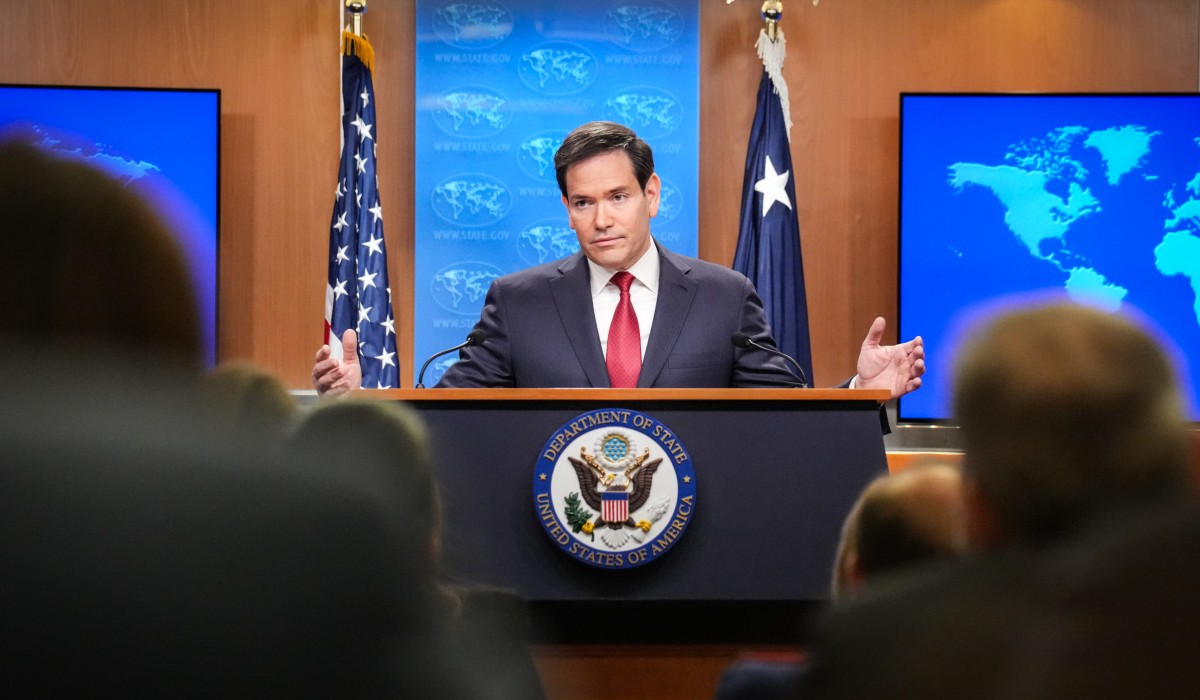
 Marco Rubio, 19 December press conference. Photo: Public Domain
The strategy of US imperialism in relative decline mirrors the brutality of British imperialism at a similar stage in the decay of its hegemony, argues Chris Bambery
Last Friday, US secretary of state Marco Rubio gave a lengthy end-of-year press conference in which he hailed Trump as a ‘peacemaker’. Rubio, who is also Trump’s national security adviser, added: ‘Peacemaking isn’t just signing a piece of paper. It’s actually complying with it. And compliance oftentimes requires … in most cases, requires daily, constant follow-up and nurture.’
Rubio is in many ways the forgotten man of the administration, frozen out of talks over Ukraine and the Middle East, with Steve Witkoff and Jared Kushner, Trump’s son on law, leading on both. Rubio is also the leading neocon in the administration who has wanted to use Ukraine to bring down Russian president, Vladimir Putin.
Trump has repeatedly claimed that he has ‘solved’ eight wars in his first ten months back in office. Well, if that’s true, the supposed jewel in the crown of Trump’s peace making was October’s Gaza ceasefire. But Israel continues to bomb and kill the partitioned Strip, where the Israeli Defence Force controls over half the territory. Israeli forces and settlers run amok in the occupied West Bank where, on Monday, Israel’s security cabinet approved the recognition of nineteen new, illegal settlements in the occupied West Bank as the government continues its settlement expansion push.
The proposal was moved by the far-right Finance Minister Bezalel Smotrich, a settler himself, and Defence Minister Israel Katz. This brings the total number of approved settlements under Smotrich’s time in office since November 2022 to 69. He hailed the move as ‘a record like no other’, adding in an X post that the ‘people of Israel are returning to their land, building it and strengthening their hold on it.’ He also stated the recognition of the new settlements is designed to ensure a Palestinian state will never come into being. Meanwhile, Israel continues its attacks in Lebanon and Syria, where, in both, it occupies territory.
As Rubio was speaking, the US launched air strikes against Isis in Syria in retaliation for an ambush that killed two American soldiers and a civilian interpreter last week. US Central Command said it had ‘commenced a large-scale strike against ISIS infrastructure and weapons sites in Syria’, hitting more than seventy targets with fighter jets, attack helicopters and artillery, supported by the Jordanian air force.
Back in February 2019, Trump claimed that ‘100 percent’ of the Islamic State caliphate, the self-proclaimed Islamic state in Syria, had been defeated. Today, Isis controls swathes of Syria and is growing in strength. There is no effective Syrian army to combat it and Israel is not going to allow one to be rebuilt. The country is effectively partitioned.
The peacemaker’s wars
What’s going on in the Middle East makes a laughing stock of claims Trump is a ‘peacemaker’ but, added to that, peace deals have come unstuck on the Cambodian-Thai border and in the Democratic Republic of Congo, where fighting with Rwanda has resumed.
Rubio, in Friday’s press conference, said of the Russo-Ukraine conflict: ‘it’s a war in another continent. We’ve got issues in our own hemisphere we need to be dealing with.’
That, of course, is in line with the recent National Security Strategy.
Rubio also addressed the status of US attacks on boats off the coast of Venezuela, the hijacking of an oil tanker and the attempted blockade of the country saying: ‘Nothing has happened that requires us to notify Congress or get congressional approval or cross the threshold in the war.’ That flies in the face of the US constitution but the US Congress is so supine, it will not attempt to bring this administration to order.
Earlier this year, following US strikes on Iranian nuclear facilities, Rubio stated that the United States was not at war with Iran. Despite the violation of Iranian sovereignty and the targeting of critical infrastructure, the whole affair was presented as the US acting in self-defence in order to avert a greater catastrophe. Israel also said it struck Iran in self-defence.
Trump used the US attack on Iran to strengthen his own hand. As one commentator said, ‘Now directly involved, U.S. participation in the Iran-Israel conflict quickly became an opportunity for Trump to both push the boundaries of the Executive Branch’s power and continue a trend he began in January: the centralization of the Executive Branch’s policy and power within the Oval Office.’
The US has always claimed a non-warlike character for many of its military interventions. The Cold War with the Soviet Union was always presented as being about US ‘security’ and preserving its freedom in the face of a totalitarian threat. The fight against Al Queda was presented in an almost exact same way.
The Korean War was presented as a police action; Vietnam as counter-insurgency against subversion; the Gulf Wars and the invasion of Afghanistan as actions against ‘rogue’ states. Washington does not do declarations of war.[1]
After the US seizure of the Venezuelan oil tanker, Trump proclaimed: ‘America will not allow Criminals, Terrorists, or other Countries, to rob, threaten, or harm our Nation and, likewise, will not allow a Hostile Regime to take our Oil, Land, or any other Assets, all of which must be returned to the United States, IMMEDIATELY.’
Now, the oil and land of Venezuela are part of its sovereign territory. A blockade is not just a use of force but it is an armed attack and under international law, Venezuela has a right to respond with counterforce. But Trump does not care about this.
All of this fits with the growing rejection by Washington of international law: the judicial system largely created by the US itself in the wake of World War II and the horrors of the Holocuast.
Spectres of imperialism past
Lauren Benton points to the continuity here with British imperialism in the nineteenth century. Benton focuses on what she calls ‘imperial small wars’; undeclared wars, seemingly limited in scope but involving raids, punitive expeditions and skirmishes. These operations constituted the primary means of imperial expansion. Benton identifies ‘serial small wars as components of conquest’, which were not aberrations but were structural to imperial rule, a ‘global regime of plunder’. Captivity as a tool of imperial control was ‘represented as a more humane alternative to slaughter thereby reinforcing imperial claims to moral superiority.’[2]
Britain moved from mapping ‘clear pathways from lawful interventions with modest objectives to brutal campaigns of dispossession and extermination.’ Frontier policing, naval patrols and disciplinary expeditions were supposedly legally sanctioned under doctrines of self-defence, subject protection, and public order. Such justifications allowed rapid escalation from isolated clashes to campaigns of extermination – all without the formal declaration of war.’ [3] Benton also outlines what she calls the ‘protection emergency’, which ‘created a legally permissive environment for imperial small wars.[4]
London or Delhi (many of these actions were carried out by the Indian Army) would declare they faced imminent threats to justify extraordinary violence. Field commanders were given a quasi-legal authority, empowered to interpret events, identify enemies, and initiate military responses. Hence, the ‘navy and army officers were not just military commanders but also legal agents.’[5]
Military authorities and settler populations portrayed indigenous resistance as rebellion and thereby excluded such actors from legal protections afforded to combatants; the dirty wars in Malaya and Kenya in the 1940s and 50s are a case in point. These fictions transformed small wars into genocidal undertakings supposedly under the pretence of lawful governance.
There are other parallels to be made. In the second half of the nineteenth century, as Britain was overtaken economically be the USA and then Germany, it resorted to imperialist actions as a means to retain its global dominance.
Today the US, while still the number one financial and military power, has been overtaken by China economically. The US has launched more invasions and occupations during its period of economic decline, beginning in the 1970s and continuing until today, than it did when it was economically dominant, from 1945 through to the early 1970s.
Britain justified Empire by claiming it was spreading ‘civilization’ through commerce in particular. It could hold up its suppression of the slave trade, for instance.
The US has a formal empire: Puerto Rico, Guam, Samoa and, at one time, the Philippines, but it is overshadowed by its informal empire. Britain, while having had a far greater formal empire, also had an important informal empire, in China, for example.
Today, the United States constantly proclaims its moral superiority in similar ways, which justifies anything it does. As Anders Stephanson concludes: ‘the movement of legalism and normativity is at odds with the imperial and messianic status of the United States, whose decisionistic authority is always in the last instance overdetermined by the absolute distinction between itself and the outside.’[6]
The ‘imperial and messianic’ message grows louder under Trump but the US claim to have moral superiority or to to be the upholder of civilisation looks threadbare. The global financial crisis of 2007-9 left the ruling classes in North America and Europe determined to maintain neoliberalism but they could only do so through permanent austerity.
Peter Gowan noted, after the Asian Financial Crisis of 1997, that neoliberal globalisation led by the United States had shrunk into a ‘narrow ideology of rentiers and speculators,’ who, despite remaining extremely powerful, ‘have lost the capacity to present themselves as the bearers of any modernization program for the planet.’[7]
Trump, through his Make America Great Again movement, has tapped into the resentment against neoliberalism promising to impose tariffs and greater political control over the economy. But his tax and spending cuts and further deregulation is continuity neoliberalism. Within the Maga base there is growing discontent that he has not ended the ‘forever wars’ and that he follows ‘Israel first’ not ‘America first’.
[1] Anders Stephanson, American Imperatives: The Cold War and Other Matters (London: Verso, 2025), p.219.
[2] Lauren Benton, They Called It Peace: Worlds of Imperial Violence (Princeton: Princeton University Press, 2024), pp.18 and 64.
[3] ibid. p.101.
[4] ibid. p.182.
[5] ibid. p.100.
[6] Anders Stephanson, American Imperatives, p.361.
[7] Peter Gowan, The Global Gamble: Washington’s Faustian Bid for World Dominance (London: Verso, 1999), p.131.
Before you go
The ongoing genocide in Gaza, Starmer’s austerity and the danger of a resurgent far right demonstrate the urgent need for socialist organisation and ideas. Counterfire has been central to the Palestine revolt and we are committed to building mass, united movements of resistance. Become a member today and join the fightback.

Chris Bambery
Chris Bambery is an author, political activist and commentator, and a supporter of Rise, the radical left wing coalition in Scotland. His books include A People's History of Scotland and The Second World War: A Marxist Analysis.