
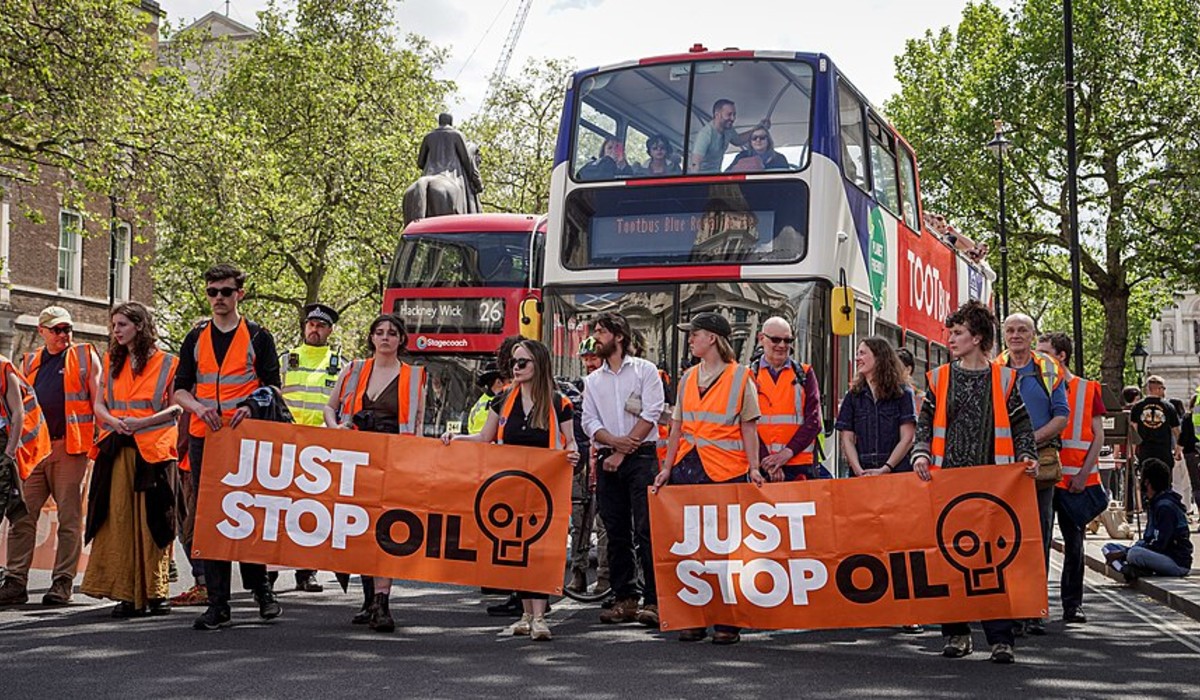
 Just Stop Oil Activists Walking Up Whitehall. Photo: Alisdare Hickson / Wiki Commons / CC 2.0
As JSO’s successor organisation, Take Back Power, launches, it is time to reflect seriously on the achievements and limitations of the strategy of horizontalist activism, argues Kevin Crane
On 6 December, four protestors intentionally got arrested in the Tower of London Jewel House for spilling some dessert on a glass box. It should go without saying that never at any point was ‘the Imperial State’ crown in any danger of being damaged, not that such a gaudy, naff object would really look much worse if it were covered in apple crumble. The more important point is that this bit of theatrical defiance was basically a photo opportunity for a banner bearing the slogan: ‘Democracy has Crumbled – Tax the Rich.’
This was the inaugural action of ‘Take Back Power’ (TBP), which is the official successor to the protest organisation Just Stop Oil (JSO). This was a comeback of sorts for JSO, after it had officially announced it was winding up operations back March. They had, quite naturally, framed that statement as them retiring in triumph, although the reality is a bit more controversial (and, unfortunately, not just due to politics).
We can be sure the courts are going to be under significant pressure from government, the establishment and the media to give these activists absurdly severe sentences, as part of the more general move by the establishment to criminalise protest. The sentiment of TBP’s slogan is also one everyone on the left should agree with: wealth inequality in this country is the most urgent question in society.
What there is further to say about is what this act represents in the wider set of political ideas and strategies promoted by TBP. Their own website describes their objectives like so:
Two supporters of Take Back Power have smothered dessert over the crown jewels. Take Back Power is a new nonviolent civil-resistance group, demanding that the UK government establish a permanent citizen’s assembly – a House of the People, which has the power to tax extreme wealth and fix Britain.
While TBP is ‘new’ in its present form, and specifically tackling wealth inequality is a departure, what’s being described here is very much of a piece with the family of protest groups that came before it. The protest tactic is well-worn by this stage; up until JSO’s recent hiatus, both the public and media had become a bit used to these sorts of stunts. Beyond that, calls for a citizen’s assembly/house of the people have been around for a while, and although they sound radical, the capacity of these demands actually to drive radical change is far from being self-evident.
The treatment of JSO, both by the state and the media, is consistently outrageous, and everyone on the left should defend them against these attacks. However, there are valid reasons for the left to have our own criticisms of both the practice and theory of this movement, because there are real demonstrable issues with both.
The short, but complicated, history of modern eco-protesting
The activist scene from which JSO and TBP emerged began just seven years ago, in the form of another group called Extinction Rebellion (XR). This group launched themselves with the deliberately ironic act of staging an occupation of Greenpeace’s British headquarters in London. Their media coordinator at the time justified the surprising move as follows:
[XR is] working on building a rebellion against our broken democracy which is complicit in the ecological crisis we are facing and which is now a real emergency … a systemic problem rather than something which can be treated through changes in individual consumption.
[Non-governmental organisations] like Greenpeace are part of the problem … since their messaging is a lot more narrow and doesn’t tell the truth of the extent of the upcoming ecological crisis. We need a rebellion to tackle the problem we find ourselves in and Greenpeace, with their connections, could have a critical impact on the success of the uprising if they would choose to support it.
These statements aren’t ridiculous; in fact they chime with common criticisms of the ‘Big Green’ lobbying groups that the anti-capitalist left has had for decades. Greenpeace is a strong example, having emerged from ecological protest movements in the 1970s and 1980s, but having eased into largely cooperating with capitalist corporations and governments over time and giving legitimacy to their propaganda about individual lifestyle choices being the way to solve climate change.
The protest didn’t manage to shift Greenpeace’s policies significantly but did catapult XR from being a tiny network into an organisation with genuine mass support. Within weeks, XR was organising big protests in central London, drawing in both public figures and larger-and-larger crowds, with something like 6,000 people participating in mass road blocks by last the few weeks of the year. There were also dozens of arrests, and XR caused some controversy on the left by issuing statements saying that this was not anything to worry about. An anarchist-led civil-rights group, the Green and Black Cross, publicly denounced an XR leaflet that suggested that time in jail could be used to practice yoga. They further refused to carry on providing legal advice to XR unless things were taken more seriously.
XR was by now a genuine mass movement, however. Large civil-disobedience events continued to be organised by XR for much of the next twelve months, with major protests, often taking the form of mass road trespasses, taking place every few weeks. XR groups existed in, effectively, every town in the country. It was a historic high point of environmental activism, but it wasn’t set to be sustained.
As 2019 wore on, the political landscape was shifting after several years of establishment paralysis caused by Brexit finally came to an end. Boris Johnson led a successful mutiny inside the Tory government, became prime minister halfway through the year, and set his sights on an early general election in which Europe, not climate change, was going to be the key issue. Jeremy Corbyn’s Labour opposition obligingly agreed to this terrible proposal. They then had a disastrous December general election trying to campaign for a second Brexit referendum, with almost all other policy discussion just becoming noise.
XR was utterly unprepared for the general election, and had no way to respond to it. The problems were both ideological and organisational: there was a widespread belief among XR activists that climate change was an issue ‘beyond politics’, because it was so serious. This left many of them feeling unable to call for a vote for Labour. Instead of any party, XR had called for a randomly selected ‘citizens assembly’ as the body to deal with climate change. It had done this at a fairly specific moment, during 2018, when a deeply-divided British parliament barely seemed to be capable of doing anything at all, and thus side-stepping the institution seemed rational.
Questions were now being raised about the rejection of a party-political line, but the structure of the network did not make it obvious how to debate the issue. XR is organised on a ‘horizontalist’ basis, meaning that there is no clear structure of membership and no decision-making structures. Early on, before it was large, XR activists agreed on a short declaration, and subsequently being in and representing XR just meant adhering to that declaration. There was no clarity on how this document would ever be revised or updated.
When the reality of the demoralisation of the Tory landslide victory hit, no one really felt like they were able to just exist beyond politics, but the triumph of a populist right-wing Tory government was only one factor that ended XR’s peak phase. Horizontalism was causing other problems, such as when a small group of XR activists staged a highly controversial blockade, not of a road, but of the Docklands Light Railway.
This drew condemnation from the rail-workers’ unions, as it was a potentially very dangerous activity in their workplaces. It also sent out a confusing message: isn’t public transport good for the environment, unlike cars? It turned out that these concerns had been raised in an XR meeting before the action, at which a majority of attendees did not like the plan. There was, however, no way to prevent a determined minority from going ahead with it, since XR’s declaration only condemns violence and not any other act, however hazardous. This is an example of ‘horizontal’ organisation working against the inherently vertical nature of a political brand: now thousands of XR supporters had to defend or apologise for a bad stunt.
Elsewhere, some XR-affiliated actions were becoming silly or confusing. A group calling themselves ‘Animal Rebellion’ cited the carbon output of the food sector to turn the movement in the direction of militant veganism. This resulted in bizarre actions such as blockading a fish market or, on another occasion, shoplifting bottles of milk and pouring it down the drain. The role played by the food industry is a complex one, it should certainly be debated, but the fact is that this was a significant departure from XR’s stated beliefs that there should be government action and that individual consumption should not be scapegoated for the failures of institutions. An even more bizarre development came with XR activists digging up the lawns outside Cambridge’s Trinity College, in a convoluted protest that was linked to the college’s interest in a land-development scheme in Suffolk. This really was very far from XR’s original focus, but the momentum had seriously declined at that point, as the world began to succumb to the Covid-19 pandemic, and strange tangential departures from the cause were morbid symptoms.
XR, unlike JSO, has never formally disbanded, and actions using its name and imagery are still sometimes carried out, including some reasonably big protests. It is fairly unlikely that it will regain that massive support and enthusiasm it had for nine months in the late 2010s. It has, however, significantly lived-on through spin-off groups.
Mostly failed experiments
It’s difficult to be completely sure how many organisations exist, or have existed, as splinters from XR. Two that were primarily active in 2021, just as lockdowns were starting to end, are notable failures. They are however, failures for very different reasons.
Insulate Britain (IB) was a post-XR group that used somewhat similar tactics, but with a very different political strategy. Its activists performed a pretty dangerous stunt of blocking motorways, much edgier than inner-city streets, rejecting the carnivalesque look of XR and just carrying simple banners displaying the group’s name. When asked what it was all about, they reported that they had just one demand: that the government should undertake a mass programme of improving heating insulation in the homes of everyone in the country. The thinking behind IB was somewhat rational, as a response to very specific criticisms of XR. Recognising that XR’s ‘revolutionary’ demands were often criticised as seeming irrelevant to the mass of the British public, in addition to the way that the protests looked very subcultural, IB shifted towards a ‘populist’ approach. In theory, it works; the vast majority of Britons should be absolutely in favour of improving the heat-retention of our notoriously draughty houses.
In practice, it didn’t work, and the group admitted defeat in February 2022. Politicians from across the spectrum, with the loyal aid of the media establishment, essentially ignored any possible debate around the insulation policy, and made sure the whole public discussion was about the ‘nuisance’ IB had caused. New, harsher anti-protest legislation was passed to ‘protect national infrastructure’ and this is the only real legacy of IB, which is not now much remembered despite fifteen of their members going to prison.
In complete contrast to IB, a group led by founding XR member Roger Hallam decided to go the other way and register a political party. They were still very taken with the concept of being ‘beyond politics’, and so chose an obscure non-political name for it: Burning Pink, a meaningless choice of words designed to have the initials BP. The programme of this party (or anti-party, or un-party, or whatever) was a doubling down on the citizens’ assembly idea that had been in XR’s declaration: politics as it is can’t actually confront climate change, therefore we just stop doing it and do a completely different politics. In this vision, they suggested the citizens’ assembly, that had originally been proposed as an emergency measure for one function, actually just be given all the functions of government and made completely permanent. On the day BP launched its government-by-random-selection manifesto, its members hurled tins of pink paint at the doors of the main offices of several political parties, including Labour and the Greens, to underline their opposition to all politicians.
It is likely that few of the people involved in BP had ever really done much electoral work in the past, since if they had, they’d probably have known that small, strange political parties with odd names and unclassifiable ideologies are set up as people’s pet-projects all the time, and voters just ignore them. To really ram this lesson home, though, BP was given the experience of running a candidate in the 2021 London Mayoral election. This contest had been delayed by Covid-19, and, as a result, a very large number of people who’d clearly had far too much time on their hands over lockdown had put together candidacies. Burning Pink was completely lost amidst a dizzyingly long list of weird and decidedly not-wonderful minor parties, and their challenger came in twentieth place with 0.2% of the vote. Among the many people getting more ballots were four YouTube personalities who’d made clear that they were only in the race for a bit of a joke. The ill-fated party faded out of existence within months.
What’s the definition of success?
Just Stop Oil was launched in 2022, and in some respects resembled an attempt to split the difference between XR and Insulate Britain’s approaches. Like IB, more than XR, its focus has been on stunts, intended to be spectacular and involving relatively small groups of people. Unlike IB, it had gone back to the big-picture demand of a more urgent turn away from fossil fuels.
When JSO announced that they were calling it a day, almost exactly three years later, the positive spin they put on it was that they had won a victory because the now-Labour government had put new oil and gas licences on hold. It’s completely understandable that people engaged in activism seek to frame events in their own way, but I do think we can quibble about this claim. For a start, the new licenses that the Tories had mooted would have been very controversial without protests or even without public opinion being taken into account. Britain was under significant international pressure not to issue them, and it was widely speculated in the science community that the oil and gas would be hard to extract profitably. The permits might never have been issued, even under a more right-wing government.
The other thing to say, though, is that JSO was probably going to collapse if it didn’t announce it was voluntarily stopping. The biggest problem they faced was, similarly to IB, that it was getting harder and harder to sustain the claim that carrying out law-defying stunts was a risk worth taking for the cause. Even before the hard authoritarian shifts, like banning Palestine Action, the gambit of using an arrestable non-violent act to raise awareness of the climate crisis always rested on a particular assumption: that the punishments weren’t going to be too severe to bear and that the media-political attention obtained would be an adequate reward.
Unfortunately, if your organisation relies on being able to recruit people who believe they can just take the risk of going to prison, in a climate of increasing political repression, you are going to exhaust your recruitment pool at some point. JSO were probably already there by mid-2024. In the meantime, it is simply not the case that splashy activities centred around throwing orange paint on things were shifting or shaping the narrative around climate change, with the political-media class now being much more interested in war and rearmament than they are in decarbonisation. The public are still very worried about the issue but have not taken inspiration from martyr-like activists to do much about it.
The organisational problems of JSO were in some ways more serious than those of XR in 2019. Thanks to some significant donations from millionaire supporters, JSO had a relatively large paid staff, but was still run on the principles of horizontalism as XR had been. In September, an email was sent by a disgruntled insider to tens of thousands of JSO supporters. It contained shocking reports that the employees of JSO had covered up cases of sexual assault against young female volunteers and staff members, with at least five men being alleged to have been responsible. Although the organisation was notionally inactive at this point, an official social-media post from JSO followed:
Our well-intentioned culture of radical trust proved inadequate, and in its place, a toxic culture of shame and silence was allowed to develop – one that protected the abusers, not the victims.
Obviously, organisations like JSO do not have any monopoly on being affected by sexual misconduct scandals, which have played out in left political parties and the trade unions too, but it is clear that they are not substantially less vulnerable to them either. Indeed, like many
organisations that experience rapid growth, JSO discovered that it didn’t have adequate means to cope with some of the issues that can unfortunately arise in a mass organisation. Horizontalism hasn’t proved to be any better than traditional democratic structures in this regard, and it might be that if JSO hadn’t gone on hiatus. the truth about this may never have come out.
We still have to question the well-intentioned
Given all the problems, it really shouldn’t be any surprise that JSO needed to be wound down and a change made. The shift to Take Back Power makes sense, since it is a recognition that the climate crisis and the cost-of-living crisis are both linked and impossible to solve in isolation. What is reasonable for socialists to point out, however, is that while TBP has left JSO behind as an organisation, it is still largely carrying over its ideas. Some of those ideas are urgently in need of being challenged at this point.
For a start, the masses are not about to rally to the cause of a randomly selected House of the People. High-concept alternatives to elections appeal to activists who are frustrated about how hard elections are, but are of absolutely of no interest to the mass of the working class, who care about outcomes over mechanisms. Politicians are widely disliked because they tell lies, take bribes and refuse to solve problems, not because of the basis upon which they are elected. The movement must focus on the big-picture questions, which right now are economic redistribution, and opposition to war.
More generally, however, it is fair to ask what the track record of a primarily civil-disobedience-based political strategy has been. I think the reason Insulate Britain isn’t talked about any more is that that was the one wing of this movement that conceded that it had failed. In doing so, it exposed the hard limitations of ‘direct action’, which is often very romanticised without critical analysis.
In his excellent history of the international social movements of the 2010s, If We Burn, American writer Vincent Bevins urges the left to remember what the basis of protest as an activity actually is. Protesting is one group appealing to another group, which has power, to do something for them. It is therefore not in itself revolutionary (though it could precede actions that might be revolutionary), because it’s asking an authority to deliver a change. Even if the protestors get what they ask for, it’s still been handed down by the government. In the case of, say, the suffragettes, you can argue that this barely matters, because their goal was so straightforward that once women had the vote, it was clear that they had won.
In the case of the climate crisis, however, the sheer number of complicated political, economic and social changes that are needed to accomplish a left-wing outcome is so complex and profound that delivering them necessitates a change to the social order. TBP’s declaration pays lip service to recognising this, but their strategy and tactics still rely on the idea that one day there would be an announcement along the lines of ‘You win! We’ll decarbonise the economy!’, and the struggle would be effectively over. At the very least, there’d be no more need to throw paint and your afters at things.
The truth is that such a struggle would be a huge clashing of social forces, for which mass organisation must be built up and sustained for a long haul. That means you can’t just burn out your activist base in a few short years of dramatic, but fleeting, escapades. Nor can you just assume that the strategic approach you had last year will still work or, if you do need to change perspective, that a new direction will happen automatically and without any need for debates,voting and reflection on past successes and failures.
