
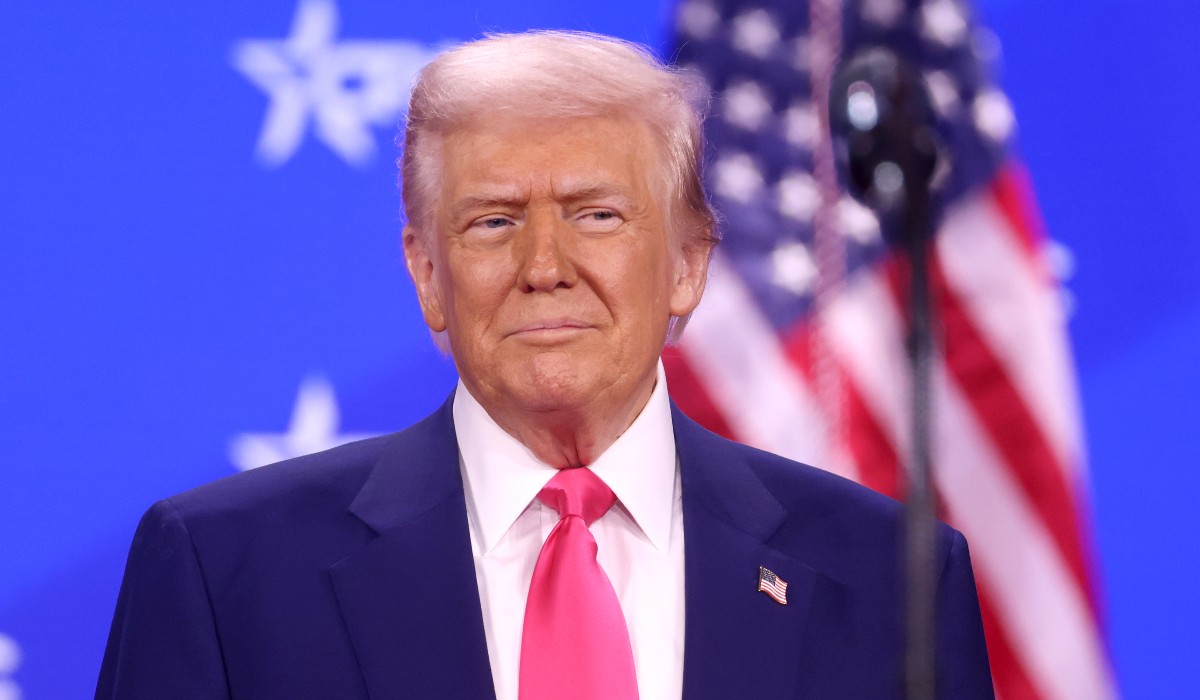
 Donald Trump. Photo: gageskidmore / Flickr / CC BY-SA 2.0
The new US strategy on foreign policy baldly states its new priority to focus ruthlessly on its immediate interests to ensure its continued dominance, argues John Clarke
In November, the Trump administration issued a National Security Strategy document that drives home the major shift that has been undertaken with regard to the US role in the world. It indicates the strategic thinking that is at work and shows the objectives that are being pursued.
While those who actually compiled this document share Trump’s reactionary political views, you get the sense that he has around him some people who are a lot smarter than he is. A great deal of deliberation and detailed strategising went into this effort.
It is readily apparent that the term ‘America First’ should not be misinterpreted. We are not dealing with an abandonment of the US’s longstanding role as a global predatory power but the document takes stock of the relative weakening of the US and seeks to shore up its declining capacity to dominate with a ruthlessly focused approach to global brigandage.
Focused strategy
In the Introduction, the document stresses the need for ‘a coherent, focused strategy for how we interact with the world’ (p.1) that corrects a situation where ‘American foreign policy elites convinced themselves that permanent American domination of the entire world was in the best interests of our country’ (p.1).
It must be stressed that the writers have no problem with ‘domination’ but they insist it must be pursued in ways that bring tangible and immediate returns for US capitalism. They argue that the US can’t continue to ‘shoulder forever global burdens’ and maintain ‘a massive military, diplomatic, intelligence, and foreign aid complex’ (p.1). The world will have to look out for itself and US intervention in its affairs will be strictly focused and ruthlessly pursued.
This more single-minded form of imperialism demands a capacity ‘to recruit, train, equip, and field the world’s most powerful, lethal, and technologically advanced military to protect our interests, deter wars, and—if necessary—win them quickly and decisively, with the lowest possible casualties to our forces’ (p.3).
The America First approach embraces a distinctly selective view of ‘burden-sharing and burden-shifting.’ Trump’s writers proclaim that the ‘days of the United States propping up the entire world order like Atlas are over. We count among our many allies and partners dozens of wealthy, sophisticated nations that must assume primary responsibility for their regions and contribute far more to our collective defense’ (p.12).
On the economic front, the document claims that the US has been taken advantage of by other nations in matters of international trade and advocates the imposition of harsher terms on friend and foe alike. It asserts that: ‘We seek fair, reciprocal trade deals with nations that want to trade with us on a basis of mutual benefit and respect. But our priorities must and will be our own workers, our own industries, and our own national security’ (p.13).
Integrally linked to the pursuit of more lucrative trading relations is an effort to restore the place of the US as the unrivalled productive power in the world. We are told that the ‘United States will reindustrialize its economy, “re-shore” industrial production, and encourage and attract investment in our economy and our workforce, with a focus on the critical and emerging technology’ (pp.13-14).
Regional priorities
The document stresses that to ‘focus and prioritize is to choose—to acknowledge that not everything matters equally, to everyone’ (p.15). It grandly declares that the ‘United States is by every measure the most generous nation in history—yet we cannot afford to be equally attentive to every region and every problem in the world’ (p.15).
Leaving no room for misunderstanding, Trump’s strategists make clear that, for the people of Latin America and the Caribbean, Washington’s ‘generosity’ will be undiminished. The document unashamedly informs us that: ‘After years of neglect, the United States will reassert and enforce the Monroe Doctrine to restore American preeminence in the Western Hemisphere, and to protect our homeland and our access to key geographies throughout the region’ (p.15).
The intensified exploitation of the countries south of the Rio Grande will, moreover, be conducted in such a way as to ‘deny non-Hemispheric competitors the ability to position forces or other threatening capabilities, or to own or control strategically vital assets, in our Hemisphere. This “Trump Corollary” to the Monroe Doctrine is a common-sense and potent restoration of American power and priorities, consistent with American security interests’ (p.15).
Chillingly, given the present escalating threat to Venezuela and the objective of regime change there, the document speaks of ‘enlisting regional champions that can help create tolerable stability in the region’ (p.16). It also emphasises the need for a ‘readjustment of our global military presence to address urgent threats in our Hemisphere’ (p.16).
When it comes to the vital question of China, the document avoids excessive belligerence and advances a strategy of containment and deterrence. It suggests that since ‘the Chinese economy reopened to the world in 1979, commercial relations between our two countries have been and remain fundamentally unbalanced. What began as a relationship between a mature, wealthy economy and one of the world’s poorest countries has transformed into one between near-peers, even as, until very recently, America’s posture remained rooted in those past assumptions’ (p.20).
The calculation is that, on the economic front, trade tariffs and a supposed resurgence in US manufacturing can limit China as a competitive threat. We are told that ‘we will rebalance America’s economic relationship with China, prioritizing reciprocity and fairness to restore American economic independence … If America remains on a growth path—and can sustain that while maintaining a genuinely mutually advantageous economic relationship with Beijing—we should be headed from our present $30 trillion economy in 2025 to $40 trillion in the 2030s, putting our country in an enviable position to maintain our status as the world’s leading economy’ (p.20).
At the same time, however, ‘this must be accompanied by a robust and ongoing focus on deterrence to prevent war in the Indo-Pacific. This combined approach can become a virtuous cycle as strong American deterrence opens up space for more disciplined economic action, while more disciplined economic action leads to greater American resources to sustain deterrence in the long term’ (p.20). It is stressed, moreover, that US allies will be expected to greatly increase their contribution to the capacity for military deterrence.
Saving Europe
The document suggests that: ‘Continental Europe has been losing share of global GDP—down from 25 percent in 1990 to 14 percent today—partly owing to national and transnational regulations that undermine creativity and industriousness’ (p.25). This decline, however, is seen as part of an even deeper malaise that threatens ‘civilizational erasure’ (p.25).
As far as the Trump administration is concerned, Europe, beset by economic decline, is charting a disastrous course marked by ‘… migration policies that are transforming the continent and creating strife, censorship of free speech and suppression of political opposition, cratering birthrates, and loss of national identities and self-confidence’ (p.25).
If these trends aren’t contained, ‘the continent will be unrecognizable in 20 years or less. As such, it is far from obvious whether certain European countries will have economies and militaries strong enough to remain reliable allies’ (p.25). This prospect is viewed with alarm since ‘Europe remains strategically and culturally vital to the United States. Transatlantic trade remains one of the pillars of the global economy and of American prosperity’ (p.26).
Nationalist and racist political movements in Europe are viewed as an entirely welcome development. ‘American diplomacy should continue to stand up for genuine democracy, freedom of expression, and unapologetic celebrations of European nations’ individual character and history. America encourages its political allies in Europe to promote this revival of spirit, and the growing influence of patriotic European parties indeed gives cause for great optimism’ (p.26).
In line with Trump’s objective of reaching a tactical accommodation with Russia, so as to lessen the prospect of an alliance with China, the document concludes that it ‘is a core interest of the United States to negotiate an expeditious cessation of hostilities in Ukraine, in order to stabilize European economies, prevent unintended escalation or expansion of the war, and reestablish strategic stability with Russia, as well as to enable the post-hostilities reconstruction of Ukraine to enable its survival as a viable state’ (p.25).
The document notes that the extent to which the US has prioritised the Middle East can be reduced. ‘Energy supplies have diversified greatly, with the United States once again a net energy exporter. Superpower competition has given way to great power jockeying, in which the United States retains the most enviable position, reinforced by President Trump’s successful revitalization of our alliances in the Gulf, with other Arab partners, and with Israel’ (pp.27-8).
Offering perhaps their most glaringly implausible conclusion, Trump’s strategists calmly suggest, even as Israel’s genocidal fury continues and the region remains a powder keg, that ‘the days in which the Middle East dominated American foreign policy in both long-term planning and day-to-day execution are thankfully over … It is rather emerging as a place of partnership, friendship, and investment—a trend that should be welcomed and encouraged’ (p.29).
Finally, the document stresses the importance of ‘harnessing Africa’s abundant natural resources and latent economic potential’ (p.29). The horrors of repression and exploitation that this involves are all too easy to appreciate but, leaving no room for doubt, we are told that the ‘United States should transition from an aid-focused relationship with Africa to a trade- and investment-focused relationship, favoring partnerships with capable, reliable states committed to opening their markets to U.S. goods and services’ (p.29).
In assessing the National Security Strategy, it is clear that we are witnessing a major course change by the world’s leading economic and military power. The America First strategy, developed by the most reactionary and ruthless elements within the ruling establishment, is an attempt to restore US power by jettisoning previous obligations and focusing on immediate gain. It brings to an end the post-war global order without offering any effective replacement for it.
US imperialism will still be as predatory as ever but it is discarding all notions of ‘responsible world leadership’ and pursuing its interests with scant regard for consequences. We are only beginning to come to terms with this development but, clearly, a period of extreme volatility, major political convulsions and huge class confrontations is opening up before us.
Before you go
The ongoing genocide in Gaza, Starmer’s austerity and the danger of a resurgent far right demonstrate the urgent need for socialist organisation and ideas. Counterfire has been central to the Palestine revolt and we are committed to building mass, united movements of resistance. Become a member today and join the fightback.

John Clarke
John Clarke became an organiser with the Ontario Coalition Against Poverty when it was formed in 1990 and has been involved in mobilising poor communities under attack ever since.