
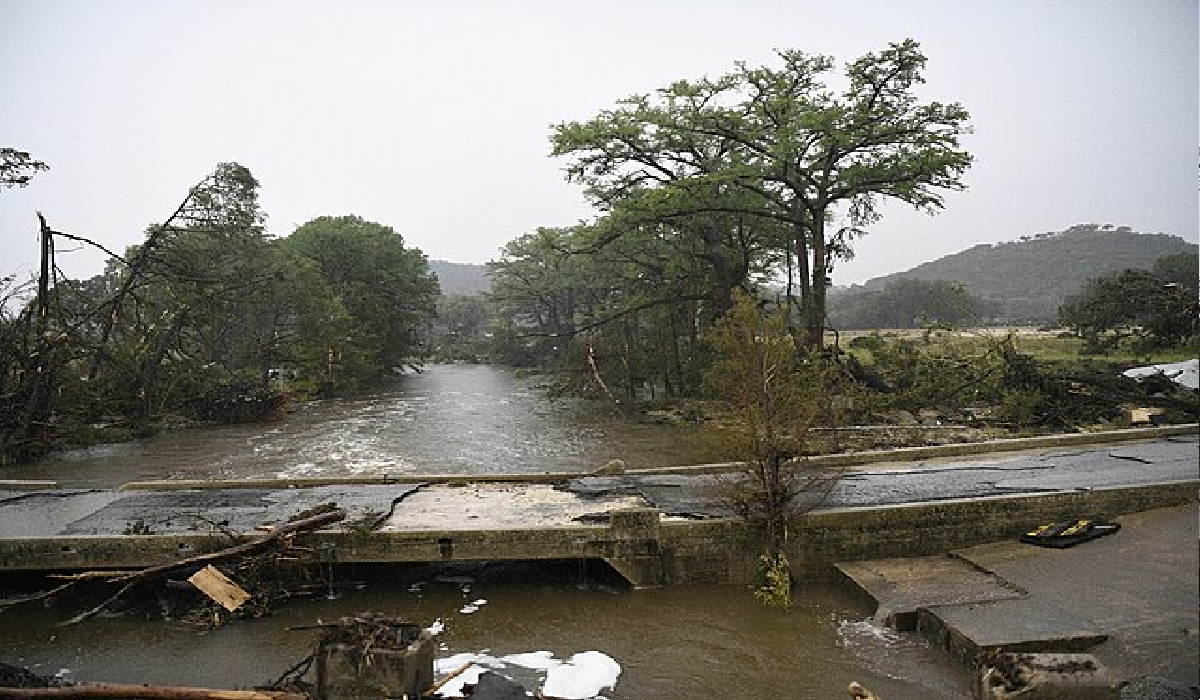
 Texas flooding / World Central Kitchen / Wikimedia Commons / CC by 4.0
Trump’s denial that the death toll from the Texas floods is the fault of his cuts feeds into a
dangerous new recklessness of the fossil-fuel sector, argues John Clarke
This week’s disastrous flooding in Texas has raised questions about the degree to which the situation may have been worsened by the climate denialism and budget cutting of the Trump administration.
As Common Dreams has pointed out, the floods took place in a context dominated by ‘Trump’s full-scale assault on the climate research and monitoring agencies tasked with studying and predicting such weather catastrophes, as well as his ongoing attacks on disaster preparedness and relief.’ Environmentalist Stephen Barlow, suggests that the ‘Trump regime is gutting scientific research into climate and atmospheric science for political reasons, at the very time we need a much better understanding of it. This is so reckless and dangerous, which is why I suggest we call these tragedies Trump events.’ Aru Shiney-Ajay, executive director of the Sunrise Movement bluntly asserts, with regard to the floods, that these ‘deaths are on Trump’s hands.’
Missing people
With at least 105 people killed and many others missing, these flash floods certainly raise issues of forecasting, preparedness and disaster response in the most compelling fashion. Portions of Texas are particularly vulnerable to the threat of such flooding, with the central area of the state often referred to as ‘flash-flood alley,’ and this month’s disaster reflected that.
Al Jazeera reported that, on 4 July, while ‘residents were still asleep … flash floods hit Texas Hill Country, a region spanning central and southern Texas. In under two hours, the Guadalupe River swelled beyond its banks, surging higher than two-storey buildings at about 9 metres (30ft).’ Tragically, the flooding took place as some 750 people were staying at Camp Mystic, a riverside camp for girls, and at ‘least 23 people from the camp are missing in the aftermath of the flooding.’ Some seventeen helicopters were searching for missing people and the National Guard was deployed to assist with search and rescue operations. The NWS issued a flood watch, noting that ‘pockets ‘of heavy rain are expected and may result in flooding.’
Trump has predictably made light of suggestions that his budget cuts could have contributed to the death toll or undermined the capacity to issue effective warnings. He told reporters that it was unlikely that his administration would rehire ‘meteorologists who had left the NWS because of the DOGE cuts’ because this ‘was the thing that happened in seconds. Nobody expected it. Nobody saw it. Very talented people in there and they didn’t see it.’ Yet the threat posed by weakening the capacity to predict extreme weather and alert communities in danger won’t be dismissed so easily.
CNN pointed out that ‘President Donald Trump’s approach to the federal government has been to cut, cut, cut, which means when there is a disaster in which the government plays a role, he will have to expect questions about those cuts.’ Furthermore, when ‘there’s a tragic flood that catches an area off-guard, the effect of his cuts on the National Weather Service and FEMA will become a line of inquiry.’
Eric Holthaus, writing in the Guardian, noted that the ‘ongoing challenges of forecasting extreme weather during the era of the climate crisis have been brought to the fore again’ by the flooding in Texas. The article acknowledged that an understaffed meteorological service did manage to get out warnings but he points out that even ‘though watches and warnings were issued on time throughout the disaster – contrasting what local officials have said in press conferences – rainfall totals specified in the first flash flood watch were about half of what ultimately fell.’ Holthaus suggested that though ‘it’s unclear to what extent staffing shortages across the NWS complicated the advance notice that local officials had of an impending flooding disaster, it’s clear that this was a complex, compound tragedy of a type that climate warming is making more frequent.’
The article also decisively refuted Trump’s suggestion that the floods were simply an aberration that couldn’t have been predicted. ‘Rainfall intensity in central Texas has been trending upward for decades.’ Moreover, ‘the conditions … over central Texas’ that caused the flooding are in line with the trend towards increasing atmospheric moisture content globally as the world warms and the air can hold more water vapor.’
Yale Climate Connections also commented on the connection between climate change and the Texas floods. A 5 July article explained that many ‘studies have confirmed that human-caused climate change is making the heaviest short-term rainfall events more intense, largely by warming the world’s oceans and thus sending more water vapor into the atmosphere that can fuel heavy rain events … Long-term human-caused warming made the [flash floods] up to 10 times more likely, according to the Climate Shift Index from Climate Central.’
Trump agenda
Brutal austerity and the reckless gutting of social protections are key elements of Trump’s political agenda, as is a major drive to expand the scale and pace of fossil-fuel extraction. This can only generate an increased risk of climate-related catastrophes like the Texas floods. At the same time, Trump is working to ensure that extreme weather events will occur in a context where people are far more vulnerable to their impacts.
The Trump administration has simply concluded that it can disregard climate change and global heating, as is shown in a 11 March article in Mother Jones that deals with a speech given by Trump’s Energy Secretary, Chris Wright, who is a former fracking executive. At that time, he addressed the CERAWeek Conference, a gathering of senior representatives of fossil-fuel companies. He used the occasion to make clear that the administration is ‘unabashedly pursuing a policy of more American energy production and infrastructure, not less.’ He suggested that efforts to limit carbon emissions only created a situation where the cure is ‘far more destructive than the disease.’
Wright took issue with assertions that he is a climate denier, stating that this ‘is simply wrong: I am a climate realist.’ He added that the Trump administration ‘will treat climate change for what it is, a global physical phenomenon that is a side-effect of building the modern world … Everything in life involves trade-off.’
The Energy Secretary went on to suggest that the continued progress of human societies required a massive increase in oil production. He argued that preserving the present US standard of living ‘requires an average of 13 barrels of oil per person per year’ and suggested that the task was to ensure that this level of consumption took place on a global scale. The Trump administration is hardly qualified to advance viable solutions to global inequality but the notion that this can be achieved through vast increases in fossil-fuel production is particularly outrageous.
Wright’s ‘realism’ is, of course, entirely delusional. He accepts that the planet is heating but disregards the degree to which this is happening, while he ignores the implications of failing to contain carbon emissions. He is apparently something of a fixture at CERAWeek conferences and his presentations are always enthusiastically received. The destructive, profit-driven irrationality he advances is entirely in line with the thinking of the fossil-fuel companies. As one oil-industry spokesperson said of Wright, he’s ‘one of us. He gets us.’
The Trump administration may be seen as the cutting edge of a strategic shift by the forces of fossil-fuel capitalism. Green pretensions and false claims to responsible environment stewardship have given way to a reckless and unconcealed drive to increase oil and gas production regardless of the environmental consequences that flow from this course of action.
It is not surprising that, as Trump advances an agenda which results in unrestrained carbon emissions, he should also pay scant attention to any effective preparations to deal with the extreme weather that this unleashes or to keeping populations safe in the face of it.
The lethal Texas floods are but the latest evidence of the rapidly worsening global climate crisis and the terrible consequences that it is unleashing. The days when we were predicting such a result are over and the world is now facing huge climate impacts that can only intensify massively. Challenging and defeating the institutions of fossil-fuel capitalism and their political enablers has become a matter of survival.
Before you go
The ongoing genocide in Gaza, Starmer’s austerity and the danger of a resurgent far right demonstrate the urgent need for socialist organisation and ideas. Counterfire has been central to the Palestine revolt and we are committed to building mass, united movements of resistance. Become a member today and join the fightback.

John Clarke
John Clarke became an organiser with the Ontario Coalition Against Poverty when it was formed in 1990 and has been involved in mobilising poor communities under attack ever since.