
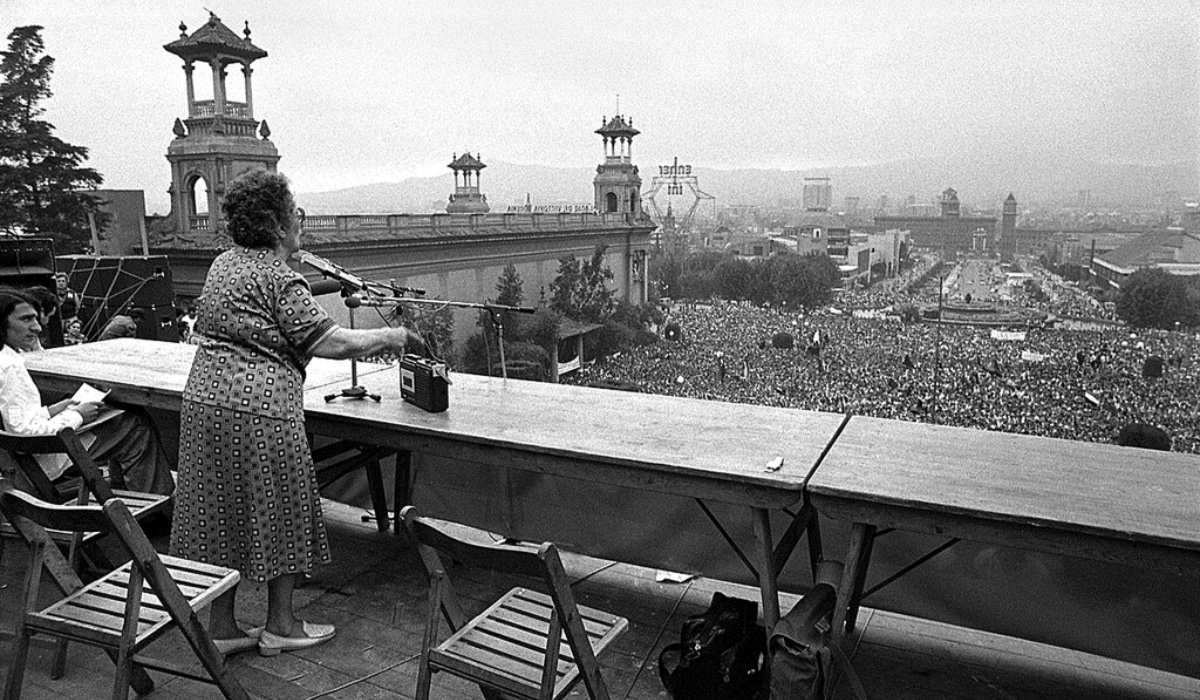
 Federica Montseny speaking at the first CNT meeting in Barcelona in 1977, 37 years after the organisation was banned. / Wikimedia Commons/ Manel Armengol, Manel Armengol, CC BY-SA 2.0
It was worker-led class struggle that brought the end of the fascist regime in Spain, but its legacy remains embedded in the state which replaced it, argues Chris Bambery
Following the victory of fascism in the Spanish Civil War, Generalissimo Francesco Franco followed a policy of autarky, or self-sufficiency, isolating Spain as much as he could from the international market.
This was a disaster and, by 1959, the International Monetary Fund warned Madrid it was only two months from bankruptcy. The regime was forced to open Spain to international investment. North American and Western European capitalists rushed to invest in a low-wage economy where trade unions were illegal and workplace discipline was guaranteed by the police. In the 1960s, the economy grew by 10% each year.
Anarchic and unregulated industrialisation saw migrants from Murcia and Andalusia in poverty-ridden southern Spain flock into the Barcelona region. The population of the industrial satellite city of Badalona grew from 92,000 to 163,000; L’Hospitaletfrom 123,000 to 242,000. Shanty towns sprang up on the edge of the cities.
Workers’ organisation
Economic growth also created confidence in a working class no longer prepared to accept Francoist restrictions. Migrants from the south also became aware of their power in the workplace and the new neighbourhoods. In 1962, there was a revival of working-class resistance across Spain when strikes in the Basque Country spread to Barcelona, Madrid and Valencia and then with 40,000 miners in Asturias joining. As a result, Communists and radical Catholics (the church was distancing itself from Franco) helped organise the Comisiones Obreras (Workers’ Commissions/CC.OO).
By 1964, the CC.OO had been transformed from a clandestine and spontaneous movement into an organised group of trade unions and it largely coordinated the entire workers’ movement in Spain despite the Franco regime. It extended almost simultaneously to Madrid, with the Comisión Obrera Metal to represent metal workers, in Barcelona with the Comisión Obrera Central and in parts of the Basque Country.
There were 777 strikes in 1963, 484 in 1965, and the number mushroomed in 1970 to 1,595, many winning major wage increases, frequently exceeding official guidelines. Angel Smith notes about the organisations that they ‘combined a weak central organisation with the power to mobilise whole factories or even regions… [they] had a hardcore of clandestine militants hierarchically organised, thereby making it difficult for the regime to totally dismember the movement.’[1]
But the dictatorship tried. In 1967, the CC.OO was declared illegal and a 1000 of its members jailed. Between 1969 and 1974, each year saw at least one striker gunned down by police.
The giant Seat car plant was situated in the Zona Franca, between the between the Port of Barcelona and Barcelona Airport and was a stronghold of the CC.OO. In 1971, the workforce was given just a day’s notice that one third of a workshop was being ordered to switch to night shifts from the next day, with the remaining two thirds on day shift expected to maintain the same level of output.
Pedro López was a member who’d been elected a representative of the fascist unions (the Communists entered these to secure representation). ‘We were hardly clandestine, at least from my side,’ he recalled, ‘I felt that everything we did was normal, meeting with colleagues, talking about our problems, and sharing what we thought with them. At the factory, we weren’t hiding, everyone knew who we were, we were the ones from the Workers’ Commission. If the colleagues didn’t know us, how could we lead them in union matters, right?’
When he and his comrades tried to talk to management, they were sacked. The workers responded to all this by occupying the plant. Management responded by summoning Franco’s riot police, the Policía Armada (Armed Police Forces), popularly known as los grises, ‘the grey ones’, from the colour of their uniforms. Pedro López takes up the story: ‘They began to throw tear gas. At first, people threw it back, but then there came a moment when you just couldn’t breathe in there. In workshop 5, the workers tried to leave but there they found the police cavalry waiting, three or four dozen horses with police and raised batons.
‘They charged at us brutally. Many workers had picked up objects to throw and some had iron bars and were throwing them at the horses and police. Many workers came from the countryside and knew how horses were, so picked up balls of tar to make a sticky substance to make them slip.
‘I think there must have been 500 police, between those on horses, on foot, with tear gas, a helicopter and they just wouldn’t let anyone talk.
‘Amid all this, we found out that there had been gunfire and that it seemed a comrade had been killed. People were very angry and wanted to burn things, and I had to tell them no. This particular comrade, Antonio – who never stood out as a prominent member of the union or for organizing or for speaking at assemblies or anything– well, he was the one who was killed.
‘We think it was a police officer who fell off his horse, and probably Antonio approached him to help him, and the policeman, being more afraid than we were, shot him in the stomach.’[2]
Resistance spreads
In Barcelona, there were demonstrations with people chanting: ‘End the Dictatorship. SEAT will win.’ The strike did not achieve complete victory but it transformed the atmosphere in the city which was becoming a bulwark of the resistance to Franco.
The Mayor of Barcelona, Josep Maria de Porcioles, had presided over a shoddy building boom. In the vast housing estates and industrial satellite towns housing was grim and there were few facilities. Neighbourhood Associations sprung up to fight for improvements and better facilities. By 1970, they existed in every one of Barcelona’s barri. Carlos Prieto,a PSUC member, led the one in Sants. He recalled: ‘People working in factories and involved in struggles for higher wages … wanted to introduce into the areas where they lived the successful ways of organising they’d experienced at work. A SEAT worker earning good wages at the end on the 1960s just wasn’t to go on living in a shack without running water.’[3]
He added, ‘Before 1973-1974 it was an uphill battle. People were often reluctant to sign petitions. “Of course we agree with you, but we can’t sign,” they’d say. Fear in Franco’s Spain was ubiquitous. The fall of [major] Porcioles gave people in Barcelona confidence. In Sants we had up to 150, most of them overjoyed just to be able to speak and hear Catalan … And in 1974 we won the battle with our alternative Plaça de Sants. We defeated the idea for a flyover and we got the old tram depot, the Coxteres, into a Community Centre.’[4]
Another vehicle of resistance also sprang up. On November 7, 1971, some 300 people held a meeting in Barcelona’s Sant Agustí church in the Raval neighbourhood. They went in with those attending early morning mass and left with those attending the last mass of the day.
The Catholic Church had supported Franco in the Civil War, blessing his ‘crusade’ against communists, freemasons and separatists. However, the outlawing of Catalan made it difficult to communicate with parishioners. The clergy began defying the law, also to provide cover for supposedly religious publications in Catalan which were, actually, about keeping Catalan culture and language alive. Under a Concordat reached between Franco and the Vatican, the security forces were supposed to be barred from entering churches or other religious buildings.
However, a few months earlier, a similar meeting in another Barcelona church had been broken up by police. The date of 7 November for the new meeting had been carefully chosen because it coincided with a visit to Barcelona of Prince Juan Carlos, the future Spanish king and Franco’s designated successor as head of state. The prince was attending a regatta and the organisers, rightly, believed the security forces would be concentrating on ensuring the visit met with no trouble.
The 7 November meeting commenced with five minutes of silence in honour of Antonio Ruiz Villalba, the trade unionist who had been murdered by police at the Seat car factory strike only weeks earlier. Rafael Ribó, the ombudsman and a former member of the organisation, told Catalan News. ‘It was very dangerous. But we were quite optimistic following what started with the May ’68 movements throughout Europe and the world, and to see that the Franco dictatorship was getting old and had holes in it helped people overcome the fear of repression.’
The platform of the new body had been thrashed out the previous summer in meetings held in the working-class neighbourhood of Sant Andreu. The initiative was taken by the Communist PSUC but it quickly broadened to include the majority of Catalan political parties, trades unions and civic organisations. Its slogan was Llibertat! Amnistia! Estatut d’Autonomia! – Liberty! Amnesty! Statute of Autonomy! This was calling for amnesty for all political prisoners, liberty meaning an end to the dictatorship and autonomy: the restoration of Catalan self-government destroyed by Franco when he captured Barcelona in early 1939.
Protests and resistance
Ribó laughed when he recalls: ‘There were mainly people protesting in the streets and 100 to 150 people would gather together, mainly in churches. I haven’t been to church as much as I did during that period because different church organizations were protecting us.’
Another meeting of the Assembly, on 28 October 1973, saw police surround the Santa Maria Mitjancera church in Barcelona and arrest 113 people. The men were sent to La Model prison, notorious for torture and executions, while the women were sent to La Trinitat prison. A year later another 87 people were arrested.
The dying Franco turned to the only response he knew: vicious repression. In 1969, he appointed Admiral Carrero Blanco as prime minister, with the brief to defeat the workers’ movement. His first move was a show trial in Burgos of sixteen members of the Basque guerilla group, Eta. Six were sentenced to death but a wave of international protest forced Carrero to commute the sentences.
In 1973, he attempted another show trial of CC.OO leaders. They were jailed but, on 21 December 1973, Eta succeeded in assassinating him, to widespread celebration. The killing of Franco’s right hand man and Franco’s political successor created a major hole in the regime. It, however, lashed out by executing the Catalan anarchist, Salvador Puig Antich in March 1974. He would be strangled to death by the garrotte.
In 1973 and 1974, the entire elected leaderships of Assemblea de Catalunya were arrested and jailed; 113 and 67 people. It failed to break the organisation. On 20 November 1975, Prime Minister Carlos Arias Navarro went on TV to announce Franco ha muerto, Franco is dead. The dictator’s family had finally agreed to switch off the life-support machine that was keeping him alive.
Arias was an old crony of Franco who had been public prosecutor in the trials which followed the fascist capture of Málaga in early 1937. Twenty thousand people were executed and he earned the nickname Carnicero de Málaga, the Butcher of Málaga. Throughout the winter of 1975-76, the hardline fascists, the Bunker, who made up Arias’ government soldiered on. Now King Juan Carlos, Franco’s designated heir, was head of state.
In March 1976, there was a general strike in the Basque city of Vitoria in solidarity with a number of ongoing strikes. The Guardia Civil were ordered to open fire to disperse protesters, and they did, killing five. The strike spread across the Basque country and 100,000 people came to the funerals.
When the Interior Minister, Manuel Fraga, visited the wounded in Vitoria hospital, one of them looked up and exclaimed, ‘Have you come to finish me off.’[5] Fraga concluded: ‘We can’t afford a Vitoria soviet.’[6]
Hardliner that he was, he had nonetheless realised that an insurgent working class could not be easily suppressed; capital, after all, relied on its daily labours. He wanted Spain to join what would become the European Union and a bloodbath of repression would stymy that.
With nothing seeming to change, the Catalan Assemblea decided to call a march in February 1976 through Barcelona in defiance of the security forces. Permission to march had been requested and refused. A statue commemorating Franco’s victory was draped with red‐and‐yellow striped flags of Catalonia by a teenage demonstrator as hundreds cheered. The New York Times reported one demonstrator remarking with a satisfied smile: ’We are covering their victory with ours.’ When the police came charging into the square, their first act was to take down the flags.
The original plan was for a peaceful march to Ciutadella Park where the old Catalan parliamentary building stood, but entry to the park was blocked by police on foot, on horses and in armoured vehicles. So, protesters simply broke up into small groups who held protests at different points across the city centre while cars filled the streets honking their horns in support. The police were chasing after them and becoming exasperated. They began attacking drivers with their truncheons, grabbing protesters who’d become isolated, beating them and many other people who had nothing to do with the protest. Riot gas and rubber bullets were fired.
There was a sit-in on the Passeig de Sant Joan, at the corner of Carrer de Provença. But the Civil Guard and riot police threw smoke bombs at the seated protesters and charged them. Later, numerous groups marched through the streets of the Eixample to reach the Modelo prison, where they sought the release of political prisoners.
A famous picture shows protesters sitting down on the road but being beaten. The man facing the camera was a Catholic priest.
End of the regime
In July 1976, Arias was sacked by King Juan Carlos who appointed Adolfo Suárez prime minister. He had been a minister under Franco but now the growing anti-fascist resistance convinced him that the old regime could not survive and that a negotiated settlement was necessary.
Western European and North American capital and governments realised the strength of anti-fascist resistance threatened social upheaval and that to contain things, it was best to enter into a pact with the opposition Socialist Party (PSOE) and the Communist Party, then a serious force. We should recall a military coup in April 1974 in neighbouring Portugal had led to a revolutionary crisis which was only ended in November 1975.
What Suárez did was enter into closed-door negotiations with the leadership of both PSOE and the Communist Party. The latter now accepted the monarchy, urged its supporters to accept ‘national reconciliation’, and promised that if the trade unions were legalised, they would enter into a Social Contract with the state and employers. Both opposition parties dropped their long-term support for a federal Spain with the right of self-determination for the Catalans and Basques.
Elections were held in June 1977. Suárez’s Union of the Democratic Centre won over a third of the votes in Spain. PSOE 28.5%, the Communists 9.3% and Fraga’s Popular Alliance (seen as the party of the Bunker) just 8.4%. In Catalonia, the Socialists came first, with 28.56%, and the Communists second with 18.31%.
The Transition, as it became known, swung into action. Franco’s Tribunal de Orden Público (Court of Public Order) was simply one day re-named the Audiencia Nacional, the national criminal court, with exactly the same judges. In the 1980s, under the PSOE government of Felipe González, a body was put in place to appoint and regulate senior judges which was elected by both houses of the Spanish parliament. Today, senior judges still owe their appointments to those elected bodies and they support either the PSOE or the right-wing Popular Party. In other words, they are politically appointees.
The Constitutional Court, another product of the Transition, declared the 2017 Catalan referendum illegal after the Catalan parliament had voted to hold it, and earlier had struck out key clauses of a new Catalan Statute of Autonomy agreed by both the Spanish and Catalan parliaments and approved by a referendum in Catalonia.
The Cuerpo General de Policía (General Police Corps, CGP), the force Franco charged with dealing with internal opposition and which included the Political-Social Brigade, the torturers, undertook a change of name to the Superior Police Corps and then became today’s National Police Corps.
On top of all this, swathes of Francoist legislation remain in place. In contrast, the Second Republic, which he overthrew, was excised out of history and none of its laws were recognised.
The Transition also rested on two agreements which had profound consequences. The first was the Amnesty Law whereby all political prisoners were released, something the left parties desired badly, but which also covered all the crimes of Franco’s assassins and torturers. The Spanish Courts have used this to block any action against those people but also any official investigation into Franco’s crimes, including into the fate of the ‘disappeared’.
The second thing agreed was a pacto de olvido (pact of forgetting) whereby both sides agreed to leave the bitter legacy of the Civil War and the repression unopened and thus never resolved. The left parties argued this had to be done to satisfy the armed forces and to neutralise the far right but the narrative which emerged was one where both sides were equally responsible and that if the issues involved were re-opened, Spaniards would fall back into the violence of the 1930s.
Institutionalised amnesia
In fact, the narrative which emerged was one that echoed Franco’s. Both sides were not equally responsible. The military rose up to overthrow a democratically elected government, cheered on by the Catholic Church, the bourgeoisie and the middle classes. Two thirds of the executions and murders were carried out by the right. It also encouraged the idea that Spaniards required strong government to contain their dark passions.
One consequence was that in universities and schools the Civil War was largely untaught. The Spanish academic Victor Pérez-Díaz, wrote that this ‘required Francoists to pretend they had never been Francoists, and left-wing compromisers to pretend they were still committed to leftist principles.’
Under Franco, the Institutional Law of the State, the nearest thing the dictatorship had to a constitution, stated that the army guaranteed ‘the unity and independence of the country, the integrity of her territory, national security and the defence of the institutional system.’ Article 8 of the Spanish Constitution, agreed in 1978, echoes this by saying that the mission of the armed forces is, ‘to guarantee the sovereignty and independence of the state, defend its territory and integrity and the constitutional arrangements.’[7] In the transition to parliamentary democracy which followed the dictator’s death in November 1975, the army received a number of guarantees, including one that the territorial integrity of Spain would be maintained.
Under Franco, the armed forces were not subjected to civilian control and had power over censorship and the judiciary. They were also directly involved in the repression of the regime’s opponents. While a Ministry of Defence was created to preside over the military, its high command was represented in the government cabinets, which answered to the dictator.
The new rulers had no choice but to give a degree of autonomy to both Catalonia and the Basque Country because they had been the principal opponents of Franco and had seen powerful mass movements on the streets demanding democracy and autonomy. That decision was not one that the military liked: ‘As far as the more intransigent sectors of the armed forces were concerned, the statutes of autonomy negotiated by the government of Adolfo Suárez [the first democratically elected government after Franco] merely confirmed the fears raised a year earlier by the introduction of the term nacionalidades in the constitution and marked the beginning of the end of Spanish national unity.’[8]
Salvador Cardús i Ros would write of the Transition: ‘The transition is, basically, a process of historical and social amnesia … achieving the unheard of situation in which the dictatorship’s juridico-political framework became the source of legitimacy for the new democratic model.’[9]
Little wonder, Spain’s Transition was used as the model for similar processes in Latin American and Eastern Europe. However, in Spain, it has left a toxic legacy, particularly in relation to the aspirations of Catalans and Basques.
The last words go to Abril Martorell, one of Suárez’s ministers, who explained the Transition thus: ‘Though it’s true that the Transition was agreed between a few individuals acting on their own, the force that obliged them to agree was in the streets.’[10]
[1] Angel Smith, ‘Spain, `in S. Berger and D. Broughton (eds), The Force of Labour: The Western European Labour Movements and the Working Class in the Twentieth Century, (Oxford: Berg, 1995), p.194.
[2] Paul Preston, Architects of Terror: Paranoia, Conspiracy and Anti-Semitism in Franco’s Spain (London: Harper Collins, 2023), pp.27-8.
[3] Michael Eude, A People’s History of Catalonia, (London, Pluto Press, 2022), pp.191-2.
[4] Chris Bambery and George Kerevan, Catalonia Reborn: How Catalonia took on the Corrupt Spanish State and the Legacy of Franco, (Edinburgh, Luath Press, 2018), p.100.
[5] ibid. p.106.
[6] ibid. p.106.
[7] Howard J. Wiarda and Margaret MacLeish Mott, Catholic Roots and Democratic Flowers: Political Systems in Spain and Portugal, (Westport, Conn: Greenwood Publishing Group, 2001), p.108.
[8] Charles Powell, Juan Carlos of Spain: Self-Made Monarch, 1996, London: Palgrave Macmillan, 1996), pp.159-60.
[9] Salvador Cardús i Ros, ‘Politics and the Invention of Memory: For a Sociology of the Transition to Democracy in Spain’, in Joan Ramon Resina (ed.), Disremembering the Dictatorship: The Politics of Memory in the Spanish Transition to Democracy, (Amsterdam: Editions Rodopi B.V., 2000), pp.18-19.
[10] Michael Eude, People’s History of Catalonia, p.195.
Before you go
The ongoing genocide in Gaza, Starmer’s austerity and the danger of a resurgent far right demonstrate the urgent need for socialist organisation and ideas. Counterfire has been central to the Palestine revolt and we are committed to building mass, united movements of resistance. Become a member today and join the fightback.

Chris Bambery
Chris Bambery is an author, political activist and commentator, and a supporter of Rise, the radical left wing coalition in Scotland. His books include A People's History of Scotland and The Second World War: A Marxist Analysis.